
Adaptive Deep Brain Stimulation for Parkinson Disease: Patient Selection, Programming, and Practical Considerations
The fundamentals of deep brain stimulation therapy—timely and appropriate patient selection, accurate electrode implantation within the selected target, clinical expertise in disease state and medication management as they relate to programming, and close collaboration with patients—remain essential to durable outcomes.
KEY TAKEAWAYS
- Adaptive DBS introduces a closed-loop approach that responds to changing neural activity rather than relying solely on fixed stimulation settings.
- Successful implementation depends on more than the technology itself, including thoughtful patient selection, programming, and interpretation of neural signals.
- Understanding where adaptive DBS fits into clinical practice can help clinicians navigate an increasingly individualized approach to neuromodulation.
Deep brain stimulation (DBS) is an established surgical treatment approved by the Food and Drug Administration (FDA) for medication-refractory tremor in essential tremor (ET) and Parkinson disease (PD), motor fluctuations in PD manifesting as disabling “off” symptoms, and dyskinesias related to progressive neurodegeneration of dopaminergic pathways. This article provides a brief overview of DBS and highlights recent advances in adaptive stimulation for PD. For further background, see the DBS overview article by Dr. Aparna Wagle Shukla in this issue.
Continuous high-frequency DBS (cDBS) modulates abnormal electrical activity in key structures in the brain that are part of the neuronal circuitry affected in ET and PD. For PD, electrodes are implanted with a high degree of precision in the subthalamic nucleus (STN) or globus pallidus interna (GPi). For ET, electrodes are implanted in the ventral intermediate nucleus of the thalamus. In cDBS, a constant current is delivered by an implantable pulse generator (IPG) through extension wires connected to the electrodes. The entire system is implanted subdermally and is not visible.
The amplitude of the current, pulse width (duration of each electrical stimulus), and frequency (rate of stimuli delivered per second) are adjusted using an external programming device that connects remotely to the IPG to provide relief of troublesome motor symptoms1 while avoiding side effects from the inadvertent spread of current to adjacent brain structures.
Stimulation-induced side effects (SISEs) are dependent on the neuroanatomic geography of each target structure. With ventral intermediate nucleus stimulation, paresthesias may result due to spread of current to adjacent thalamic nuclei, and gait imbalance, dysarthria, and muscle contractions may result from internal capsule activation. With GPi stimulation, dyskinesias and diplopia may result from activation of the external globus pallidus and optic nerve fibers, respectively. With STN stimulation, dysarthria, dyskinesias, gait impairment, and neuropsychiatric symptoms may result from stimulation spread.2
With technologic advances in electrode design, such as segmental contacts, current can be directionally steered based on somatotopic and neuroanatomic knowledge of the target and surrounding brain structures to minimize SISEs while optimizing therapeutic benefits.1
Surgical complications, such as infections, seizures, and stroke resulting in long-term deficits, are uncommon in skilled and experienced centers but should be discussed with patients, in addition to hardware-related complications.
Appropriate patient selection for DBS is as important as implanting the electrode with submillimetric accuracy in the chosen brain target. The utility of DBS in improving primarily levodopa-responsive motor symptoms in PD, with the exception of refractory rest tremor, should be clearly communicated with patients and caregivers. Improvement in certain nonmotor symptoms, such as sleep, has been documented but should not be promised, as these benefits are anecdotal. A confirmed diagnosis of PD and documented improvement of at least 30% in the motor section of the Unified Parkinson’s Disease Rating Scale between medication “on” and “off” states should be demonstrated before surgery.
Because DBS is contraindicated in dementia and untreated neuropsychiatric disorders, a formal presurgical neuropsychologic examination is standard of care in both PD and ET. Persistent poor balance resulting in falls is also a contraindication to DBS surgery. Patients’ and caregivers’ expectations should be commensurate with the expected DBS outcomes.
Typically, DBS programming is initiated a few weeks after implantation of the IPG and performed at regular intervals to optimize therapy by skilled programmers. Between programming sessions, electrical parameters remain constant, but patients can incrementally increase or decrease stimulation amplitude or switch between programs to optimize efficacy and minimize SISEs.

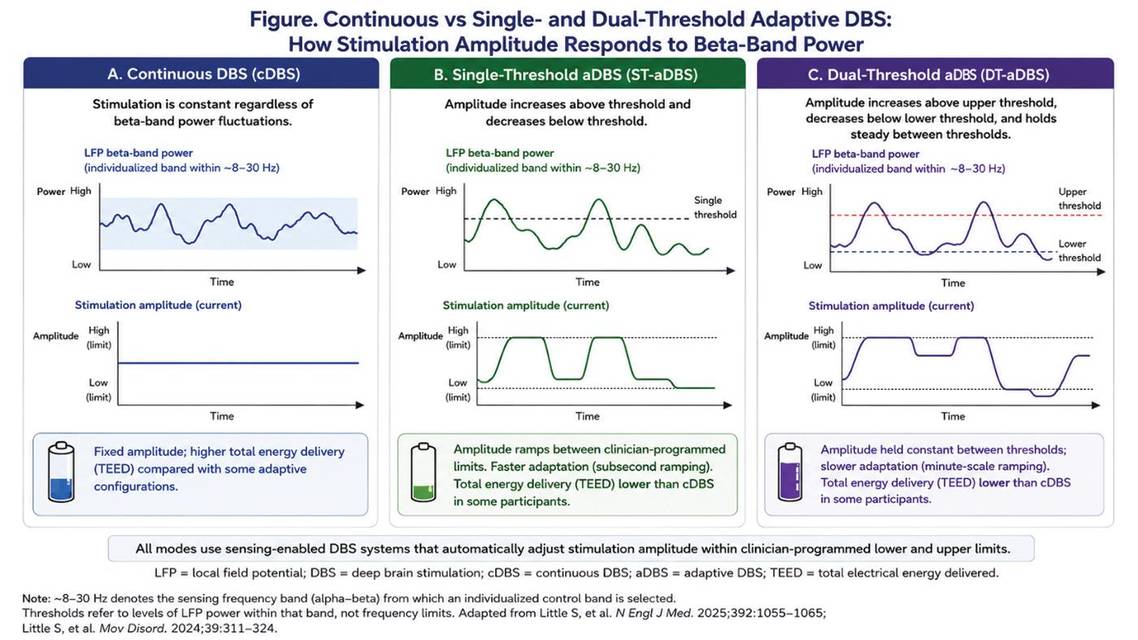
Figure. Continuous vs single- and dual-threshold adaptive deep brain stimulation (DBS). A, Continuous DBS (cDBS) delivers stimulation at a fixed amplitude. B, Single-threshold adaptive DBS (ST-aDBS) adjusts stimulation in response to beta-band power crossing a single threshold. C, Dual-threshold adaptive DBS (DT-aDBS) adjusts stimulation based on upper and lower thresholds. Approximately 8 to 30 Hz denotes the sensing frequency band (alpha–beta) from which an individualized control band is selected. Illustration generated using ChatGPT 5.1 (OpenAI) based solely on information provided in this article. Abbreviations: aDBS, adaptive deep brain stimulation; cDBS, continuous deep brain stimulation; DT-aDBS, dual-threshold adaptive deep brain stimulation; LFP, local field potential; ST-aDBS, single-threshold adaptive deep brain stimulation; TEED, total electrical energy delivered.
The mechanism of DBS, although not fully elucidated, involves modulating electrical activity to improve cardinal motor symptoms of PD and tremor in ET. PD is characterized by progressive α-synuclein pathology involving neuronal and glial populations.3 Fundamental to the comprehension and advancement of DBS technology has been the recognition and processing (decoding) of neural activity reflected by local field potentials (LFPs). A detailed discussion of the historical and technical aspects of LFP processing in DBS is beyond the scope of this review; the following discussion is focused primarily on PD, in which most of the research has been reported.
Briefly, field potentials, such as those recorded by EEG, represent transmission of neural activity across brain networks in time and space. LFPs are thought to represent electrical activity in specific areas of the brain that are part of large, interconnected neural networks. LFPs recorded from the STN and GPi nuclei in untreated PD oscillate at low alpha–beta band frequencies of 8 to 35 Hz. They have been shown to correlate with the motor state in PD and are attenuated by dopaminergic treatment and DBS (Figure),4 an observation that was pivotal in advancing translational research and enhancing the clinical utility of DBS.5–7
Previously, conventional, commercially marketed “open-loop” cDBS systems did not have the ability to adjust electrical parameters without manual intervention. Over the past decade, however, DBS technology has advanced to enable systems that can record neural activity and adjust stimulation in response to beta-frequency fluctuations in PD.8 This advancement led to FDA approval of the Percept PC neurostimulator (Medtronic; Minneapolis, MN) and SenSight electrodes (Medtronic), which can sense and record LFPs in the beta-band range with the proprietary BrainSense technology (Medtronic); however, the programmer initially had to manually “close” the loop in the clinic by adjusting stimulation parameters to attenuate peak beta-band activity detected at specific contacts on the DBS electrodes. With further technologic advancements, the treatment loop that was previously “open” can now be “closed” by self-adjusting electrodes that modify stimulation based on levels of beta-band activity at any given moment. Such systems, which can adapt to real-time fluctuations in beta-band frequencies associated with motor state in PD and spontaneously optimize therapy to mitigate symptoms, are known as adaptive deep brain stimulation (aDBS).9–17
In a recent multicenter, prospective, single-blind, randomized crossover study, aDBS was demonstrated to be safe, tolerable, and effective, with outcomes comparable to cDBS, supporting FDA approval of the aDBS programming option.18 This study evaluated 2 aDBS outcomes: a single-threshold aDBS (ST-aDBS) algorithm that increased stimulation amplitude when beta-band power exceeded a predefined frequency and a dual-threshold aDBS (DT-aDBS) mode that increased or decreased stimulation amplitude in response to a rise or fall in beta-band frequencies above or below predefined limits (8–30 Hz), respectively, while maintaining stimulation at a constant level when beta-band power was within the frequency limits. The primary endpoint required that at least 50% of participants meet a performance goal of “on” time (ie, time when symptoms were well controlled) without troublesome dyskinesias with no more than 1 SD reduction (and a post hoc threshold of no more than a 2-hour-per-day reduction) reported during aDBS therapy compared with cDBS, determined from a self-reported motor diary. The study concluded that most participants tolerated either ST-aDBS or DT-aDBS well in the home setting, and on-time without troublesome dyskinesia was comparable with cDBS. In addition, aDBS delivered less total electrical energy compared with cDBS.
In clinical practice, BrainSense offers a choice between programming in the cDBS or aDBS modes. If cDBS provides a satisfactory outcome without SISEs, there might not be a need to use aDBS unless the therapeutic efficacy window is narrow or motor response fluctuates between programming sessions. If aDBS is indicated, the first stage of programming involves identification and selection of electrode contacts detecting an alpha–beta band (8–25 Hz) frequency of interest (FOI).19 After a few weeks, LFP fluctuations and their correlation with the individual’s clinical state are analyzed, which allows for the selection of contacts that provide the most satisfactory motor outcomes during and between clinic visits. Discrepancies between stimulation current adjustments and physiologic responses may warrant selection of an alternate FOI. ST-aDBS is suggested when LFP recordings show rapid but transient bursts of high-amplitude activity, there is a narrow therapeutic window with significant SISEs, antiparkinsonian medications are stopped or did not have a predicted effect on the FOI, or freezing of gait is present. DT-aDBS is preferred when there is evidence of predictable modulation of the alpha–beta band by motor fluctuations and dyskinesias and by PD medications. The threshold limits for both modes are selected based on accepted conventions for each and are tested in the clinic for safety and efficacy. DBS programming is optimized over subsequent programming sessions by adjusting threshold limits based on longitudinal data and in-clinic observations.
aDBS can autoadjust stimulation current in response to motor state fluctuation through a closed-loop approach, but it is far from a fully automated DBS system in its current form.20 aDBS requires periodic manual programming to select the electrode configuration that best detects peak beta-band power and the stimulation settings that attenuate it, although less frequent manual programming is required than with cDBS. In addition, manual adjustments are necessary to resolve side effects and redefine LFP thresholds if beta rhythms are not stable over time. With hardware advancement and application of generative algorithms that constantly learn and adapt to neural and peripheral inputs correlating to diverse clinical states, future DBS platforms could adjust multiple stimulation parameters for optimal therapeutic outcomes. These advances would reduce the need for repeated manual programming sessions, although human programmers would still need to remain available as ultimate guardrails for safety and accountability.
Successful widespread adoption of aDBS in clinical practice will depend on long-term outcome tracking and the development of control policies (ie, stimulation parameters) that reliably optimize motor function. Although programming guidelines have been proposed,19 implementation will likely remain iterative and individualized, particularly when mixed tremor phenomenology predominates, beta-band power is confounded by artifact, or SISEs occur during automated adjustments. Additional algorithms capable of independently regulating stimulation in response to gamma-band rhythms (60–80 Hz), which are associated with dyskinesias, may further expand the clinical utility of aDBS.
The fundamentals of DBS therapy remain essential to durable outcomes. These include timely and appropriate patient selection, accurate electrode implantation within the selected target, clinical expertise in disease state and medication management as they relate to programming, and close collaboration with patients to optimize quality of life. These principles are indispensable to achieving durable outcomes with aDBS, just as they have been for cDBS.
Ready to Claim Your Credits?
You have attempts to pass this post-test. Take your time and review carefully before submitting.
Good luck!
Recommended
 SEP-OCT 2026 ISSUE
An Update on Devices for Essential Tremor Treatment
Mackenzie R. Paller-Moore, MD; Katelynn Getchell, MDMackenzie R. Paller-Moore, MD; Katelynn Getchell, MD- SEP-OCT 2026 ISSUE
Wearable Devices in Parkinson Disease: A Practical Guide for Clinicians
Siegfried Hirczy, MD; Ruth B. Schneider, MDSiegfried Hirczy, MD; Ruth B. Schneider, MD - Movement Disorders
The New Era of Deep Brain Stimulation Programming in Parkinson Disease
Aparna Wagle Shukla, MDAparna Wagle Shukla, MD