
Wearable Devices in Parkinson Disease: A Practical Guide for Clinicians
Wearable devices can provide objective, real-world data on Parkinson disease symptoms and fluctuations to help inform clinical management.
KEY TAKEAWAYS
- Wearable technology can capture aspects of Parkinson disease that may be difficult to assess during a brief clinic visit.
- Consumer and medical-grade devices differ substantially in validation, clinical utility, and the questions they can reliably answer.
- The value of wearable data ultimately depends on whether the information is meaningful enough to inform clinical management.
Parkinson disease (PD) is a neurodegenerative movement disorder characterized by motor abnormalities, such as slowness of movement (bradykinesia), tremor, and rigidity, as well as neuropsychiatric and autonomic dysfunction. The mainstay of symptomatic treatment is dopaminergic therapy, most commonly with levodopa. In the early stages of disease, this can have a remarkable effect, with near normalization of function. However, as the disease progresses, many individuals develop motor fluctuations, including wearing-off, delayed “on” periods, dose failures, and dyskinesia, with progressively shorter periods of optimal symptom control. As these motor symptoms emerge, determining the optimal intervention strategy can become increasingly challenging. In order to manage this complex state, clinicians need a clear understanding of symptom fluctuations between clinic visits and the effects of interventions.
Standard clinical care, however, is typically delivered through brief in-clinic patient–provider encounters that occur every few months and provide only partial information. Typically, only one clinical state (eg, “on”) can be examined at each visit, and even this state may not accurately reflect the usual condition; patients may overperform or underperform during a medical appointment. Furthermore, symptoms are affected by changes in physical activity, diet, general health status, social stressors, and poor sleep. Given the limited information available during clinical encounters and disease complexity, even expert clinicians caring for well-informed people with PD with close caregiver involvement may struggle to determine the optimal interventions to improve quality of life, lessen bothersome symptoms, and reduce the risk of falls. There is an unequivocal need for better monitoring of features of PD to improve patient management.
How Can Wearables Add to the Clinical Assessment?
Wearable technologies are electronic devices that can be worn on the body to capture and display information from the user. Wearable devices come in various forms, such as watches, rings, shoes, glasses, and headsets. They often incorporate a suite of sensors that detect movement, electrical activity, changes in temperature, and speech, from which measures of health, wellness, and disease activity can be derived. Wearables can also present information to users and allow communication and connection with others and with systems. Wearable devices are almost always a component of a larger digital platform, which combines wearable data with other sources of data and then integrates, analyzes, and summarizes the data for review on other devices, such as smartphones.
What Clinical Questions Can Wearables Answer?
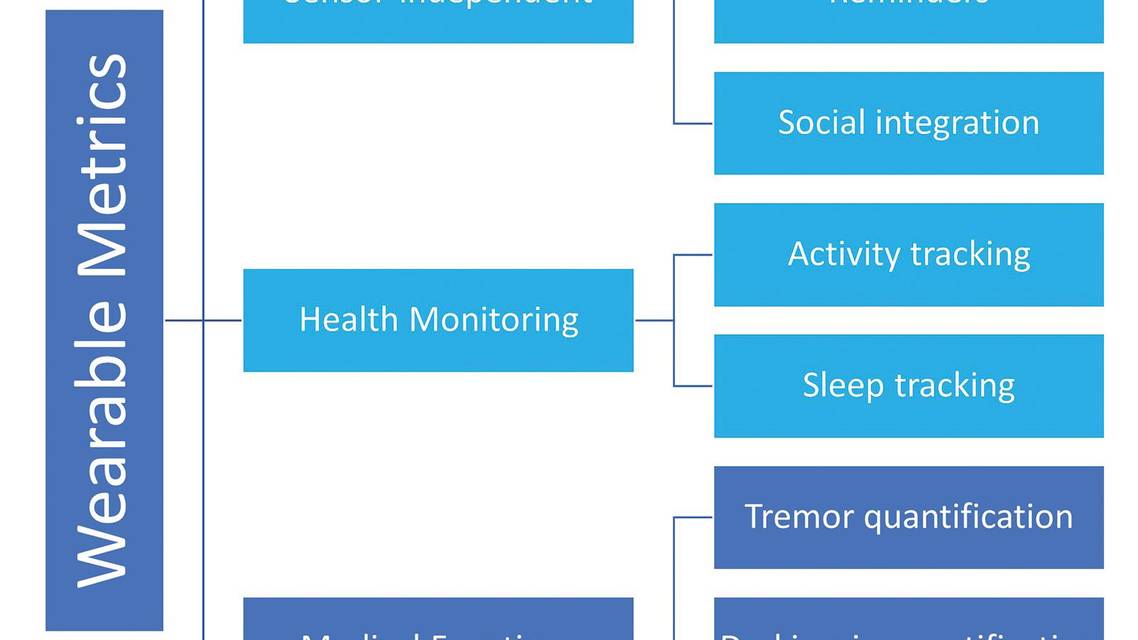
The ability to continuously collect data from the patient about symptomatology and physiology is of potential value to clinicians treating patients with PD. Access to valid at-home patient-reported and objective data may improve understanding of disease status relative to standard practice and help clarify therapeutic benefits and side effects. The practical question is whether a wearable can answer a specific clinical question and whether the answer is likely to change management. Definitive evidence that wearable monitoring improves quality of life is not yet available. We discuss 2 device categories (consumer and medical) and 3 practical categories of monitoring with different levels of validation (sensor-independent, general health and wellness, and disease-specific; Figure 1).

Figure 1. Summary of wearable-derived metrics.
Using Consumer Wearable Data in Clinical Practice
Wearable devices are primarily consumer-based and have rapidly proliferated over the past decade. Survey data in 2019 estimated that ~30% of Americans were using a wearable device1; by 2025, the estimate was near 50%.2 These devices generate metrics to help understand and improve general health and lifestyle. Commonly, these metrics characterize physical activity, sleep, mood, and stress levels. Functions intended solely for general wellness typically are not subject to the same Food and Drug Administration (FDA) oversight as medical-device functions.3 Consumer devices may also include FDA-cleared medical functions, such as certain cardiac rhythm-detection features. Consumer wearable devices also can be used to monitor PD symptoms with features that do not require sensor validation.
Patient-Entered Data: Symptoms, Medications, and Falls
Event Logging
Wearable devices can allow for more timely and accurate recording of events by reducing barriers to logging given their active presence on the body. Symptoms, medication administration, and falls can be tracked on the device through user input. This information can then be displayed on a timeline or analyzed by other methods to evaluate for trends or relationships.
Reminders
Devices can prompt users to perform certain activities based on the time of day, location, or other factors. The presence on the body is expected to increase the likelihood of a reminder reaching the user. Common uses include medication reminders, which can then be paired with event logging of the medication administration.
Social Integration and Calls for Assistance
Many devices reduce barriers to social interaction by enabling messaging and calling from the device. This allows individuals with mobility difficulties to have easier access to others and facilitates caregiver monitoring.
Evidence
The benefits of event logging and reminders are self-evident, as medication adherence is known to be challenging in conditions requiring multiple medication administrations per day.4 A smartphone app study in 2017 reported that these features resulted in improvements in medication adherence and nonmotor symptomology.5 However, whether wearable monitoring is meaningfully better than smartphone monitoring or whether wearable-based social access has a positive effect is unknown.
Interpreting Activity and Sleep Data
Activity Tracking
Wearable devices typically provide users with information about their physical activity through automated detection of patterned limb movements, physiologic changes, or user input. Maintaining and increasing physical activity in people with PD is essential, and understanding the amount and type of activity can help clinicians address deficiencies and potentially slow disease progression.6 An umbrella review (ie, a systematic review of systematic reviews and meta-analyses) concluded that activity trackers increase physical activity, improve body composition, and improve fitness in the general population.7
Sleep Tracking
Devices worn during the night can provide information on sleep quantity, quality, and states. Clinicians who have access to information about sleep and wake cycles can more effectively prescribe interventions meant to cover the active portion of the day. In addition, better understanding of sleep cycles can help inform decision-making about sleep-promoting medications or the need for specialist sleep medicine evaluation. A 2026 review indicated moderate accuracy for measures of duration and circadian timing, although accuracy was more limited for other features.8 A small study of healthy individuals showed improvement in sleep quality with the use of a consumer wearable device.9
Validity
General-wellness metrics are not necessarily reviewed by the FDA for clinical accuracy, and manufacturer validation studies are often performed in healthy individuals. Measures have been shown to be less reliable in older adults and in people with PD. Disease features such as autonomic dysfunction may limit detection of physical activity, abnormal movements may affect step counts, and dream enactment may result in mislabeling of sleep states due to pathologically increased movement.10-12 Consumer wearable measures may provide value in PD, but more research is needed to understand their reliability, validity, and clinical utility in this population.
How Should Clinicians Respond to Consumer Wearable Data?
Consumer wearables are increasingly commonplace, and clinicians should be prepared to discuss the use of wearable devices with people with PD. Clinicians should be prepared to discuss the potential benefits of integrating wearable consumer devices to help with PD management but should also discuss the limited evidence, potential risks, and potential downsides, including financial cost, time commitment, and added stress. Patient autonomy and shared decision-making, as always, are key. Those who choose to use consumer wearable systems should be encouraged to increase their understanding about the relationship and validity of device measures by comparing derived measures with their own experience, the observations of others, and other validated sources. Furthermore, clinicians should ask about the use of wearable devices and proactively discuss their use and provide appropriate counseling.
FDA-Cleared Wearables for PD Monitoring
In contrast to consumer wellness functions, medical wearable devices are intended for a medical purpose in a specified context (eg, clinic or home) and may require regulatory clearance or approval.13 Metrics supporting these intended uses are evaluated through clinical studies reviewed by regulators. Below, we discuss devices that have received FDA 510(k) clearance for specified uses in the home setting. Clearance permits marketing for the stated intended use but should not be taken to imply that routine use of the device improves clinical outcomes. In addition, although not generally considered a wearable device, smartphones also have integrated sensors that can be used to track certain disease features, and various smartphone monitoring technologies have also been cleared by the FDA.
What Do PD-Specific Wearables Measure?
FDA-cleared wearable devices can provide PD-specific data related to motor symptoms, such as tremor, dyskinesia, and bradykinesia. Most have taken the form of smartwatches or wristbands, and some systems use consumer wearable hardware (Table). The Kinesia platform (Great Lakes NeuroTechnologies; Cleveland, OH) was the first to obtain FDA clearance as a tremor transducer in 2007. Kinesia 360 and KinesiaU were subsequently cleared for remote, home-based monitoring. The Personal KinetiGraph (PKG) (Global Kinetics; Hopkins, MN) received FDA clearance in 2014 after a study showed that its measures of bradykinesia and dyskinesia correlated with clinical ratings and differed between people with and without PD.14 In 2021, the motor fluctuations monitor for PD (MM4PD; Apple Inc., Cupertino, CA) was validated against expert clinician assessments in a large study of 343 participants.15 This system was subsequently used by Rune Labs (San Francisco, CA) to create the StrivePD application, by H2O Therapeutics (Fairfax, VA) for the Parky application, and by New Touch Digital (Washington, DC) for the NeuroRPM application. Validation studies for these devices and a summary have been published.16

Despite their ability to quantify common clinical phenomena, such as tremor and dyskinesia, measures derived from different devices are not interchangeable and may reflect different aspects of a given clinical feature. Although direct comparisons with clinical examinations and patient-reported experiences would be valuable for determining which measures are most clinically meaningful, few head-to-head studies have directly compared these measures.
Evidence supporting the benefits of wearable monitoring on clinical care is limited. In a 2020 Australian multicenter, blinded, controlled study, clinical outcomes were compared between participants whose clinicians were provided with PKG data and those receiving standard care. The study did not meet its primary end point of change in Movement Disorder Society–Unified Parkinson’s Disease Rating Scale (MDS-UPDRS) total score. MDS-UPDRS scores improved by 8.1±13.6 points in the PKG+ arm (n=75), compared with 3.8±10.2 points in the PKG– arm (n=79) (P=.07). However, there was a statistically significant improvement in MDS-UPDRS Part III score (5.6±8.2 vs 1.6±9.6) (P=.01). Quality-of-life scales (PDQ-39 [Parkinson’s Disease Questionnaire–39] and SENS-PD [Severity of Predominantly Non-dopaminergic Symptoms in PD]) also trended to greater improvement with PKG, but these effects were small and not significantly different.17 A small study of Kinesia360 showed improvements in MDS-UPDRS Parts II and III scores with wearable monitoring compared with standard of care.18 In an observational study, PKG data prompted a change in management in 32% of 112 physician assessments.19 In addition, there is some limited evidence of the cost-effectiveness of PKG monitoring.20 Despite a need for additional research and clinical trials to evaluate the added value of wearable monitoring, it appears that these devices can be integrated effectively into clinical care and provide additional clinically relevant information.
When Should a Practice Adopt Wearable Monitoring?
To provide medical wearables to people with PD, a clinician must have access to a wearable monitoring platform. Clinicians should review the available options and consider the ease of integration into their workflow, the quality of the data produced, the likelihood that patients will use the device and the ease of use, cost, and other factors when deciding whether to integrate them into their practice. If possible, brief trials of the different platforms may allow the clinician to assess patient perceptions, effects on clinical efficiency, and impact on care quality.
For most clinicians, these devices must also be financially viable. Platforms may include fixed service fees and per-user fees. Some wearable-monitoring workflows may support reimbursement through remote monitoring services, but applicable codes and coverage depend on the device, data collected, clinical workflow, payer, and current coding requirements. Practices should confirm current requirements before implementation. When a remote-monitoring program is used, data review and periodic patient or caregiver interaction can be incorporated between office visits (Figure 2).

Figure 2. Comparison of standard clinical practice with remote therapeutic monitoring enhanced practice. Abbreviations: Hx, history; RTM, remote therapeutic monitoring.
Which Patients Are Most Likely to Benefit?
Clinicians should consider discussing medical wearable devices and their potential role in the management of PD. There is an assumption that people with PD may be uninterested in these technologies because of technologic barriers, but a subgroup of individuals has a strong interest in incorporating wearable devices into their care.21-23 Many individuals who are interested in wearable devices are not educated on their use or given the opportunity to use them.24
Medical wearable monitoring is most useful when there is a specific unanswered clinical question that could change management, such as the timing or severity of bradykinesia, dyskinesia, or tremor. It is less useful when the clinical question is already addressed or the resulting data are unlikely to alter care. For interested individuals, clinicians should discuss available devices, what their use will require within the clinic, and potential costs. Clinicians without access to these systems may consider referral to centers with access when objective home monitoring could clarify the management of complex fluctuations.
Conclusion
Wearable devices have the potential to improve PD monitoring. Many people with PD already use consumer wearable devices with limited guidance or integration into care, and several medical wearables are available with preliminary evidence supporting their use. Despite substantial evidence gaps, clinicians should be prepared to discuss the potential uses, benefits, and limitations of wearable monitoring. Medical wearable monitoring is most reasonable when fluctuations are clinically important, the history or examination is insufficient to characterize them, and the resulting data are likely to change management.
Ready to Claim Your Credits?
You have attempts to pass this post-test. Take your time and review carefully before submitting.
Good luck!
Recommended
 Movement Disorders
Adaptive Deep Brain Stimulation for Parkinson Disease: Patient Selection, Programming, and Practical Considerations
Pravin Khemani, MDPravin Khemani, MD- SEP-OCT 2026 ISSUE
Freezing of Gait in Parkinson Disease: Technology for Evaluation and Treatment
John B. Sanderson, MDJohn B. Sanderson, MD