
Freezing of Gait in Parkinson Disease: Technology for Evaluation and Treatment
Wearable sensors, external cueing devices, and neuromodulation technologies are expanding options for evaluating and treating freezing of gait in Parkinson disease.
KEY TAKEAWAYS
- The episodic and context-dependent nature of freezing of gait creates important challenges for diagnosis and treatment assessment.
- Wearable sensors and computational tools may help capture freezing episodes in real-world settings that are difficult to reproduce in the clinic.
- Emerging cueing and neuromodulation strategies illustrate both the promise and limitations of device-based approaches to gait dysfunction.
Technology for Evaluation and Treatment
Parkinson disease (PD) is a heterogeneous neurodegenerative disease characterized by a cardinal motor syndrome of resting tremor, bradykinesia, rigidity, and gait instability. Freezing of gait (FoG) is a gait disorder associated with PD and is linked to falls, loss of independence, substantial morbidity, and decreased health-related quality of life.1,2 In 2026, the International Consortium for Freezing of Gait defined FoG as “paroxysmal episodes wherein there is an inability to step effectively, despite attempting to do so.”3 A recent meta-analysis found an overall prevalence of FoG in people with PD of 50.6% and 64.1% in people with a disease duration >8 years.4
The pathophysiology of FoG involves dysfunction in cognitive, motor, and affective circuits.1,5 Abnormalities in multiple neurotransmitter pathways, including the nigrostriatal dopaminergic, cholinergic, and noradrenergic systems, are also implicated.1 Dysfunction of structures involved in supraspinal control of gait, including the cerebellum, basal ganglia, pontomedullary reticular formation, mesencephalic locomotor region, several cortical areas, or their intervening white matter tracts, may all contribute to FoG.1,5
There are no Food and Drug Administration (FDA)–approved interventions for FoG in PD, nor are there expert consensus guidelines endorsed by the International Parkinson and Movement Disorder Society (MDS). A 2025 review by Tosserams and colleagues6 advocates for a mechanistic approach to the treatment of FoG, proposing approaches that either reduce the excessive inhibitory output from the globus pallidus or recruit alternative cortical pathways to overcome freezing episodes. In their paradigm, FoG responsiveness to dopaminergic medication can reveal the primary network dysfunction and guide treatment approach. Specifically, dopamine-responsive FoG indicates aberrant basal ganglia output, whereas unresponsiveness to levodopa implies dysfunction in other networks.6 The authors note that dopamine-responsive FoG may require higher levodopa doses than other motor symptoms, which may lead to incorrect FoG classification.6
The role of technology in the evaluation and treatment of FoG is growing. Wearable sensors can generate large data sets, and the increasing efficiency of computational classification models can analyze these to predict, identify, and monitor FoG over time in real-world settings. Device-based treatments are common, and ongoing advances will make these devices more effective.
This article summarizes the current use and future promise of device-based assessment and treatment of FoG in PD.
Evaluation
The paroxysmal and context-dependent nature of FoG hinders definitive diagnosis and quantification of treatment response over time. Most interventional studies rely on patient-reported outcome measures, such as the Freezing of Gait Questionnaire, New Freezing of Gait Questionnaire (NFoGQ), or MDS–Unified Parkinson’s Disease Rating Scale (UPDRS) Part II (Motor Experiences of Daily Living); laboratory-based kinematics; or MDS-UPDRS Part III (Motor Examination). Patients or caregivers may also record representative episodes because FoG may not occur during a routine examination. A device able to predict, identify, and quantify FoG in real-world situations may improve our understanding of the phenomenon, allow for more rigorous evaluation of interventions, and assist in clinical decision-making.
Wearable inertial measurement units (wIMUs) use a combination of accelerometers, magnetometers, and gyroscopes to characterize movements and are the most extensively studied modality for real-world detection of FoG. Individuals can wear wIMUs in several locations, including the ankle, thigh, torso, lumbar area, and waist. An episode of FoG can be identified from wIMU data using either a pre-defined threshold or an individual- or population-trained algorithmic classifier. Several publicly available datasets generated using wIMUs in gait laboratories are available to train such classifiers.7 Given the myriad experimental approaches and classification methods used in FoG studies, the described sensitivities and specificities of different wIMUs vary widely.7,8
Other devices that may identify FoG include ambulatory EEG to detect cortical signatures of freezing episodes9 and ECG or photoplethysmography to detect a characteristic increase in heart rate preceding a freezing episode.8 Augmented and mixed reality devices can collect contextual information from a real-world freezing episode to identify triggers.9 Virtual reality paradigms can simulate FoG triggers in a controlled setting, which can facilitate systematic assessments or help interrogate underlying pathophysiology in conjunction with functional neuroimaging.10
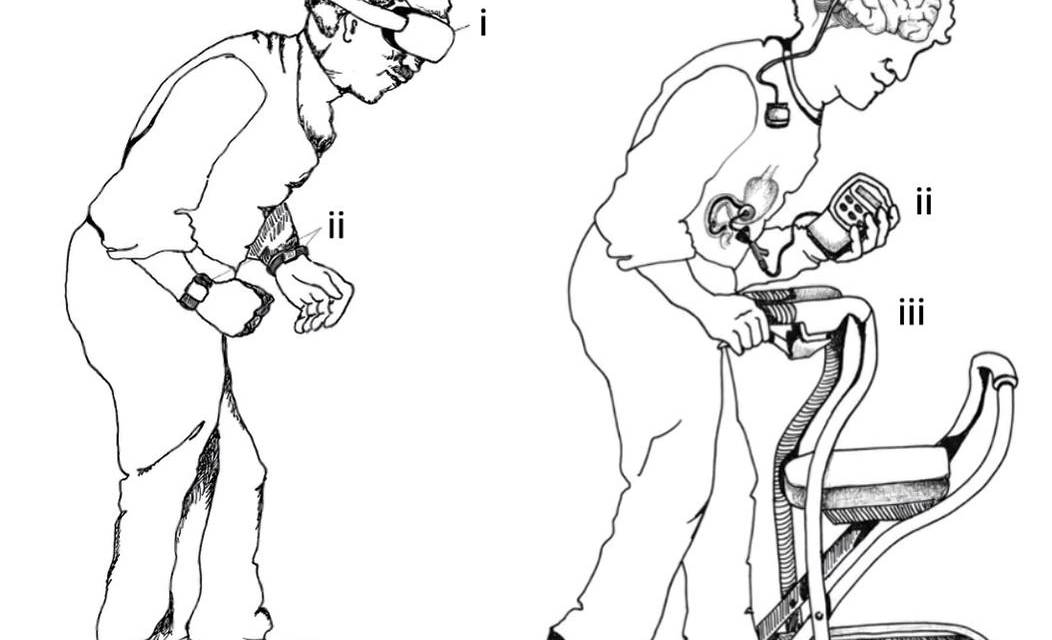
There is extensive literature on various computational approaches to processing and analyzing data collected from sensing devices to predict and identify FoG episodes. Challenges include increasing the accuracy of algorithmic classifiers, identifying features that can predict FoG episodes before onset to facilitate preventative on-demand treatment, and ensuring accessibility and practicality of devices to encourage widespread adoption.7 Ultimately, optimized versions of these technologies will improve research quality and clinical management of FoG in PD (Figure 1A).

Figure 1. Artist’s depiction of diagnostic and therapeutic devices for freezing of gait (artist: Katelynn Getchell, MD). A, Diagnostic devices include (i) virtual reality headsets, (ii) wearable inertial measurement units, and (iii) shoes with pressure-sensing insoles. B, Therapeutic devices include (i) deep brain stimulation, (ii) intestinal carbidopa/levodopa suspension, and (iii) U-Step walker, which may include laser projections or metronomic auditory stimuli for external cueing. The illustrations are independently created artistic representations intended solely for academic and educational purposes and are not manufacturer-supplied product images or depictions of proprietary technology. The illustrations have not been reviewed or approved by the respective device manufacturers. The figure and depicted likenesses are not licensed by, sponsored by, endorsed by, or affiliated with any device manufacturer.
Treatment
Technology-based treatment approaches are summarized in the Table and depicted in Figure 1B.

External Cueing
The use of discrete external visual targets or auditory and somatosensory temporal references is a mainstay of FoG management. This approach, known as external cueing, engages goal-directed motor circuits to circumvent dysfunctional automatic gait networks11 by directing attention toward gait, preventing the deterioration of the gait pattern over time, and recoupling the processes of anticipatory postural changes and step initiation.20
Despite the widespread use of cueing as a therapeutic strategy, a 2023 meta-analysis was inconclusive due to significant heterogeneity in study methods, including outcome measures and provoking maneuvers.11 Additionally, many studies included in this analysis relied primarily on gait laboratory measurements as proxies for FoG risk and lacked direct reporting of FoG episodes. Despite these challenges, the analysis found that visual and auditory cues improve measures associated with the preparatory phase of gait, reduce turning time, and reduce step length variability with turning, all of which may be increased in individuals with FoG.11 With straight walking, visual cueing improves stride length in the “on”-medication state, although gait velocity increased only in the “off”-medication state.11 There are far fewer studies examining somatosensory cueing, limiting the feasibility of systematic analysis.11
There are several devices that generate external visual cues, including laser projection devices for walkers and canes, shoes with integrated laser projectors, and augmented reality glasses. Metronomic auditory cuing may improve temporal gait measures in appropriately selected individuals. Cue modality and rhythm should be comprehensively tested with the user because a strategy effective for straight walking may fail during turning or dual tasking. The U-Step Neuro Walking Stabilizer (In-Step Mobility Products; Skokie, IL) is designed to minimize PD-associated instability and has an optional attachment that generates both a visual cue and a metronomic auditory cue.
Advances in wearable technology and computational classification for real-time detection or prediction of FoG have facilitated the development of on-demand or adaptive delivery of external cues. For example, a 2024 randomized active-controlled trial of an auditory cueing device connected to wIMUs by Bluetooth (DeFOG; MHealth Technologies, Bologna, Italy) reduced video-rated FoG during device use in a home-based provoking protocol in both “on” and “off” medication states. However, it did not show a carryover benefit when the device was not used.21 Another study showed that on-demand visual cueing delivered based on input from a pressure-sensitive insole reduced FoG episodes compared with both continuous cueing and no cueing.22 Notably, a study of on-demand cueing delivered through mixed reality glasses showed that the unfamiliar glasses themselves increased FoG, without a significant reduction in FoG with visual cueing.23 While technological advances have improved therapies for FoG in PD, this result highlights the potential unintended consequences of novel device-based treatments.
Deep Brain Stimulation
Deep brain stimulation (DBS) attenuates aberrant basal ganglia output to reduce symptoms of PD. The accumulated evidence suggests that subthalamic nucleus (STN) DBS most consistently improves levodopa-responsive, medication-“off” FoG, particularly in the medication-“off”/stimulation-“on” state.14 The evidence for improvement of FoG with DBS of the globus pallidus internus is less clear.12 Improvement of biphasic or medication-“on” FoG through a stimulation-mediated reduction of dopaminergic medications has been reported.6 Low-frequency STN DBS (typically either 60 Hz or 80 Hz) may improve axial motor symptoms, including FoG, compared with high-frequency STN DBS (typically ≥130 Hz), although this strategy may also worsen appendicular motor symptoms.15,16
Several studies have examined DBS of the pedunculopontine nucleus (PPN), a key structure in the mesencephalic locomotor region of the brainstem. Small studies suggest a possible benefit for FoG, although not for other PD motor symptoms.18,19 PPN DBS remains investigational, with no consensus on patient selection, targeting, or stimulation parameters.
A local field potential–guided adaptive DBS (aDBS) feature, in which beta-band power modulates stimulation amplitude, was approved by the FDA for eligible patients with PD in 2025. While the pivotal studies of aDBS were not designed to evaluate its impact on FoG,24 adaptive stimulation is conceptually well-suited to treat paroxysmal symptoms. A small pilot study comparing aDBS with continuous DBS demonstrated safety and feasibility of aDBS using local field potential beta-band power thresholds in the STN for treatment of gait symptoms, although gait kinematics did not improve with aDBS compared with continuous DBS.17 Other biomarkers of FoG, such as beta–gamma phase amplitude coupling in the primary motor cortex25 or wIMU-derived FoG indicators, may be feasible aDBS drivers in the future.
Other DBS stimulation strategies that may help treat FoG include rhythmic alternating STN stimulation26 and on-demand rhythmic bursting stimulation of the STN as a cuing strategy (CereGate, Munich, Germany).27
Other Neuromodulation Strategies
Several other neuromodulation strategies have been studied for the treatment of FoG in PD. Evaluations of transcranial magnetic stimulation (TMS), transcranial direct current stimulation (tcDCS), noninvasive vagal nerve stimulation (nVNS), and epidural spinal cord stimulation (eSCS) have shown varying effects.12 These treatments may modulate cortical, brainstem, or spinal networks involved in gait, although their mechanisms and optimal targets remain uncertain.
TMS and tcDCS both activate cortical targets. In the treatment of FoG, data for these methods are overall mixed, although 2 sham-controlled randomized trials of TMS targeting the supplementary motor area reduced FoG episodes.28,29
nVNS is thought to activate the locus coeruleus, a noradrenergic nucleus that degenerates early in PD. One small sham-controlled randomized trial showed improvement in gait kinematics with nVNS, but there was no significant between-group difference in FoG questionnaire scores.30
eSCS likely targets supraspinal control of gait through activation of the dorsal columns and desynchronization of low-frequency corticostriatal oscillations.12 Small studies have reported improvements in FoG with cervical and thoracic eSCS, but optimal stimulation parameters and spinal level targets remain uncertain.12 Unlike the less invasive methods described above, eSCS also carries operative and hardware-related risks.
Small sample sizes in individual neuromodulation studies and the variability in stimulation parameters, targets, and outcomes across studies limit their generalizability. Larger studies with more precise and uniform outcomes are needed before these interventions can be recommended routinely.
Infusions
In a small prospective cohort, enteral carbidopa/levodopa infusion was associated with improved NFoGQ scores, gait speed, and stride length; these changes were independent of improvement in MDS-UPDRS Part IV motor complications scores.31 This delivery mechanism is associated with a high complication rate related to the placement and maintenance of a percutaneous jejunostomy. Whether continuous subcutaneous foscarbidopa/foslevodopa provides similar benefit for FoG is unknown.
Conclusion
FoG is a symptom of PD that contributes to substantial morbidity and decreased quality of life. Its phenomenologic diversity and inconsistent response to medications highlight its pathophysiologic complexity. Typically, treatment involves behavioral interventions and external cueing to circumvent dysfunctional automatic gait circuits. Heterogeneity in testing methods and outcomes limits the systematic study of these interventions. Studies that rely on quantitative gait assessments in an artificial environment or self-reported severity measures limit generalizability and reliability.
The advent of ubiquitous wIMUs and advances in computational classification methods could allow for real-world, quantitative prediction and identification of FoG. The integration of automated FoG prediction with on-demand intervention could lead to the development of more efficient and effective closed-loop treatment systems. For example, a recent study of a shoe with integrated alternating laser projections, pressure-sensitive insoles to detect gait phase, and a wearable IMU shows the potential for integrated technology to streamline and improve FoG management.32
Commercial cueing aids may be used for symptomatic management, whereas automated FoG detection and prediction, augmented and mixed reality systems, and neuromodulatory approaches specific to FoG remain investigational. Future studies will benefit from the use of standardized, real-world, and quantitative outcome measures to facilitate comparison and compilation of evidence. In the meantime, external cueing and FoG-focused gait rehabilitation are reasonable first-line strategies.13 STN DBS may improve levodopa-responsive “off”-state FoG when performed for otherwise appropriate PD indications.
Ready to Claim Your Credits?
You have attempts to pass this post-test. Take your time and review carefully before submitting.
Good luck!
Recommended
 SEP-OCT 2026 ISSUE
An Update on Devices for Essential Tremor Treatment
Mackenzie R. Paller-Moore, MD; Katelynn Getchell, MDMackenzie R. Paller-Moore, MD; Katelynn Getchell, MD- Movement Disorders
Adaptive Deep Brain Stimulation for Parkinson Disease: Patient Selection, Programming, and Practical Considerations
Pravin Khemani, MDPravin Khemani, MD - SEP-OCT 2026 ISSUE
Wearable Devices in Parkinson Disease: A Practical Guide for Clinicians
Siegfried Hirczy, MD; Ruth B. Schneider, MDSiegfried Hirczy, MD; Ruth B. Schneider, MD