
Medical-Legal Issues Related to the Use of Generative Artificial Intelligence in Neurology Clinics
As generative artificial intelligence becomes more prevalent, clinical neurologists should understand not only its promise but also its risks and implications for patient safety.
KEY TAKEAWAYS
- As generative AI enters neurology practice, clinicians must understand both its clinical potential and its legal responsibilities.
- Responsible AI use requires physician oversight, awareness of hallucination risk, and compliance with evolving regulatory and privacy requirements.
- Practical strategies can help neurologists incorporate generative AI while maintaining patient safety, documentation standards, and independent clinical judgment.
Artificial intelligence (AI) has been part of neurology longer than many clinicians may realize. For years, machine learning algorithms have assisted with EEG readings, seizure detection analysis, and imaging interpretation (eg, MRI). Such tools have been validated through clinical testing and, as medical devices, are subject to US Food and Drug Administration (FDA) oversight. In contrast, generative AI is a new and fundamentally different technology.1 A neurologist might ask a large language model (LLM)—the technology that powers generative AI—to review a differential diagnosis, draft an after-visit summary, or summarize medical records. These are each novel and largely untested use cases in clinical care.
This article examines the medical-legal issues relevant to neurologists as generative AI evolves from a novelty to a clinical tool, discussing how generative AI differs from traditional AI, the current regulatory environment, and how neurologists can leverage generative AI while protecting themselves and their patients.
Generative vs Traditional AI
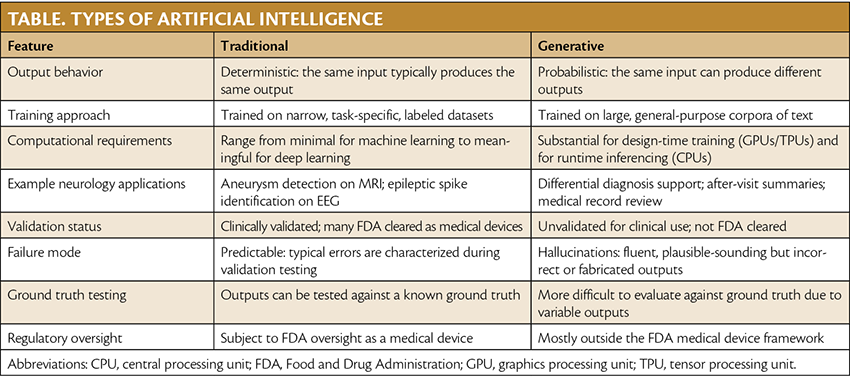
The American Academy of Neurology (AAN) recognizes and distinguishes several categories of clinical AI: machine learning, deep learning, natural language processing, clinical algorithms, and generative AI.2 Traditional diagnostic AI, such as the kind used in FDA-cleared applications for aneurysm detection on MRI or spike identification on EEG, operates on fixed, validated algorithms applied to specific, narrow tasks. Its outputs are deterministic (ie, the same every time given the same input) and can be tested against ground truth (ie, verified correct output). If it fails, the failure mode is generally predictable to clinicians, because typical errors have surfaced and been characterized during validation testing.
Generative AI operates differently. An LLM is trained on large collections of text data. When queried, the model generates responses based on probability by predicting the next token (ie, word or word fragment). By default, LLMs are not deterministic due to sampling randomness in how tokens are selected. This means that the same input can yield different results. In addition, an LLM cannot reliably distinguish what it knows from what it does not know. This is the root of generative AI hallucinations (ie, incorrect outputs, presented fluently and confidently).3
The Table summarizes and compares traditional and generative AI.

Generative AI Hallucinations
It is important to understand a counterintuitive finding from recent research: general-purpose models outperform medical-specialized models on hallucination resistance. A 2025 study evaluated 11 models across 7 medical tasks and found that general-purpose models achieved hallucination-free responses at a median rate of 76.6%, compared with 51.3% for medical-specialized models.4 The authors concluded that hallucination resistance emerges not from domain-specific fine-tuning but from the sophisticated reasoning capabilities developed during “large-scale pretraining.”4 A neurologist who selects a medical model over a general-purpose one may be sacrificing reliability.
The same study4 found that 64% to 72% of residual hallucinations stemmed from causal and temporal reasoning failures, not missing medical knowledge. One such example cited in the research was an LLM incorrectly attributing heart failure to a lung infection.4 Prompting the model to explain its reasoning reduced hallucinations in 86.4% of comparisons.4 For neurologists, these findings suggest the necessity of 2 practical safeguards:
- Ask the LLM to explain the basis for its conclusions, showing its evidence, assumptions, and sources.
- Treat any claim that a model is “medically trained” or “domain-specialized” with the same skepticism as any unproven treatment claim.
Generative AI Technology
The origins of generative AI can be traced back to the paper “Attention Is All You Need” by researchers at Google Brain (Mountain View, CA).1 The authors introduced Transformer architecture as a neural network design based on a mechanism called “self-attention,” which they used to replace the recurrent and convolutional layers of natural language processing (NLP). Virtually all LLMs employ Transformer architecture. The release of ChatGPT (OpenAI, San Francisco, CA) in November 2022 introduced generative AI to the public; GPT stands for Generative Pre-trained Transformer.
Two key hardware components underpin generative AI: training and inference. During training, an LLM is built using massive computational resources, primarily graphics processing units (GPUs). Inference—the process of interacting with an LLM as a user—also requires substantial computing power, but less than training and can be performed on a range of hardware, including central processing units (CPUs). Choosing a general-purpose LLM means using a model backed by substantial and tested hardware resources across both phases, whereas domain-specific or smaller models may not have the same level of infrastructure behind them.
Related technologies—retrieval-augmented generation (RAG) and model context protocol (MCP)—can be used to inform a general-purpose LLM with domain-specific context at the time of inferencing. These techniques supplement the model with trusted, up-to-date external sources when formulating a response. An example of using RAG is uploading the current AAN guidelines when prompting an LLM. An example of using MCP is connecting the LLM to an external data source, such as a database, using a standardized protocol.
The Generative AI Regulatory Landscape Relevant to Neurologists
Accountability in Generative AI–Assisted Care
Under US medical malpractice law and in many common law jurisdictions, clinicians have a nondelegable duty of care. Therefore, responsibility for generative AI–assisted decisions rests with the physician. American Medical Association (AMA) policy reflects this: AI must remain an assistive tool, not an autonomous decision-maker, and accountability stays with the treating clinician.5 Liability does not transfer to the LLM vendor if a generative AI recommendation is incorrect. Physicians who fail to exercise independent clinical judgment before acting on a hallucinated recommendation may face their own liability exposure. The issue of responsibility when generative AI is used by nonphysician clinicians or by health care institutions in clinical settings is an evolving, unsettled area of law.
Standard of Care in the Age of Generative AI
The standard of care is based on what a reasonable and prudent neurologist would do under similar circumstances, generally reflected by accepted practice among peers. If most neurologists are using generative AI to assist with a given task, such as reviewing medication interactions or drafting patient communications, failure to do so could fall below the standard. Conversely, if a neurologist uses generative AI in a way that a reasonable clinician would not, that usage may breach the standard.
In the age of generative AI, the standard of care may be changing at an unprecedented pace. To navigate this evolving landscape, neurologists should remain informed about how their peers are using generative AI in clinical settings. Keeping current with AAN guidance, continuing medical education, and institutional AI policies, and seeking legal counsel when appropriate, can help clinicians adapt to changing expectations. Documentation of generative AI use and independent clinical reasoning is the primary legal protection for neurologists.6
The Regulatory Landscape for Generative AI in Medicine
The FDA has cleared >1250 AI-enabled medical devices but has not yet authorized any that use generative AI, which the agency considers experimental in clinical settings.7 This leaves a gap: the AI tools most likely to be used at the point of care—that is, general-purpose LLMs queried about clinical questions—are outside FDA oversight. LLMs are not tested for clinical safety, validated against patient outcomes, or subject to adverse event reporting.
Health Insurance Portability and Accountability Act (HIPAA) compliance requirements add complexity. Any generative AI tool that processes Protected Health Information must satisfy HIPAA’s Privacy, Security, and Breach Notification Rules. Neurologists must verify that any generative AI application used in a clinical setting has appropriate data processing agreements in place before patient data are exposed.
Determining whether a generative AI tool is HIPAA-compliant is critical. HIPAA requires a Business Associate Agreement before patient data can be shared with any third-party vendor. Commercial LLMs, whether free or paid, are not HIPAA-compliant and cannot be used with patient data without violating HIPAA. Only organizations that have a Business Associate Agreement in place and proper tool configuration are permitted to use a generative AI platform with Protected Health Information.8
Informed Consent and Documentation
California AB 3030 requires health facilities, clinics, physician offices, and group practices to affix a disclaimer to generative AI–created clinical communications and provide instructions for reaching a human provider, unless the communication is read and reviewed by a licensed or certified human health care provider before it reaches the patient.9
Although limited to California, passage of this law signals the direction governance is heading. In terms of patient documentation, if generative AI was used to inform a clinical decision, that should be reflected in the after-visit notes. A simple mention that generative AI–assisted review was performed and independently verified by the clinician creates a record of oversight that satisfies AMA standards and would be essential in any subsequent liability analysis.5
Clinical Applications of Generative AI in Neurology
Diagnosis and Patient Care
AAN guidelines indicate that generative AI applications in clinical neurology, including diagnostic support, after-visit summaries, and patient communication, are being piloted but not yet validated for practical use.2 Once verified, generative AI may help neurologists synthesize complex histories, detect overlooked findings, or consider a broader differential diagnosis.
The clinical consequences of generative AI hallucinations are not abstract. The 2025 study cited previously4 also surveyed 70 clinicians across 15 specialties, finding that 91.8% had encountered AI hallucinations in practice, and 84.7% believed such hallucinations could cause patient harm. Documented hallucinations included fabricated medication names, invented drug interactions, incorrect diagnostic criteria, and misattributed symptoms.
The study organized generative AI hallucinations into 5 categories with clinical relevance: factual errors, outdated references, spurious correlations, fabricated sources or guidelines, and incomplete chains of reasoning.4 The last category is particularly difficult to detect in neurology, where causal and temporal reasoning underlies much of diagnosis and treatment.
Patient Notes and Summarization
Documentation produced by generative AI, such as clinical notes from patient visits, is among the fastest-growing applications in neurology. This output reduces administrative burden and may improve documentation completeness but also introduces hallucination risk at the point of record creation. The AAN specifically notes that LLMs may hallucinate content that is not present in the source transcript, including symptoms the patient never reported.2 A hallucinated symptom in a medical record can negatively influence future care, shape insurance determinations, and persist in the patient’s history.
Patient Communications
Some patients report comfort using generative AI–mediated communications for certain interactions, such as appointment scheduling, medication reminders, and condition education, in part due to availability outside office hours and reduced concern about judgment. A 2025 study found that patients were less likely to worry about being judged through an LLM interaction than through a conversation with a doctor. These patients preferred chatbots for administrative tasks and sensitive topics but still preferred human clinicians for diagnostic tasks.10
This task-dependent pattern is relevant to neurology, where diagnostic complexity is high and administrative and patient educational needs are substantial. AAN identifies generative AI–produced patient communications as a testing ground.2 Neurologists deploying such tools should ensure that any AI-generated clinical content is reviewed before delivery and that patients are informed of the use of generative AI in their care.
Emerging Use Cases
Generative AI–specific applications in neurology remain nascent, with clinical evidence still emerging. However, the use of machine learning has been explored across neurology subspecialties for diagnosis, forecasting, and treatment optimization. Although most of this predates the current wave of generative AI, it foreshadows future use cases.
Headache medicine offers an illustrative example. A 2024 review11 of 44 studies found that AI diagnostic models achieved accuracies ranging from ~60% to >90%, although many were tested only through cross-validation rather than on an independent dataset. In one case, giving nonspecialist clinicians access to an AI diagnostic tool raised their diagnostic accuracy from a 46% baseline to 83%, suggesting potential as a decision-support aid, particularly for less experienced providers. Other applications, including forecasting headaches and predicting treatment response, showed mixed results, ranging from modest to strong performance depending on the study and data.11
Agentic AI is on the horizon, where autonomous agents use an LLM to reason through tasks and take actions on behalf of another, such as querying external systems and acting on the responses.12 Although the technology is nascent, adoption in other industries, such as software and personal assistants, is spreading. Neurologists should be aware of these trends as they consider the potential applications and implications of generative AI in clinical practice.
Generative AI Best Practices for Clinical Neurologists
The following suggestions reflect current AMA policy, AAN resources, and emerging research.
- Trust but verify. Generative AI output should not be used as a substitute for independent clinical judgment. Treat AI-generated content as a starting point for reasoning, not a conclusion. Consider generative AI output potentially useful but never the basis for an unchecked clinical decision.
- Favor general-purpose over domain-specific models. The research shows that broader reasoning capability, not medical specialization, predicts hallucination resistance. A well-prompted general-purpose model trained using the latest hardware is likely more reliable than a purpose-built medical AI for most clinical queries.
- Ground generative AI queries with verified knowledge. RAG-based tools and MCP integrations that connect generative AI tools to current, curated sources, such as medical society guidelines and patient records, if appropriate, reduce hallucination risk by anchoring outputs in authoritative evidence rather than solely training data.
- Use generative AI as a collaborator, not a replacement. The AMA framing of AI as “augmented intelligence” is useful here. The most effective clinical use involves iterative dialogue, including questioning the reasoning of the generative AI tool, probing its conclusions, and integrating one’s own clinical expertise.
- Document the use of generative AI in clinical notes. Brief notation of generative AI–assisted review and independent verification creates a record of the oversight required by the standard of care and protects the clinician in any subsequent review.
- Match the tool to the task. Understand how generative AI works, where it excels, and where it struggles. Generative AI processes everything entered in a prompt all at once, rather than reading word by word or line by line, as humans do. Generative AI uses a transformer self-attention mechanism to weigh how each part relates to every other part; it generates response one token at a time, but each token is chosen with that full context already in view. As a result, generative AI excels at synthesizing large volumes of text (eg, reviewing medical records, summarizing literature, drafting communications). Generative AI is limited in the facets of care neurology demands most: causal reasoning, temporal sequencing, and nuanced clinical judgment.
- Stay current with evolving regulations and standards of care. The regulatory landscape for generative AI in clinical settings is changing rapidly at both the federal and state levels. California AB 3030, the AMA STEPS Forward governance toolkit, and anticipated FDA action on generative AI devices will shape what is required and what is protected in the months and years ahead.
Conclusion
As generative AI matures, the question is not whether neurologists will use it, but how, and with what understanding of its capabilities, limitations, and the legal context in which it operates. The AMA recommends a risk-based approach to AI governance that prioritizes patient safety, physician oversight, and institutional accountability.13 The same principles that govern sound clinical practice apply to generative AI adoption: verify, document, and trust clinical judgment. The neurologist who approaches generative AI with informed skepticism, rather than uncritical enthusiasm or reflexive avoidance, is best positioned to use it well and to enhance patient care.
Ready to Claim Your Credits?
You have attempts to pass this post-test. Take your time and review carefully before submitting.
Good luck!