
Physician Impairment, Disability Law, and Neurologic Disease: Navigating the ADA, Substance Use, and Fitness-for-Duty Evaluations
The Americans with Disabilities Act shapes physician impairment cases involving substance use disorders, neurologic disease, reasonable accommodations, medical board oversight, and return-to-practice decisions.
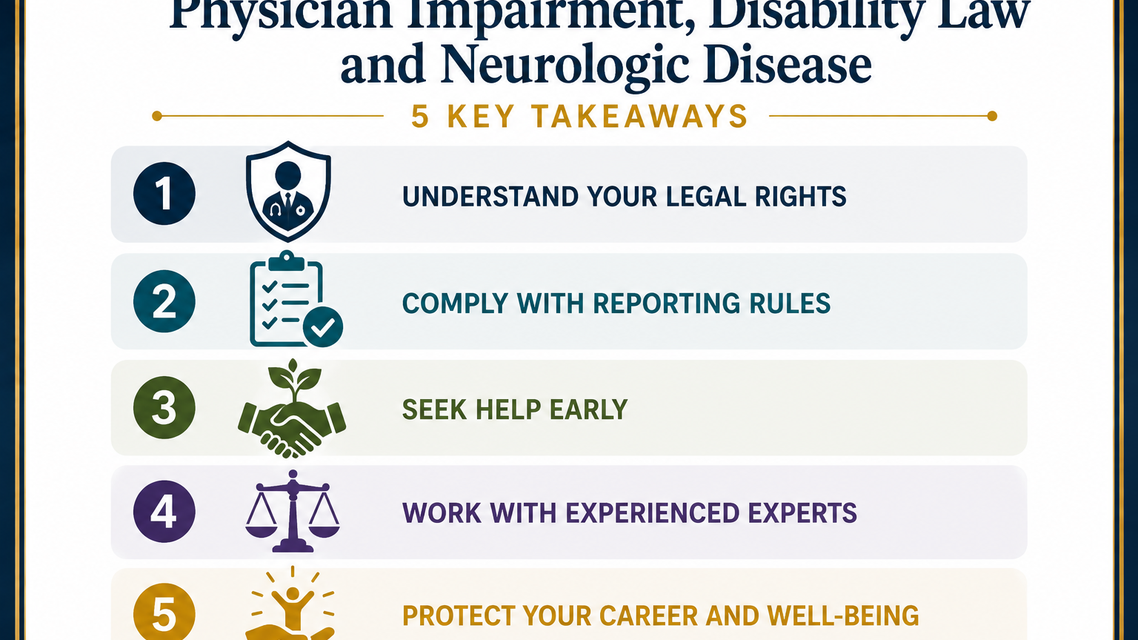
KEY TAKEAWAYS
- Physician impairment cases require balancing patient safety, physician rights, and legal responsibilities under evolving disability law.
- Neurologists play a unique role in evaluating physician health, fitness for duty, and appropriate workplace accommodations.
- Understanding how the ADA applies to neurologic disease and substance use can help clinicians navigate complex employment and licensing issues.
The American Medical Association (AMA) defines physician impairment as “any physical, mental or behavioral disorder that interferes with ability to engage safely in professional activities.”1 The AMA imposes responsibilities on physicians who identify a colleague as impaired. The AMA acknowledges that:
a variety of physical and mental health conditions—including physical disability, medical illness, and substance use can…put patients at risk, compromise physicians’ relationships with patients, as well as colleagues, and undermine public trust in the profession. While some conditions may render it impossible for a physician to provide care safely, with appropriate accommodations or treatment many can responsibly continue to practice or resume practice once those needs have been met.2
This article examines important sources of physician impairment relevant to neurologists in their dual roles as colleagues and potential patients. It focuses on the most common cause of complaints related to physician impairment—substance use disorders (SUDs)—and also addresses physicians diagnosed with potentially impairing neurologic conditions, as well as the implications of antidiscrimination laws for physicians with such conditions.
Antidiscrimination Law and Physician Impairment
The word “discrimination” evokes hallmark civil rights laws, such as Title VII of the Civil Rights Act of 1964, which prohibits discrimination based on race, sex, religion, color, or national origin, and the Age Discrimination in Employment Act of 1967, which outlaws age-based discrimination. However, these statutes do not directly govern how a hospital, medical staff, or licensing board may respond to a physician who is alleged to be impaired. The controlling statutes under such circumstances are the Americans with Disabilities Act of 19903 (ADA) and its 2008 amendments (ADAAA),4 which lowered previous barriers to establishing disability status and receiving legal protections.
This article applies the ADA/ADAAA framework to physician impairment, examining what “reasonable accommodation” entails in clinical practice and how medical boards and physician health programs approach evaluation, monitoring, and license reinstatement.
Substance Abuse
Between 10% and 25% of the American population may be under the influence of alcohol or illicit drugs while at work,5,6 and “[a]n estimated 10%–15% of doctors will develop a problem with substance abuse at some point in their careers.”7,8 Substance misuse or abuse is likewise an ongoing concern among medical students and trainees.9
Title I of the ADA expressly permits employers to ensure that a workplace is “drug and alcohol free” and that companies comply with related state and federal laws. As referenced in a US Commission on Civil Rights publication,10 employers and employees have the following legal obligations, which affect whether an individual has a disability that falls under the umbrella of the ADA and ADAAA:
- An individual who is currently engaging in the illegal use of drugs is not an individual with a disability when the employer acts on the basis of such use.
- An employer may not discriminate against a person who has a history of drug addiction but who is not currently using drugs and who has been rehabilitated.
- An employer may prohibit the illegal use of drugs and the use of alcohol at the workplace.
- It is not a violation of the ADA for an employer to give tests for the illegal use of drugs.
- An employer may discharge or deny employment to persons who currently engage in the illegal use of drugs.
- Employees who use drugs or alcohol may be required to meet the same standards of performance and conduct that are set for other employees.
Employees may be required to follow the Drug-Free Workplace Act of 1988 and rules set by federal agencies pertaining to drug and alcohol use in the workplace.10
The US Circuit Courts of Appeals have held that a person may still be considered a current user of drugs even after a period of abstinence spanning weeks to months.11-13 The Fifth Circuit, in Zenor v El Paso Healthcare Systems, Ltd,14 held that a pharmacist was a current user because he had used cocaine 5 weeks before being notified of his discharge. Similarly, the Third Circuit, in Salley v Circuit City Stores, Inc.,15 noted that it was unaware of any case in which a 3-week period of abstinence was sufficient to remove an employee from “current user” status. The law protects individuals in recovery or undergoing treatment, but does not protect individuals who are “current users” of alcohol or illicit drugs.16
Movement Disorders, Seizure Disorders, and Cognitive Decline
Besides SUD, neurologists may identify impairment in physician colleagues due to the same conditions they diagnose in patients every day. Three categories deserve particular attention: movement disorders, seizure disorders, and cognitive decline.
Movement Disorders
Essential tremor is the most common movement disorder in adults, and validated disability instruments show that even moderate tremor frequently impairs fine motor tasks17 (eg, writing, pouring, using utensils)—tasks essential to procedural practice. Parkinson disease raises overlapping concerns, including tremor, bradykinesia, and, over time, cognitive decline. Under the ADA, neither essential tremor nor Parkinson disease is considered automatically disabling. Coverage and any resulting accommodation depend on individualized assessments of functional limitations, not diagnosis alone. When tremor limits function, treatment options (eg, deep brain stimulation) may produce sustained, meaningful tremor control in appropriately selected patients, and may restore fine motor function sufficient to continue procedural practice.18,19
Seizure Disorders
Epilepsy in a physician raises patient safety concerns, but the ADA does not permit a categorical bar. As with any potentially disabling disorder, the determination of disability is individualized, based on seizure type, frequency, warning signs, medication response, and the specific tasks required. State rules restricting driving after a seizure, which typically require a fixed seizure-free interval, address risks associated with loss of consciousness behind the wheel, and do not translate directly into standards for medical licensure or hospital privileging. Employers and medical staff can tailor practice conditions (eg, restrictions on solo procedural work during a period of medication adjustment) to the physician’s actual risk profile, but a blanket exclusion based on the diagnosis alone will not survive ADA scrutiny.
Cognitive Decline
With an aging physician workforce, cognitive decline has become one of the most consequential and legally fraught forms of impairment. A number of hospitals have adopted “late-career practitioner policies,” requiring physicians above a set age (commonly 70 years) to undergo neuropsychologic and other testing as a condition of continued privileges. The Society of Surgical Chairs has recommended mandatory cognitive and psychomotor testing for surgeons ≥65 years.
These policies sit in real tension with antidiscrimination law. In February 2020, the US Equal Employment Opportunity Commission sued Yale New Haven Hospital, alleging that its late-career practitioner policy, which required neuropsychologic and ophthalmologic examinations only for practitioners ≥70 years, violated both the Age Discrimination in Employment Act and the ADA’s prohibition on medical examinations that are not job-related and consistent with business necessity. The litigation, including discovery disputes over disclosure of affected physicians’ identities, continued for several years after filing.20,21
The lesson for hospitals, medical staffs, and licensing boards is consistent across this area of law: screening triggered by performance concerns, rather than age or diagnosis alone, is far more defensible than blanket categorical testing.
Neurologists, occupational health physicians, and psychiatrists are the clinicians best positioned to design these evaluations and to conduct them fairly.22 Neuropsychologic assessment is the gold standard for evaluating physicians whose cognitive fitness is in question, but the assessment is only as good as the norms on which it is based: physicians, as a group, perform above the general population on standard cognitive measures; therefore, tools normed to the general population risk underidentification of meaningful impairment in physicians who have already declined from a higher personal baseline.23-25
The Neurologist’s Dual Role: Treating Physician and Fitness-for-Duty Evaluator
Neurologists asked to weigh in on an impaired colleague often occupy 2 very different roles, and the distinction matters both ethically and legally. A treating neurologist owes the physician–patient the ordinary duties of confidentiality and care. An independent fitness-for-duty evaluator, by contrast, is retained by an employer, medical staff, or licensing board to answer a narrower question for a different audience, and must obtain informed consent that makes the evaluation’s limited confidentiality and intended recipient clear before the assessment begins. Conflating the 2 roles of allowing a treating physician to also render the fitness-for-duty opinion used by an employer undermines both the therapeutic relationship and the reliability of the evaluation.
The central purpose of a fitness-for-duty evaluation is not to confirm or exclude a diagnosis, but to determine whether the physician can function safely and effectively in the specific role at issue. That functional framing allows the ADA’s individualized assessment requirement and a hospital’s legitimate patient safety interest to coexist: the question is never “Does this physician have Parkinson disease, epilepsy, or mild cognitive impairment?” Rather, the question is “[g]iven this physician’s actual, current functional status, can the essential functions of this job be performed safely, with or without accommodation?” Neurologists, more than perhaps any other specialty, are trained to answer exactly that question.
Reasonable Accommodations
Reasonable accommodations are dependent upon a law or regulation’s express language. Under the ADA, a “reasonable accommodation is any change or adjustment to a job or work environment that permits a qualified applicant or employee with a disability to participate in the job application process, to perform the essential functions of a job, or to enjoy benefits and privileges of employment equal to those enjoyed by employees without disabilities.”26
Failing to provide reasonable accommodation is generally a violation; however, an exception exists when providing the accommodation would impose an “undue hardship” on the operation of the business. Undue hardship is defined as an accommodation that “would require significant difficulty or expense.”27
For physicians with neurologic conditions, accommodations that typically fall short of undue hardship often include modified call schedules, protected time for medical visits, adaptive instruments or ergonomic equipment for tremor, voice-recognition or scribe support for documentation, or, for a physician with a seizure disorder, temporary restrictions on solo high-risk procedures during a period of medication adjustment.
It is well established that an employer is not required, as a reasonable accommodation, to ignore misconduct resulting from alcoholism. In Flynn v Raytheon Co,28 the court held that an employee who violated the company policy prohibiting being under the influence of alcohol in the workplace could not retroactively invoke the ADA’s reasonable accommodation provisions to escape discipline. The First Circuit also noted that the ADA does not require an employer to rehire a former employee who was lawfully discharged for disability-related failure to perform essential job functions.
Physician treatment outcomes for SUD surpass those of the general public. “The outcome of substance abuse treatment is generally more favorable for physicians than for the general public. Reported abstinence rates for physicians vary from 70% to 90%. Treatment programs estimate that 75% to 85% of physicians return to work.”29 Outcomes for physicians treated for neurologic impairment that does not involve cognitive decline can be similarly favorable when the condition is identified early, treated appropriately, and monitored. Employers, medical staff credentialing committees, medical schools, and state medical boards should take this into account when reviewing requests for reinstatement of licensure or privileges, regardless of whether the underlying impairment is an SUD or a neurologic condition.
Medical Boards, Physician Health Programs, and a Case Study
State medical boards recognize that a health condition, whatever its cause, should not permanently restrict an individual from the practice of medicine. For example, the Texas Medical Board (TMB) states that its mission is “to protect and enhance the public’s health, safety and welfare by establishing and maintaining standards of excellence used in regulating the practice of medicine and ensuring quality health care for the citizens of Texas through licensure, discipline, and education.”30 The TMB is not unique in its mission of protection and prevention of harm.31
The stakes are elevated in medicine because of the potential for adverse patient outcomes, including death. In 2009, the Texas Legislature recognized the need for a program to assist physicians who receive medical board complaints tied to health issues. With support from the Texas Medical Association, the Texas Physician Health Program was established.32 This program allows physicians to self-report impairment to the TMB through a confidential process “to enhance public safety [and] to be a therapeutic alternative, in lieu of discipline.”32 However, when a physician is reported to the TMB by a third party, a separate, public process ensues.
Health care facilities, state medical boards, other medical professionals, and patients should recognize that not every physician with a health condition presents a “Dr. Death” scenario, a term often associated with former neurosurgeon Christopher Duntsch, whose misconduct and SUD led to many poor patient outcomes and deaths due to failures within the health care system and TMB to revoke his license in a timely fashion.33
Instead, most physicians are more appropriately viewed as having situations similar to that of Gregory Spencer Mynko, MD, JD, who surrendered his medical license after being accused of impairment related to SUD.34 The underlying conduct was serious: Dr. Mynko self-administered Demerol diverted from his own patients, misused alcohol, and misrepresented his sobriety to a subsequent employer. However, after a hearing, the California Medical Board provisionally reinstated Dr. Mynko’s medical license in 201835 based on the types of objective evidence commonly considered in impairment cases, including letters of support, medical and drug testing records, and sustained participation in recovery programs (eg, Alcoholics Anonymous), subject to 17 conditions of probation.
California courts have long held that rehabilitation, whether from alcoholism or “other kinds of addictions,” is assessed on a case-by-case basis and requires a sustained, demonstrated commitment to recovery.36,37 The same case-by-case logic applies to demonstrating stable control of a potentially impairing neurologic disorder.
Given the likelihood of successful rehabilitation among physicians, coupled with the safeguards implemented by the California Medical Board, Dr. Mynko’s case illustrates the appropriate balance of public policy considerations involving patient safety and physician and health care system accountability—a balance that applies with equal force whether the underlying impairment is SUD or a neurologic condition.
Conclusion
The ADA and ADAAA distinguish between a physician, or any workforce member, who is actively impaired and one who is in a defined program of treatment and monitoring. The ADA does not preclude removal from practice based on an objective, job-related finding, and an employer may test or evaluate any individual before hiring and during employment, consistent with a signed attestation and the individualized assessment requirements described previously. In essence, the law creates safeguards and avenues for both physicians and the patients they serve. Each case must be evaluated on a case-by-case basis, although some physicians may never regain the functional capacity to practice safely.
Neurologists occupy a distinctive vantage point in this landscape: as colleagues who may be the first to notice a tremor or a subtle cognitive change; as treating physicians for physician–patients; and as specialists asked to render fitness-for-duty opinions on which hospitals, medical staffs, and licensing boards rely in cases involving neurologic impairment.
Ready to Claim Your Credits?
You have attempts to pass this post-test. Take your time and review carefully before submitting.
Good luck!
Recommended
 AUG 2026 ISSUE
Five Malpractice and Medical Liability Risks Every Neurologist Should Know
Rachel V. Rose, JD, MBA; Kirby D. Hopkins, JDRachel V. Rose, JD, MBA; Kirby D. Hopkins, JD