
Fraud, Waste, and Abuse Laws in Neurology: A Practical Guide for Clinicians
Understanding the False Claims Act, Anti-Kickback Statute, and compliance strategies can help neurologists reduce legal risk while supporting ethical, patient-centered care.
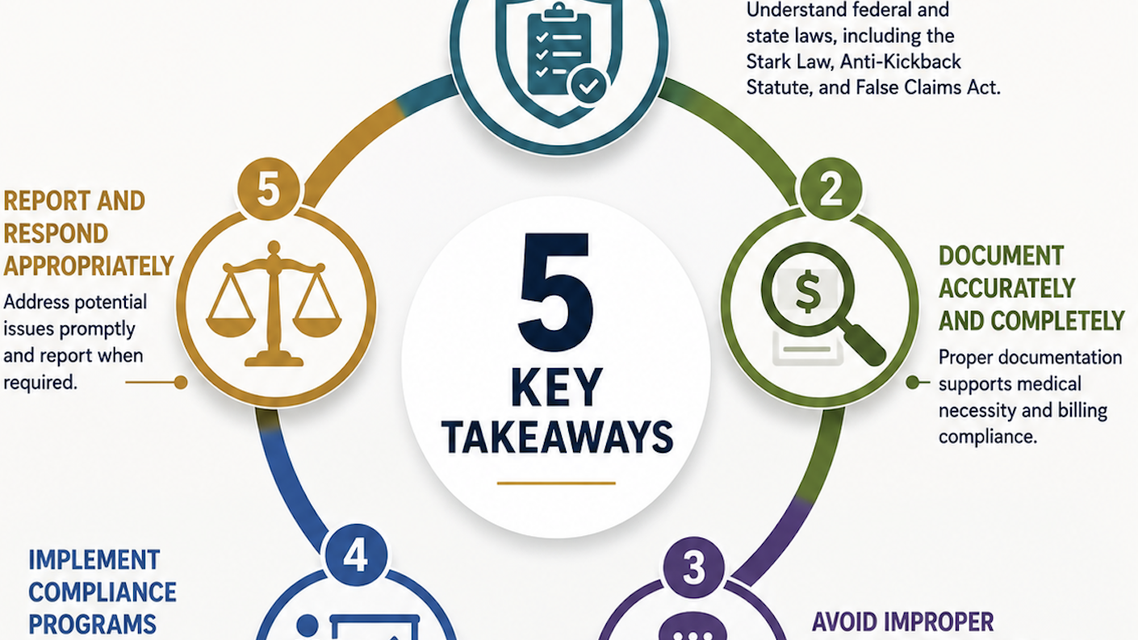
KEY TAKEAWAYS
- Fraud, waste, and abuse laws affect everyday neurology practice, making compliance essential to both patient care and professional protection.
- Understanding how the False Claims Act and Anti-Kickback Statute intersect can help clinicians recognize legal risks before they become enforcement actions.
- A strong compliance program supports ethical clinical decision-making while reducing the risk of civil and criminal liability.
When was the last time you thought about your fraud, waste, and abuse (FWA) training?
If we’re honest, it was probably not recently. Physicians’ days are packed. Yet certain laws weave through everyday practice in a very significant way, and physicians should remain aware of the laws and regulations that substantially influence everyday medical practice. Such laws include the Health Insurance Portability and Accountability Act of 1996 (HIPAA), informed consent requirements, do-not-resuscitate laws, and FWA laws. These laws are significant and material for a number of reasons. First, patients are affected either directly or indirectly. Second, if the trust between a patient and a physician erodes, the impact on the health care system may erode with it. Lastly, a physician may end up wearing the proverbial “orange jumpsuit” because of potential criminal liability and/or civil penalties. If the term “orange jumpsuit” did not catch your attention, then perhaps the previous sentence should be read again.
The objective of this article is to inform physicians, advanced practitioners, and ancillary care staff about FWA laws. It also explains how effective compliance can not only mitigate the risk of civil or criminal government investigations but also lead to improved patient-centered care free from inappropriate financial incentives.
Analysis of FWA
The US Department of Health and Human Services Office of the Inspector General (HHS-OIG) identifies 5 FWA laws as imperative for physicians to know: the False Claims Act (FCA), the Anti-Kickback Statute (AKS), the Physician Self-Referral Law (Stark Law), the Social Security Act (which includes the Exclusion Statute and Civil Monetary Penalties Law), and the US Criminal Code.1 Additionally, physicians should be familiar with the Eliminating Kickbacks in Recovery Act of 2018 (EKRA),2 particularly those who treat patients, refer them to laboratories, own any laboratory,3 or refer them to recovery homes or inpatient treatment facilities. While it is a criminal statute with similarities to the AKS, it should not be overlooked. EKRA also differs from the aforementioned FWA laws because it applies to “any public or private plan or contract, affecting commerce, under which any medical benefit, item, or service is provided to any individual, and includes any individual or entity who is providing a medical benefit, item, or service for which payment may be under the plan or contract.”4
Given the significance of health care recoveries under the FCA, many of which also involve AKS violations, this article focuses primarily on these two laws.
The False Claims Act
Known as the “Lincoln Law,” the FCA was enacted in 1863 in response to contractor fraud during the Civil War and has since been amended several times. The FCA is the federal government’s primary tool for combating fraud and recovering taxpayer funds for the US Treasury. According to the Third Circuit Court of Appeals, “The FCA’s ‘chief purpose… is to prevent the commission of fraud against the federal government and to provide for the restitution of money that was taken from the federal government by fraudulent means.’”5 FCA settlements and judgments exceeded $2.2 billion for the fiscal year (FY) ending September 30, 2022. Collectively, the federal “government and whistleblowers were party to 351 settlements and judgments, the second-highest number of settlements and judgments in a single year.”6 These recoveries reflected FCA enforcement involving the payment of kickbacks in violation of the AKS and Stark Law, as well as the DOJ’s new enforcement priorities, which included pandemic relief and cybersecurity requirements7 in government contracts and grants.6
For FY 2025, the US Department of Justice (DOJ) reported more than $6.8 billion in total FCA settlements and judgments.8 Health care continued to account for the largest share of FCA recoveries8 as the health care sector accounts for nearly 18% of the US gross domestic product (GDP). Also, when one considers the number of claims submitted to Medicare, Medicaid, and TRICARE, as well as direct procurement by the federal government compared with any other sector, statistically, it makes sense.
The FCA provides “that any person who knowingly submitted false claims to the government is liable for … treble damages plus a penalty that is linked to inflation.”9 The US may pursue an FCA violation on its own, or private citizens represented by counsel may file suit on behalf of the government against persons who have allegedly defrauded the US.10 The FCA’s fundamental premise is that a knowing submission of a fraudulent claim to the government is unlawful, and “the primary purpose of the FCA is to indemnify the government—through its restitutionary penalty provisions—against losses caused by a defendant’s fraud.”11
The FCA prohibits the following: knowingly presenting (or causing to be presented) to the federal government a false or fraudulent claim for payment or approval; knowingly making or using (or causing to be made or used) a false record or statement material to a false or fraudulent claim; conspiring to commit a violation of the FCA; and/or knowingly concealing or knowingly and improperly avoiding or decreasing an obligation to pay or transmit money to the federal government.12
While some FCA actions involve claims submitted to the government that are false or fraudulent on their face, such as the submission of claims for services not rendered, the FCA’s reach is not limited to these claims. “Accurate claims submitted for services actually rendered may still be considered fraudulent and give rise to FCA liability if the services were rendered in violation of other laws.”13 Claims for payment submitted to any federal health care programs in violation of the AKS are false claims for purposes of the FCA.14 Cases illustrating the nexus between the FCA and AKS are highlighted in the next section.
The Anti-Kickback Statute
Enacted in 1972, the AKS15 is a statute that has the potential for both criminal and civil penalties.16 Simply stated, the AKS applies to all medical providers and prohibits remuneration in cash or in kind in exchange for referrals or the utilization of services or products (eg, durable medical equipment, pharmaceuticals, medical devices) of government program (ie, Medicare, Medicaid, TRICARE) beneficiaries. The only federal government program that the AKS does not apply to is the Federal Employee Health Benefits Program; however, the FCA, as well as the Travel Act, still applies.
Although not the focus of this article, the AKS includes several safe harbors,17 which provide that certain payment and business arrangements that may implicate the AKS will not be treated as actionable offenses by the HHS-OIG if the applicable safe harbor requirements are met. The most recent safe harbor additions and modifications to the safe harbors were published in the Federal Register on December 2, 2020, with most provisions becoming effective on January 19, 2021.18
As codified in the Patient Protection and Affordable Care Act of 2010 (PPACA), “a claim that includes items or services resulting from a violation of this section constitutes a false or fraudulent claim for purposes of [the FCA].”19 According to the legislative history of the PPACA, this amendment was intended to clarify “that all claims resulting from illegal kickbacks are considered false claims for the purpose of civil actions under the FCA, even when the claims are not submitted directly by the wrongdoers themselves.”20
Compliance with the AKS (42 U.S.C. § 1320a-7b[b]) is a condition of payment under federal health care programs and is reiterated in every attestation on every claim submitted—whether paper or electronic. Claims for products or services arising from kickbacks expressly and impliedly misrepresent compliance with a material condition of payment, namely, compliance with the AKS. Specific intent is not required to establish a violation of the AKS. “With respect to violations of this section, a person need not have actual knowledge of this section or specific intent to commit a violation of this section.”21
A notable example of an FCA case, which was brought by a whistleblower and involves AKS violations, is the 2022 Biogen settlement. On September 26, 2022, the DOJ announced that Biogen agreed to pay $900 million to resolve allegations of AKS violations, which led to the submission of false and fraudulent claims to Medicare and Medicaid. In a case that the DOJ initially declined to intervene in, and in which the whistleblower’s attorneys took to trial, the pharmaceutical company allegedly paid kickbacks to physicians in exchange for the prescription of Biogen’s drugs.22 “According to [Relator Michael Bawduniak’s] complaint, from January 1, 2009, through March 18, 2014, Biogen offered and paid remuneration, including in the form of speaker honoraria, speaker training fees, consulting fees, and meals, to health care professionals who spoke at or attended Biogen’s speaker programs, speaker training meetings, or consultant programs to induce them to prescribe the drugs Avonex, Tysabri, and Tecfidera, in violation of the Anti-Kickback Statute.”23
These cases demonstrate that the AKS is often utilized in conjunction with the FCA to substantiate the submission or the causing submission of false and fraudulent claims to federal health care programs. Additionally, it reinforces a unique aspect of the FCA—a case may be filed by the government or through a whistleblower represented by an attorney. Reading nearly any DOJ press release related to the AKS and FCA reveals that the government and relators (aka whistleblowers) are concerned about the following three items: (1) combatting health care fraud; (2) corrupting independent medical decision-making of providers; and (3) “kickbacks hav[ing] no place anywhere in our health care system,” which will be identified and punished.22 In sum, paying remuneration, whether in cash or in kind, directly or indirectly, can, as the aforementioned cases demonstrate, have both criminal and civil implications.
Constructing an Effective Compliance Program
Whether establishing a new compliance program or conducting an annual evaluation of an existing program, 42 CFR §483.85 provides a roadmap for 7 key elements:
- Written policies and procedures;
- Compliance leadership and oversight;
- Training and education;
- Effective lines of communication with the compliance officer and disclosure program;
- Enforcing standards with consequences and incentives;
- Risk assessment, auditing, and monitoring; and
- Responding to detected offenses and developing corrective action initiatives.
To assist with the content of these 7 areas, from time-to-time, HHS-OIG releases updates to its publication, General Compliance Program Guidance, which most recently occurred in November 2023.24
The DOJ’s Evaluation of Corporate Compliance Programs25 is another helpful resource. The September 2024 update highlighted the following:
- Key considerations: The adequacy and effectiveness of the organization’s compliance program at the time of the offense, as well as at the time of the charging decision. US Sentencing Guidelines advise that consideration be given to whether the corporation had an effective compliance program in place at the time of the misconduct and whether any remedial improvements have been tested to demonstrate the likelihood of prevention and/or detection of similar future misconduct.
- Potential mitigation associated with an effective compliance program: An effective and comprehensive compliance program that was effective at the time of the offense and is effective at the time of the charging decision can mitigate the form of any resolution or prosecution; any monetary penalty; and compliance obligations contained in any corporate criminal resolution (eg, monitorship or reporting obligations).
As recommended by the DOJ, all organizations, regardless of their size, should evaluate their compliance programs with the following questions in mind:
- Is it well designed and does it address the 7 elements set forth in 42 CFR 483.85?
- Is the program being applied earnestly and in good faith or stated another way (ie, is it adequately resourced and does the corporate culture empower it to function effectively)?
- In practice, does the compliance program work?
By having an effective compliance program, not only can risk of a government enforcement action be mitigated, but the fiduciary relationship between a physician and patient will remain intact. The physician’s prescribing or utilization of drugs, use or ordering of equipment, and performance of diagnostic and surgical procedures will be in the patient’s best interests rather than financial incentives.
Conclusion
FWA laws influence everyday clinical practice and the decisions physicians make on behalf of their patients. With the increasing enforcement of the False Claims Act and the continued importance of the Anti-Kickback Statute, compliance remains a critical component of ethical, patient-centered care. Compliance is not simply about avoiding civil or criminal liability; it is about ensuring that clinical decisions remain guided by the best interests of patients rather than by inappropriate financial incentives.
Ready to Claim Your Credits?
You have attempts to pass this post-test. Take your time and review carefully before submitting.
Good luck!
Recommended
 AUG 2026 ISSUE
Five Malpractice and Medical Liability Risks Every Neurologist Should Know
Rachel V. Rose, JD, MBA; Kirby D. Hopkins, JDRachel V. Rose, JD, MBA; Kirby D. Hopkins, JD