
Five Malpractice and Medical Liability Risks Every Neurologist Should Know
Malpractice and medical liability remain significant concerns in neurology, but understanding common risk areas can help clinicians protect patients and their practices.
KEY TAKEAWAYS
- Medical liability extends beyond malpractice claims, making proactive risk management an essential part of modern neurologic practice.
- Understanding the legal and regulatory issues most likely to affect neurologists can help strengthen both patient care and practice protection.
- Small changes in documentation, communication, and clinical decision-making may reduce legal exposure while supporting better patient outcomes.
What distinguishes medical liability from medical malpractice? “Medical professional liability is the legal responsibility that health care professionals have to provide competent and safe medical care to their patients [as a fiduciary].”1 When a health care provider fails to meet this duty and patient harm occurs, the provider may face a medical malpractice claim.1 The concept of medical liability is not new; it has been recognized since the Babylonian Code of Hammurabi, one of the earliest written legal codes governing physician responsibility.2
Specifically, as the American Bar Association states, “Medical malpractice is negligence committed by a professional health care provider—a physician, nurse, dentist, technician, hospital, or hospital worker—whose performance of duties departs from a standard of practice of those with similar training and experience, resulting in harm to a patient or patients.”3 Most medical malpractice claims arise as common-law negligence actions, which requires a plaintiff to establish the following elements: (1) duty, (2) breach, (3) causation (actual and proximate), and (4) damages. According to an American Medical Association Benchmark study, approximately 22% of neurologists have been sued during their careers, some more than once.4
Medical liability serves are the broader umbrella concept, while medical malpractice represents one form of liability arising from a breach of the applicable standard of care. Because medical liability encompasses more than malpractice claims alone, this article highlights 5 key areas of malpractice and medical liability that neurologists should consider in clinical practice.
Five Common Sources of Malpractice and Medical Liability
What follows is a list of 5 common sources of malpractice and medical liability that neurologists should address from both patient care and compliance perspectives. Medical liability may result not only in malpractice litigation but also in exclusion from Medicare, Medicaid, and other government programs; in disciplinary action; or in suspension or revocation of a medical license.
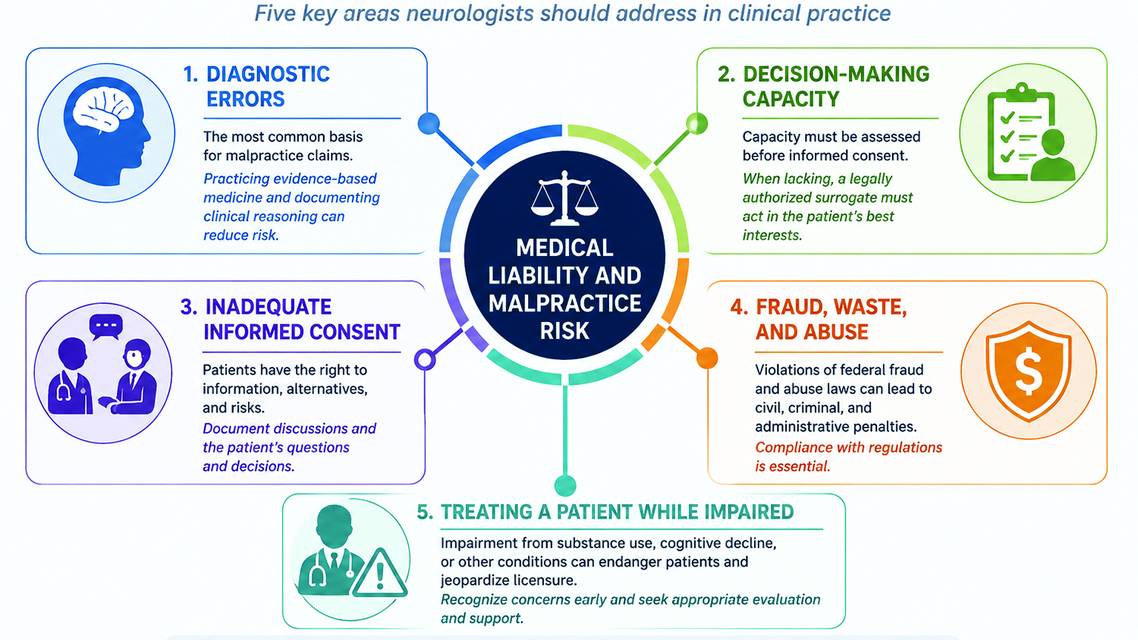
1. Diagnostic Errors. This is the most common basis of medical malpractice against neurologists. Examples include the diagnosis and management of acute stroke and chronic neurologic diseases, such as amyotrophic lateral sclerosis (ALS), multiple sclerosis (MS), and Parkinson disease.5 Diagnostic errors account for approximately one-third of malpractice claims against neurologists. A 2019-2023 analysis by the Medical Professional Liability Association found that 31% of claims resulted in an indemnity payment, with an average payment of $427,464; diagnostic and procedural errors were the leading allegations.5
Alzheimer disease, a disease that draws a great deal of attention, is also a high-risk area for litigation, in particular in conjunction with prescribing drugs. For example, Biogen’s Aduhelm (aducanumab) illustrates a failure by a manufacturer to adequately warn doctors and patients about the increased risk of potentially fatal brain swelling (ARIA-E).6 Strategies to reduce malpractice risk include practicing evidence-based medicine, discussing the potential risks and benefits of treatment—including boxed warnings7 and off-label use when applicable—and documenting that the patient has decision-making capacity and has provided informed consent. Importantly, this situation could raise two types of cases: (1) product liability and (2) medical negligence, depending on the facts and circumstances of the physician’s prescribing.
2. Decision-Making Capacity—Patient & Physician. Before a patient can provide informed consent, the treating physician must determine that the patient has decision-making capacity. Decision-making capacity is distinct from legal competency. In the health care setting, capacity is determined by the treating physician and is based on four elements: (1) understanding, (2) appreciation, (3) reasoning, and (4) the ability to communicate a choice.8 Decision-making capacity is frequently affected in patients with Alzheimer disease because of progressive cognitive decline. If a patient lacks decision-making capacity—whether because of age, illness, injury, or another legally recognized circumstance—a legally authorized surrogate decision-maker must act in accordance with the patient’s known wishes and best interests.9 Without decision-making capacity or a legally authorized surrogate decision-maker, valid informed consent cannot be obtained.
3. Inadequate Informed Consent. As indicated in the American Medical Association’s Code of Medical Ethics Opinion 2.1.1 – Informed Consent, “Patients have the right to receive information and ask questions about recommended treatments so that they can make well-considered decisions about care.”10 Obtaining informed consent requires more than securing a patient’s signature on a form. Physicians should discuss the proposed treatment, reasonable alternatives, expected benefits, material risks, and potential consequences of declining treatment, while providing the patient an opportunity to ask questions. Thorough documentation of these discussions may be critical if the adequacy of informed consent is later challenged.
4. Violating Fraud, Waste, and Abuse Laws. The US Department of Health and Human Services Office of Inspector General identifies 5 federal fraud and abuse laws that are particularly relevant to physicians: the False Claims Act (FCA), the Anti-Kickback Statute, the Physician Self-Referral Law (Stark Law), the Exclusion Authorities, and the Civil Monetary Penalties Law.11 The federal government’s most significant fraud fighting tool remains the FCA, which for FY 2025 exceeded $6.8 billion in recoveries during fiscal year 2025.12 In addition to civil monetary penalties, the federal government may pursue parallel criminal proceedings or exclude providers from participating in federal health care programs, including Medicare and Medicaid.
5. Treating a Patient While Impaired. As a matter of public policy, state Medical Boards are tasked with licensing physicians and protecting the public. Participating “in patient care while under the influence of controlled substances”13 can lead to license suspension and ultimate termination. Because of the potential physical, emotional, and mental harm to patients, this is an area for physicians to appreciate, not only in terms of substance use disorder but also for cognitive decline. Early recognition and appropriate intervention may help protect patients while reducing the risk of disciplinary action and professional liability (Figure).

Conclusion
Appreciating their fiduciary duty to patients, neurologists should recognize that medical liability extends beyond malpractice claims and encompasses a broad range of legal, ethical, and regulatory responsibilities. By recognizing common sources of liability risk and also incorporating sound clinical judgment, effective communication, informed consent, thorough documentation, and regulatory compliance into everyday practice, neurologists can better protect their patients, reduce legal exposure, and uphold the highest standards of patient care.
Ready to Claim Your Credits?
You have attempts to pass this post-test. Take your time and review carefully before submitting.
Good luck!
Recommended
 AUG 2026 ISSUE
Medical-Legal Issues Facing Neurologists
Rachel V. Rose, JD, MBA; Joseph S. Kass, MD, JD, FAANRachel V. Rose, JD, MBA; Joseph S. Kass, MD, JD, FAAN