
The Many Faces of Facioscapulohumeral Muscular Dystrophy
Facioscapulohumeral muscular dystrophy should be conceptualized not as a single entity, but as a spectrum disorder with a complex genetic basis.
Facioscapulohumeral muscular dystrophy (FSHD) is a form of muscular disorder that poses distinct diagnostic challenges given its insidious onset and slow progression. FSHD is thought to be the third most common form of muscular dystrophy, previously estimated to affect 1 in 15,000 to 20,000 individuals in European countries, with some data suggesting a higher incidence of ~1 in 8000, likely dependent on geography.1
The classic FSHD phenotype is characterized by progressive, often asymmetric weakness with a rostral to caudal distribution, initially affecting the muscles of the face, scapular girdle, and upper limbs, followed by the periscapular region, proximal upper extremities, and trunk, and then the lower extremities.2 Most individuals present in their late teens to early adulthood. Weakness develops insidiously with slow progression over decades.
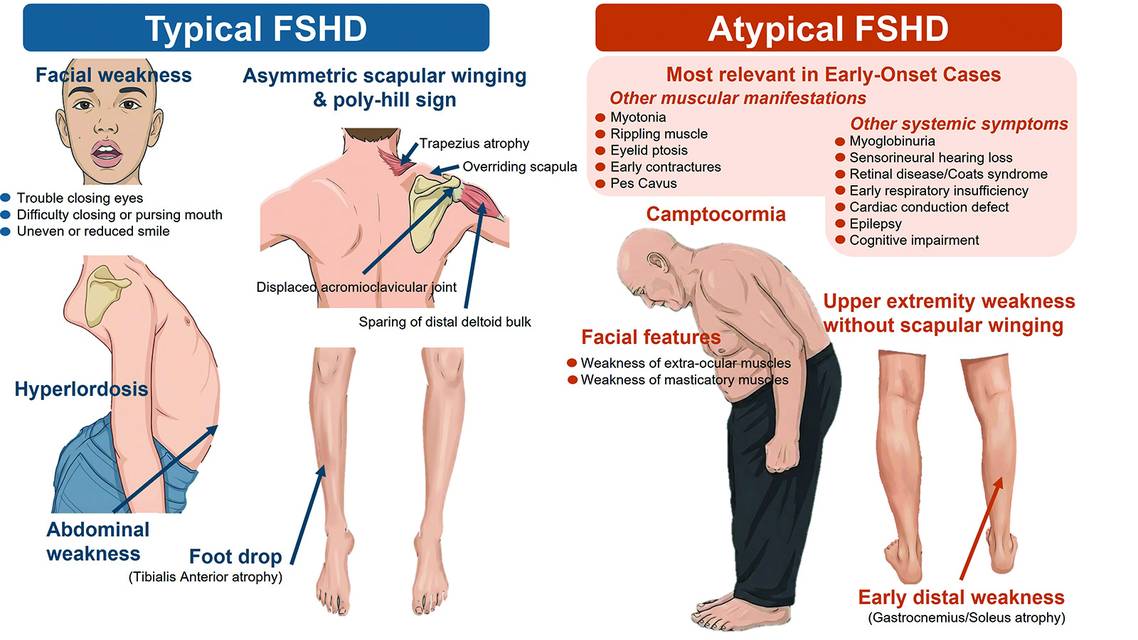
Our understanding of FSHD has evolved to recognize an expanded phenotypic landscape that extends beyond the classic presentation. Within this spectrum, individuals with atypical onset represent a clinically significant population that warrants closer investigation (Figure). Phenotypic complexity is further highlighted by marked intrafamilial variability: even among relatives harboring identical FSHD-related sequence variations, there is often striking heterogeneity in both age at onset and severity of disease progression (Table).

Figure. Typical and atypical features of facioscapulohumeral muscular dystrophy (FSHD).
Data from Ricci G, Ruggiero L, Vercelli L, et al. A novel clinical tool to classify facioscapulohumeral muscular dystrophy phenotypes. J Neurol. 2016;263(6):1204-121453 and Mul K. Facioscapulohumeral muscular dystrophy. Continuum (Minneap Minn). 2022;28(6):1735-1751.54-57

The clinical variability of FSHD is underscored by a deeply layered genetic landscape, which provides the foundation for its diverse manifestations. FSHD should be conceptualized not as a single entity, but as a spectrum disorder with a complex genetic basis.
The Evolving Genetic Landscape of FSHD
The primary molecular mechanism of FSHD involves D4Z4 hypomethylation, a key epigenetic feature that leads to erroneous chromatin activation and transcription of genes designed to be silent after development is complete.3,4 This is most commonly triggered by contraction of D4Z4, a tandem repeat array of 3.3-kilobase (kb) units located in the subtelomeric region of chromosome 4q35. In affected individuals with FSHD type 1, this array is shortened to between 1 and 10 repeat units. If D4Z4 contractions are on a permissive 4q haplotype, the polyadenylation signal allows for stable aberrant expression of the DUX4 gene, leading to activation of several unwanted downstream pathways.
Disease severity in FSHD1 generally scales inversely with the number of D4Z4 repeats; however, moving beyond this simplistic view is essential for accurate prognosis and counseling. Several conditions deviate from this norm. Individuals with 1 to 3 D4Z4 repeat units can have considerable systemic involvement (eg, cognitive impairment, epilepsy, cardiac arrythmia, early respiratory failure) in addition to early-onset severe myopathy.5,6 Individuals with larger D4Z4 repeat units (>7) or borderline allelic contractions have higher variability in age at onset and severity of progression, and exhibit a distribution of weakness that diverges from the classic phenotype.7-9 In addition, intrafamilial clinical variability and occurrence of asymptomatic or nonpenetrant cases despite a permissive genetic background are more evident in this cohort. In these cases, a “borderline” allelic contraction genotype appears to function less as a deterministic diagnostic marker and more as a significant susceptibility factor.5,10-12 The explanation of these deviations lies in additional unidentified elements required to enhance activation of DUX4.13
The extent of DNA hypomethylation at the D4Z4 locus appears to be a stronger indicator of clinical FSHD and can be independent of D4Z4 repeat size.3,14,15 Hypomethylation of the D4Z4 locus can occur in several ways. FSHD2 (<5% of cases) is a digenic condition secondary to heterozygous sequence variations in genes such as SMCHD1, which directly affect D4Z4 hypomethylation on a normal-length D4Z4 with a permissive 4q allele, thereby enabling DUX4 expression.16 Additional epigenetic control of the D4Z4 structure through DNMT3B and LRIF1 has also been identified in recent years.17
Other genetic factors contributing to the heterogeneity of FSHD include cis D4Z4 duplication or triplication,16,18,19 somatic mosaicism,20-22 complex rearrangements,23 and ethnic variations.24-26 In European populations, symptomatic cases frequently occur within the 8–10 D4Z4 repeat range, but global population studies demonstrate substantial ethnic variation in FSHD genotype–phenotype correlations. The Korean national database includes no individuals with >6 repeats,24 and Japanese registries show a notably lower frequency of longer repeats (>7) compared with European populations.25 Furthermore, the relative rarity of FSHD among individuals with Indian ancestry suggests the presence of specific genetic protective features that may mitigate disease expression.26
FSHD is understood to be a predominantly epigenetic disorder characterized by the hallmark feature of D4Z4 hypomethylation.3,4 Because traditional Southern Blot testing fails to measure the degree of DNA hypomethylation or capture other complex genetic factors, diagnostic practices are shifting toward newer methods. These approaches include molecular combing (which allows direct visualization using fluorescent probe labeling, enabling superior accuracy in repeat sizing, detection of somatic mosaicism, and identification of complex rearrangements), optical genome mapping (which has similar benefits as molecular combing), and bisulfite sequencing (which provides more accurate detection of DNA hypomethylation).3,27,28
Asymptomatic Carriers
Up to 30% of individuals who carry the FSHD genotype remain asymptomatic, including family members who carry identical D4Z4 contractions.29 The cause of this nonpenetrant or variable penetrant feature of FSHD is multifactorial and may include some of the genetic factors mentioned previously. Approximately 1% to 3% of European individuals carry the permissive allele and a contraction <10 repeats but are asymptomatic.30,31 It is estimated that up to 3% of this population would have D4Z4 repeat units between 7 and 10 without manifesting symptoms despite a permissive haplotype.10,11 The prevalence of asymptomatic FSHD carriers is predicted to be higher in individuals with Asian ancestry, given the ethnic variations found in population studies.24-26
Infantile and Early-Onset Presentations
The terms infantile and early-onset FSHD have been used interchangeably in the literature but are defined by onset of facial weakness >5 years of age and shoulder girdle weakness >10 years of age, respectively.6,32 The reported incidence ranges from 3% to 21% of the total FSHD population.32,33 This group has a high incidence of extramuscular (systemic) involvement, including hearing loss (up to 68% of cases); retinal abnormalities, which can lead to vision loss (Coats syndrome; ~37% of cases); developmental delays or intellectual disability (up to 92% of cases); epilepsy (including infantile spasms); restrictive lung disease; scoliosis; and cardiac arrythmias.32-34 A systematic review of data from 227 individuals with early-onset FSHD found that perinatal complications—including prematurity, low birthweight, and dysmorphic features—were reported in only 5% of cases (5 out of 99 individuals with available clinical records), with unclear disease association.33 Rare cases of severe infantile facial diplegia were reported, which may lead to an initial misdiagnosis of Möbius syndrome. Unlike in classic Möbius syndrome, the weakness in FSHD is myopathic, not neuropathic.35 Individuals in this population almost unambiguously have shorter repeat units (<3 in most cases) with a higher reported percentage of de novo changes.5,33
Late-Onset Presentations
Facial-Sparing Scapular Myopathy
Facial-sparing scapular myopathy, or scapulohumeral dystrophy (SHD), is clinically defined by the absence of apparent facial muscle weakness upon neurologic examination at presentation.36-39 This population is often misdiagnosed with scapuloperoneal muscular dystrophy.
The clinical profile of SHD is typically characterized by milder myopathic symptoms and slower progression of weakness compared with classic FSHD. Many people with SHD are diagnosed only after their children are diagnosed. The mean age at onset is typically later, most often >39 years.36,38 The reported incidence varies between 6% and 16%.36-39
SHD is usually associated with larger D4Z4 repeat sizes (7–10 units). Penetrance is variable and dependent on hypomethylation from epigenetic modifications.
Axial, Limb-Girdle, and Distal Myopathy Presentations
The FSHD genotype can manifest with primary weakness in patterns that mimic other forms of muscular dystrophy, extending well beyond the classic facioscapulohumeral distribution.
A notable example is an extreme form of axial presentation causing camptocormia, or “bent spine syndrome.” This pathologic forward flexion of the spine, which worsens when standing and resolves when lying down, can be a presenting feature of FSHD, particularly in older individuals (the mean age at presentation is 59.6 years).40,41 In one neuromuscular cohort, FSHD was the single most common cause of myopathic camptocormia, accounting for 47% of cases.41 The clinical signature of FSHD-related camptocormia includes later disease onset, marked axial involvement with predominant spinal extensor weakness, relatively preserved abdominal strength, and severe paravertebral fatty replacement on muscle MRI with subclinical involvement of limb muscles.40
Other reported atypical myopathic phenotypes in individuals with a confirmed FSHD genotype include a limb-girdle pattern of weakness, distal myopathy, asymmetric brachial weakness, isolated facial diplegia in older individuals, and isolated monomelic (single-limb) lower-limb atrophy.37,38,42 These entities share a pattern of late onset (mostly >45 years of age) with repeat sizes >7. Data from the Clinical Trial Readiness to Solve Barriers to Drug Development in FSHD study (ReSolve; NCT03458832) also suggest that individuals with late-onset FSHD (age >45 years) have a higher number of D4Z4 repeats with milder facial and upper limb involvement but with much greater lower limb impairment, likely reflecting the stochastic nature of DUX4 activation and associated unpredictable muscle repair processes.43
Overlapping Conditions (“Double-Trouble” FSHD)
“Double-trouble” FSHD refers to FSHD presenting along with a second, unrelated neuromuscular disorder or sequence variation. This phenomenon contributes to cases in which disease severity exceeds what would be expected based solely on the size of the D4Z4 contraction.44-52 Whole exome sequencing of 42 individuals with atypical FSHD identified 24 (57%) with genetic variants linked to other neuromuscular disorders or known FSHD modifiers.53 A concomitant diagnosis of calpainopathy, dystrophinopathy, hereditary sensorimotor polyneuropathy, myasthenia gravis, myotonic dystrophy type 1, or rippling muscle disease has been reported as the “double” component of the individual’s “trouble” leading to a more severe phenotype.44-47,49-52 These findings emphasize the clinical necessity of comprehensive genetic screening after positive FSHD genetic testing, especially when an individual’s phenotype is more severe than anticipated based on the D4Z4 contraction size.
The epigenetic landscape of the 4q35 region—particularly its chromatin relaxation and hypomethylation—may predispose individuals with FSHD to double-trouble disease. The 4q35 region clusters multiple genes important in muscle function, increasing the risk of a single epigenetic shift to dysregulate several loci simultaneously.44 This combinatory effect, in which overlapping genetic vulnerabilities lower disease thresholds, results in a clinical phenotype that is more severe than any associated with a single sequence variation.45
Conclusion
As next-generation disease-specific therapeutics emerge, understanding the full clinical and genetic spectrum of FSHD will be important for treatment prioritization. Earlier diagnosis of classic FSHD should be a priority to reduce diagnostic delays, which can extend up to 16 years.1 Clinicians should be vigilant in considering FSHD as a cause of asymmetric myopathy regardless of age, while recognizing possible concomitant neurodegenerative or neuromuscular conditions that may not respond to DUX4-targeted treatment.
Symptomatic individuals with classic and late-onset FSHD will likely qualify for emerging therapeutics, but the decision to treat asymptomatic or presymptomatic carriers remains challenging. D4Z4 repeat size must not be the sole criterion on which to base management decisions. Pathogenicity based on D4Z4 repeats in the 7 to 10 range carries different prognostic weight depending on genetic background, which is further complicated by incomplete penetrance and other genetic modifiers.24-26 A more comprehensive definition of the phenotypic spectrum of the D4Z4 susceptibility locus is essential to optimize longitudinal care and personalized treatment.
Ready to Claim Your Credits?
You have attempts to pass this post-test. Take your time and review carefully before submitting.
Good luck!
Recommended
 Neuromuscular
Inclusion Body Myositis: Diagnosis, Clinical Features, and Emerging Therapies
Sangri Kim; Tulsi MalaviaSangri Kim; Tulsi Malavia