
Inclusion Body Myositis: Diagnosis, Clinical Features, and Emerging Therapies
Despite limited effective treatments, advances in understanding inclusion body myositis pathophysiology are driving new therapeutic approaches currently under investigation.
Inclusion body myositis (IBM) is a muscle disease that presents with slowly progressive, painless weakness, typically involving the finger flexors and knee extensors. Although IBM usually affects individuals aged >50 years, some studies show that ~20% of individuals start having symptoms in their 40s.1 The prevalence ranges from 5 to 112 cases per million individuals.2 IBM affects more men than women and is more commonly seen in White individuals, although this may reflect underdiagnosis in other populations.
Pathophysiology
The pathophysiology of IBM remains incompletely understood but is thought to involve both inflammatory and degenerative pathways.3,4 The inflammatory pathway, thought to be T cell–mediated, is characterized by endomysial collections of cytotoxic CD8+ cells invading non-necrotic muscle fibers. These cells lack expression of CD28 and express markers such as KLRG1, CD57, and PD-1. These T-cell populations are specialized, which could contribute to the ineffectiveness of traditional immunosuppressive therapy in individuals with IBM. Whether the cytotoxic T cells are disease-inducing or simply reactive is unclear.
A degenerative pathway is suspected due to findings seen on muscle pathology: an accumulation of protein within rimmed vacuoles in muscle cells such as TDP-43 or Β-amyloid, which are also observed in other neurodegenerative diseases. Nuclear degeneration and mitochondrial abnormalities also can be seen.
Clinical Characteristics
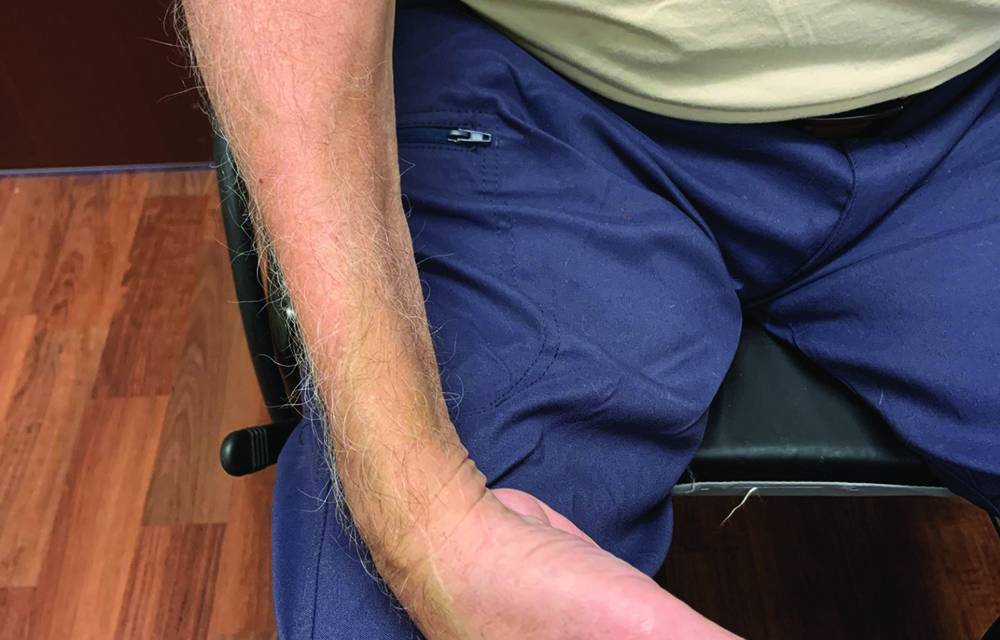
IBM typically presents in the early stages with finger flexion and knee extension weakness. The most commonly affected muscles are biceps, flexor digitorum profundus (Figure 1), and quadriceps, with greater involvement of the vastus medialis and lateralis compared with the rectus femoris. Muscles involved in shoulder abduction, hip flexion, hip adduction, and hip abduction are relatively spared. As the disease progresses, individuals may develop orbicularis oculi weakness, tibialis anterior weakness, and dysphagia. Handgrip weakness, difficulty buttoning shirts, knee buckling, and tripping are often reported. This particular pattern of muscle involvement differentiates IBM from other myopathies.

Figure 1. Forearm flexor atrophy.
Differential Diagnosis
Whereas the pattern of weakness described previously is suggestive of IBM, it is not unique to this disease and should raise a broad differential. A slowly progressive course with involvement of both proximal and distal muscles along with bulbar symptoms can be seen in inherited myopathies or muscular dystrophies, including limb-girdle muscular dystrophies, GNE myopathy, myofibrillar myopathies, VCP myopathy, adult-onset Pompe disease, and myotonic dystrophy types 1 and 2.5 Acquired myopathies should be considered as well, including inflammatory myopathies, amyloid myopathy, granulomatous myopathy, and drug-induced myopathies.5,6 Non–muscle-related disorders, including neuromuscular junction disorders, motor neuron disease, and mononeuropathy multiplex, must be excluded from consideration.
Diagnostic Criteria
The first formal diagnostic criteria for IBM were established in 1995 with the Griggs criteria, which encompassed both clinical and laboratory features and distinguished between definite and probable IBM based on the number of muscle pathology findings. A 2024 revision by the European Neuromuscular Center expanded on the Griggs criteria to include anti–cytosolic 5’-nucleotidase 1A (cN1A) autoantibodies and muscle imaging.7
Diagnostic criteria include both presentation characteristics and investigation findings (Table). Diagnosis of IBM is confirmed when the following criteria are met: a common presentation with finger flexor and knee extensor weakness along with a mandatory investigation finding; a common presentation with finger flexor or knee extensor weakness, a mandatory investigation finding, and a supportive investigation finding; or an uncommon presentation, a mandatory investigation finding, and 2 supportive investigation findings.

Diagnostic Workup
Muscle biopsy plays a central role in the diagnosis of IBM. Common biopsy targets include the quadriceps and biceps. Muscle pathology should demonstrate primary endomysial inflammation of non-necrotic muscle fibers (Figure 2).7 Immunohistochemical staining will show the presence of CD8+ T cells and increased major histocompatibility complex class 1 and 2 staining.7 Rimmed vacuoles and cytoplasmic aggregates are also hallmark features associated with IBM. However, this finding may be absent in as many as 20% of individuals;8 therefore, absence of rimmed vacuoles does not exclude the diagnosis of IBM. Another supportive histopathologic feature is the presence of mitochondrial dysfunction with cytochrome c oxidase–negative, succinate dehydrogenase–positive muscle fibers.9 There can be evidence of nonspecific findings, such as type 2 fiber atrophy, internalized nuclei, and variation in fiber size.

Figure 2. Muscle biopsy in inclusion body myositis. Hematoxylin & eosin stain shows primary endomysial inflammation surrounding and invading non-necrotic muscle fibers (A). Gomori trichrome stain shows red-rimmed vacuoles (B). Cytochrome oxidase–negative, succinate dehydrogenase–positive muscle fibers show mitochondrial dysfunction (C). CD8-positive T cells are visible in the muscle biopsy (D).(Images courtesy of the Northwestern University Neuromuscular Pathology Lab.)
The presence of primary endomysial inflammation of non-necrotic muscle fibers and typical clinical features—such as age at onset >45 years, a history of weakness >12 months, and a common pattern of weakness—are enough to make the diagnosis of IBM. However, in individuals with atypical presentation, serologic workup and muscle imaging are used to support the diagnosis.
Anti-cN1A antibodies, first identified in 2013 in association with IBM, have a sensitivity of ~50% and a specificity of ~90%.10 A positive test can be a helpful supportive finding in the diagnosis of IBM. However, anti-cN1A antibodies have also been identified in individuals with other immune-mediated or inflammatory diseases, such as lupus, systemic sclerosis, Sjögren syndrome, dermatomyositis, and antisynthetase syndrome.11,12 Other serologic workup includes serum creatine kinase (CK) levels, which are typically mildly elevated in individuals with IBM. Often, these values are <15 times the upper limit of normal.7
Muscle imaging with MRI or ultrasound can also be supportive of the diagnosis of IBM. Common findings include abnormalities in the distal quadriceps with involvement of the vastus lateralis and vastus medialis and relative sparing of the rectus femoris, gastrocnemius medial head, and deep finger flexors. Both imaging modalities demonstrate atrophy with pronounced fatty infiltration of affected muscles and can help identify appropriate targets for muscle biopsy.13
Electrodiagnostic evaluation is not required for diagnosis of IBM but can be used to help confirm the pattern of muscle involvement and rule out nonmyopathic mimics. EMG typically demonstrates mixed features of an irritable myopathy with superimposed neurogenic changes. This is characterized by early recruitment of small-amplitude, short-duration, and polyphasic motor unit action potentials; spontaneous activity; and a superimposed pattern of reduced recruitment of larger remodeled motor units.7 Nerve conduction study results are typically normal.
Prognosis
Individuals with IBM may have a mildly reduced life expectancy compared with the general population. Factors most often associated with increased mortality risk include dysphagia, leading to an increased risk of aspiration pneumonia, and respiratory involvement.14 Individuals also experience considerable morbidity due to weakness and limited mobility. Approximately half of individuals with IBM require a walking aid, such as a cane or walker, within 8 years of symptom onset, and a similar proportion progress to wheelchair dependence.15 Whether anti-cN1A antibodies correlate with disease severity or prognosis is unclear.16
Treatment
No clinical trial has demonstrated effective pharmacologic treatment of IBM. Current management focuses on supportive and symptomatic management through nonpharmacologic approaches. Individuals with IBM should be evaluated for weakness, dysphagia, and respiratory involvement; referred to physical and occupational therapy; and assessed for mobility aid requirements. Exercise is often encouraged, although there are no current guidelines on specific exercise regimens.17
Dysphagia is a common symptom of IBM and contributes greatly to morbidity and mortality. Individuals should be screened for dysphagia with swallow evaluations and referred to a speech-language pathologist when needed. Cricopharyngeal myotomy or dilation may be recommended in individuals with severe obstructive dysphagia due to a cricopharyngeal bar.18 Individuals should be screened regularly for signs of respiratory involvement with appropriate pulmonary function testing or a sleep study. They should also be referred to sleep medicine specialists and pulmonologists when appropriate.
Several therapeutic strategies have been studied in clinical trials and have been aimed at targeting inflammatory or degenerative pathways. Traditional immunosuppressants or immunomodulatory treatments, including steroids, intravenous immunoglobulin, azathioprine, and methotrexate, and biologics, such as interferon Β-1a, etanercept, Kineret (anakinra; Swedish Orphan Biovitrum AB, Waltham, MA), natalizumab, infliximab, and alemtuzumab, have shown no benefit to individuals on ≥1 immunomodulatory agents.5
Nonimmunomodulatory treatments have also been investigated, such as myostatin pathway inhibitors. Bimagrumab, an investigational myostatin receptor antagonist, was found to lead to an increase in muscle volume. However, this did not translate to functional improvement, and the study failed to meet its primary end point of an improvement in 6-minute walk distance.19
Oxandrolone and follistatin have likewise been studied for their theoretical effects on muscle synthesis, but neither demonstrated clinical efficacy.20,21 Miplyffa (arimoclomol; Acer Therapeutics, Newton, MA), a heat shock protein inducer, was studied for its potential to reduce toxic protein degradation pathways hypothesized to be involved in disease pathology. The trial failed to meet its primary functional end point of demonstrating a significant difference in IBM Functional Rating Scale Score at 20 months between the treatment and placebo groups.22
Clinical Trials
Ongoing clinical trials of sirolimus, ulviprubart, and rapamycin (ABC008; Abcuro, Newton, MA) for IBM have had promising results. Sirolimus is an immunosuppressant that binds to FKBP12 intracellularly. The resulting sirolimus–FKBP12 complex binds to and inhibits the mTOR complex. mTOR normally activates cell growth and proliferation pathways. By inhibiting this pathway, sirolimus inhibits the proliferation of cytotoxic CD8+ T cells while preserving regulatory T cells and inducing protein aggregate destruction.
Rapamycin vs Placebo for the Treatment of Inclusion Body Myositis (RAPAMI; NCT02481453), a phase 2b trial, showed statistically significant improvements in a number of secondary outcomes, including forced vital capacity, thigh fat fraction, 6-minute walk distance, and the Health Assessment Questionnaire without Disability Index.23 However, there was no improvement in the primary outcome of muscle strength.
The ongoing Phase 3 Trial of Sirolimus in IBM (NCT04789070) has a plan to enroll 140 participants and follow them over an 84-week period.24
Ulviprubart is an investigational monoclonal antibody targeting KLRG1+ cytotoxic CD8+ T cells. A phase 1, open-label study of 19 participants (A Phase 1 Study of ABC008 in Ascending [Single Ascending Dose/Multiple Ascending Dose] Study in Patients With IBM; NCT04659031) showed that the drug selectively depleted cytotoxic CD8+ T cells after a single dose while maintaining levels of regulatory T cells and B cells, without adverse events.25 A phase 2/3 trial has been completed, with initial results showing that the study did not achieve the primary end point in the change in IBM Functional Rating Scale. Additional subgroup analyses are still pending.
Conclusion
IBM is a rare muscle disorder characterized by slowly progressive muscle weakness, predominantly affecting the forearm flexors and knee extensors. Symptoms and examination findings can be subtle in the early stages, making recognition of clinical signs challenging, although essential. Diagnostic evaluation involves clinical examination, muscle biopsy, and supportive laboratory and imaging studies. Although no treatments exist, and previous clinical trials with traditional immunosuppressants have not shown any clear benefit, more targeted therapies are under investigation with results anticipated in the near future.
Ready to Claim Your Credits?
You have attempts to pass this post-test. Take your time and review carefully before submitting.
Good luck!
Recommended
 Neuromuscular
Generalized Myasthenia Gravis: Inside the MINT Trial and CD19 B-Cell Therapy Advances
Richard Nowak, MD, MSRichard Nowak, MD, MS