
Oculopharyngeal Muscular Dystrophy: Key Clinical Features, Genetic Diagnosis, and Management Strategies
Early identification of oculopharyngeal muscular dystrophy can streamline diagnosis and help address dysphagia-related morbidity, a major driver of quality of life.
Oculopharyngeal muscular dystrophy (OPMD) is a rare, late-onset myopathy characterized by progressive ptosis and dysphagia, variably progressing to proximal extremity weakness. Initial symptoms typically present in the fifth to sixth decades of life. Although rare, OPMD has a higher prevalence in specific populations, including individuals of French-Canadian descent. Before genetic characterization of OPMD in 1998, diagnosis relied on clinical findings, family history, and muscle histology demonstrating tubulofilamentous intranuclear inclusions. OPMD is usually inherited in an autosomal dominant pattern and is caused by a short trinucleotide repeat expansion in the PABPN1 gene. Although disease progression is slow and life expectancy is generally preserved, quality of life is often substantially affected by progressive dysphagia, which may lead to aspiration pneumonia and malnutrition.
Genetics of OPMD
Genetic testing establishes the diagnosis of OPMD in a proband with consistent phenotypic features and confirmatory molecular findings. OPMD results from expansion of alanine-encoding GCN trinucleotide repeats in exon 1 of the PABPN1 gene on chromosome 14.1,2 Less commonly, pathogenic point sequence variations in PABPN1 extending the polyalanine tract have been reported.3
Most cases follow an autosomal dominant inheritance pattern, with heterozygous expansion of the wild-type PABPN1 allele from the normal 10 GCN repeats to a pathogenic range of 11 to 18 GCN repeats.1,4,5 This sequence variation results in elongation of the N-terminal polyalanine domain of polyadenylate-binding nuclear protein 1 (PABPN1).6 Longer GCN repeat expansions have been associated with earlier symptom onset and more severe clinical manifestations.4,7
A small minority of individuals have autosomal recessive inheritance due to biallelic expansions, which can be either homozygous or compound heterozygous.2,8 These individuals typically present at an earlier age with more severe symptoms, and some have been reported to exhibit cognitive or psychiatric features.9,10
OPMD has been reported worldwide but has a higher prevalence in specific populations, including Bukhara Jews in Israel (1:600) and French-Canadian individuals (1:1000).2,5,11 Outside of these populations, prevalence estimates in Europe are ~1:100,000.2,5,12
Clinical Features
Individuals most commonly present with ptosis or dysphagia, followed variably by proximal extremity weakness.6,13 In a large French cohort, the initial symptom was ptosis in 41.2%, dysphagia in 32.2%, and ptosis and dysphagia in 9.1% of participants.13
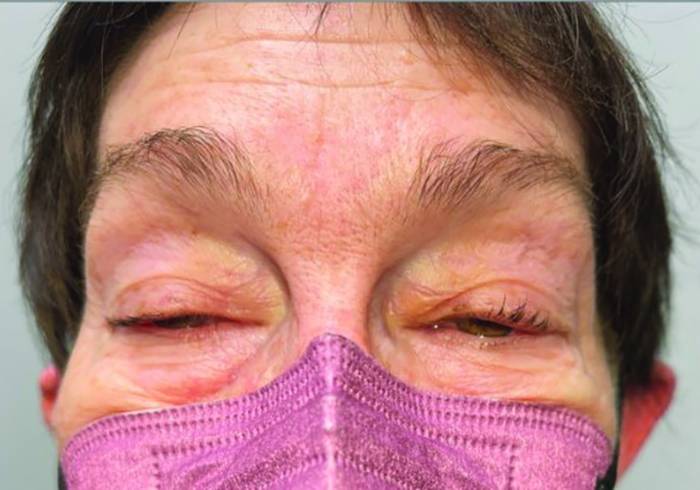
Bilateral ptosis due to levator palpebrae weakness is the most common presenting feature and may progress to involve extraocular muscles, occasionally causing diplopia6,7,13 (Figure). Individuals often compensate with frontalis muscle recruitment or neck extension, which may exacerbate dysphagia. In one cohort, 38% of individuals undergoing ptosis surgery required repeat corrective procedures.14 Although eye movement abnormalities can occur, complete external ophthalmoplegia is rare in OPMD.6,13,14

Figure. Severe bilateral ptosis in an individual with genetically confirmed oculopharyngeal muscular dystrophy. Weakness of the levator palpebrae muscles is typical and may lead to compensatory frontalis muscle recruitment.
Weakness of pharyngeal muscles leads to progressive dysphagia, initially affecting solid foods and later, liquids. The pathophysiology includes dystrophic and fibrotic changes in the pharyngeal musculature and the cricopharyngeus muscle, resulting in inefficient bolus propulsion and impaired upper esophageal sphincter opening.15,16 Videofluoroscopic studies consistently demonstrate pharyngeal residue, reduced swallow efficiency, and aspiration events, with airway compromise observed in a substantial proportion of individuals (Video).15 Although overall survival is not markedly reduced, dysphagia-related complications remain a leading cause of morbidity and mortality.6,13
Video. Videofluoroscopic recording in an individual with oculopharyngeal muscular dystrophy.
Proximal extremity weakness, which occurs more frequently in the lower extremities, was observed in 86.7% of participants in a cohort reported by Brisson et al.13 Weakness is typically symmetric and affects pelvic and scapular girdle muscles with distal involvement in later stages. Cardiac or smooth muscle involvement are not characteristic of OPMD. Declining mobility frequently necessitates assistive devices, which correlates with reduced quality of life.13,17
Additional features include dysphonia, facial weakness, chewing difficulty, tongue weakness, and pooling of secretions, often resulting in a characteristic “wet voice.”2,13 Fatigue is a common complaint, which has been postulated to be a predictor of functional decline.13
Symptom onset typically occurs in the fifth to sixth decade of life, and rarely before age 40 years or after age 70 years.13 Symptoms are typically slowly progressive, with a median interval of 3 to 7 years between onset and development of the next symptom.13
The diagnosis is often delayed due to insidious onset, phenotypic heterogeneity, and disease rarity. Key overlapping and distinguishing features of conditions included in the differential diagnosis of OPMD, as well as the recommended diagnostic workup, are presented in the Table.

Diagnostic Testing
OPMD should be suspected in individuals with adult-onset ptosis or dysphagia and a positive family history. Diagnostic criteria include reduced palpebral fissure height (<8 mm) or previous ptosis surgery and delayed swallowing time on standardized liquid bolus testing.6
Molecular confirmation is achieved through targeted PABPN1 testing, including polymerase chain reaction fragment analysis, Sanger sequencing, or next-generation sequencing to quantify GCN repeat expansions.2 In atypical cases, multigene panels or exome sequencing may be considered.
Muscle biopsy is now rarely required but may be useful if genetic testing results are inconclusive. Characteristic findings include PABPN1-positive tubulofilamentous intranuclear inclusions composed of ~8.5-nm–outer diameter filaments on electron microscopy, which are highly specific for OPMD.18,19 Nonspecific pathologic findings include loss and variation in size of muscle fibers, small angulated fibers, and rimmed vacuoles.19
Creatine kinase levels are typically normal to mildly elevated, with a median level of 300 U/L.4 Muscle MRI frequently demonstrates fatty replacement, particularly involving the tongue, adductor magnus, and soleus muscles, correlating with disease severity.20 MRI showed fatty replacement of muscles in 96.7% of 168 symptomatic participants in a large cohort.20
EMG may reveal myopathic changes in affected muscles.
Management
Management is symptomatic and multidisciplinary, with an emphasis on ptosis and dysphagia. Ptosis surgery is considered when ptosis impairs vision or causes severe neck pain due to compensatory hyperextension of the neck. For milder ptosis with good to fair levator function, levator resection or advancement is generally performed, whereas a frontalis sling procedure is preferred for individuals with poor levator function and palpebral fissure height <8 mm.19,22 The frontalis sling procedure offers more permanent results but requires general anesthesia; individuals who undergo levator resection or advancement typically require revision surgery as the ptosis progresses.19,22 Important clinical considerations include poor orbicularis function, ophthalmoplegia, dry eyes, or a history of glaucoma-filtering or corneal procedures.22
Dysphagia management includes dietary modification, swallow therapy, and periodic assessment. Interventions targeting the upper esophageal sphincter such as cricopharyngeal myotomy, dilation, or botulinum toxin injection may provide temporary benefit for severe dysphagia, although symptoms often recur.15 Botulinum toxin injection has demonstrated symptomatic improvement but carries risks of dysphonia and worsened swallowing.23 Aspiration pneumonia remains a major cause of morbidity and mortality.
Annual neuromuscular assessment, physical and occupational therapy, and timely provision of assistive devices are recommended.
Investigational therapies include gene therapies, autologous myoblast transplantation into pharyngeal muscles, and pharmacologic therapies to inhibit myostatin to reduce muscle atrophy or reduce PABPN1 aggregates.5 A phase 1b/2a trial (A Phase 1b/2a, Openlabel, Dose Escalation Study to Evaluate the Safety and Clinical Activity of Intramuscular Doses of BB301 Administered to Subjects With Oculopharyngeal Muscular Dystrophy With Dysphagia; NCT06185673) is underway with BB-301, an adeno-associated virus–mediated gene therapy that uses a “silence-and-replace” approach to the PABPN1 gene.2,24,25
Conclusion
The diagnosis of OPMD may be complicated by its rarity, insidious onset, and clinical heterogeneity. Clues to the diagnosis, such as a positive family history, progressive ptosis, and dysphagia, with variable accompaniment by more proximal extremity weakness, should prompt genetic evaluation for characteristic GCN expansions in the PABPN1 allele. Muscle biopsy can support the diagnosis if genetic testing is inconclusive. Despite advances in diagnosis, management remains largely supportive. Dysphagia remains one of the major determinants of quality of life and morbidity. Ongoing investigations into potential disease-modifying therapies are underway, and may inform future treatment strategies for OPMD.
The authors thank Dr. Jaydeep M. Bhatt and Dr. Mary-Lynn Y. Chu for assistance in identifying the individuals with oculopharyngeal muscular dystrophy (OPMD) featured in the Figure and Video, respectively. A special thank you to Dr. Stratos Achlatis for providing the video-fluoroscopic recording in an individual with OPMD for the Video.
Ready to Claim Your Credits?
You have attempts to pass this post-test. Take your time and review carefully before submitting.
Good luck!
Recommended
 Neuromuscular
Generalized Myasthenia Gravis: Inside the MINT Trial and CD19 B-Cell Therapy Advances
Richard Nowak, MD, MSRichard Nowak, MD, MS