
What Are Migraine Diaries Really Measuring and Why Does It Matter?
Migraine diaries can help guide diagnosis and treatment decisions, but their clinical value depends on capturing outcomes that reflect the patient's experience and inform care.
KEY TAKEAWAYS
- Migraine diaries can reduce reliance on recall, but commonly tracked measures such as headache frequency may not capture disability, symptom burden, or the outcomes patients value most.
- The most useful migraine diary depends on the clinical decision being made, whether the goal is diagnosis, preventive treatment assessment, acute treatment evaluation, or recognition of prodromal symptoms.
- Digital migraine tracking can generate increasingly detailed data, but more information does not necessarily translate into more meaningful or patient-centered measurement.
Who got better?
A patient returns to their neurologist after starting a new preventive migraine treatment. Their diary shows some improvement, with the number of monthly headache days decreasing from 12 to 8 since starting the new medication. The patient still avoids travel, often cancels social plans, and worries about attacks interrupting their work. Meanwhile, another patient’s monthly headache days do not change at all after a medication change, but their attacks are shorter and less severe, their acute medication works better, and they feel more in control of their life.
So, which patient improved? In migraine care, the answer to that question often depends on what was measured and patient preference.
Migraine is a longitudinal disease that is most often evaluated during episodic clinical encounters, when attacks are rarely present. Instead, the clinician and patient must reconstruct weeks or months of symptoms and data, including headache days, migraine days, medication use, attack duration, pain severity, disability, treatment response, and the ability to function between attacks, among other details. The headache diary seems like a relatively simple solution to that problem. However, as diaries have evolved from paper calendars to electronic apps integrating everyday language, clinical end points, and predictive algorithms, the old question "How many migraine days did you have?” has become much larger in scope with regard to everyday use. The central questions are now twofold: “what are migraine diaries measuring, and why does that matter?”
At the 2026 American Headache Society meeting in Orlando, FL, a central focus was the future of migraine measurement. Sessions and abstracts pointed toward more frequent, granular, and digital measurement, including digital biomarkers, patient-reported outcome measures, and predictive models of next-day attacks, including Goadsby and colleagues’ analysis of machine-learning data from 53,000 app users.1 A plenary session on digital biomarkers described ecological momentary assessment, actigraphy-based measurement, continuous glucose monitoring, light exposure, and digital symptom tracking.2
The field is clearly moving beyond the paper calendar, but the problem remains the same: more data do not automatically translate into better measurement.
Recall vs Reliable Measurement
The need for diaries stems from a basic sampling problem: patients are asked to summarize symptoms that often fluctuate substantially, relying on their memory. While still clinically useful, these reports are imprecise and subject to recall bias. Chronic migraine is defined as headache on ≥15 days per month for ≥3 months, with migraine features on ≥8 days per month.3
To address the limitations of recall-based headache diagnosis and classification, diaries became a standard tool, but their widespread use warrants scrutiny. Although imperfect instruments, they offer a practical solution to a real measurement problem.

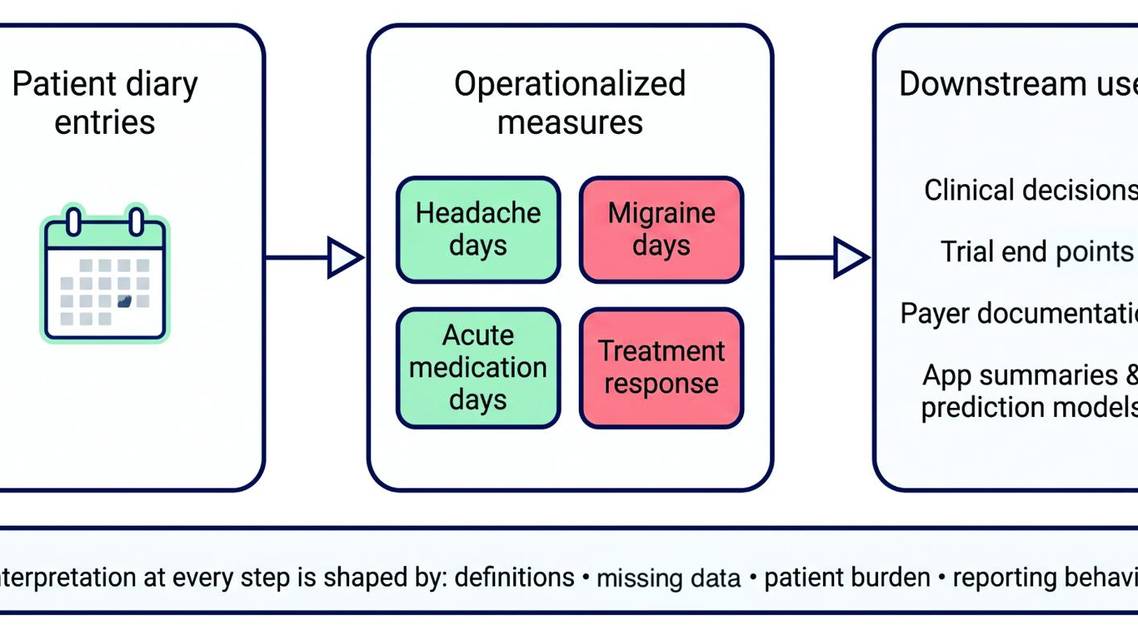
Figure. From diary entry to clinical inference. A diary entry can inform multiple measures and applications including headache days, migraine days, acute medication days, treatment-response measures, trial end points, payer documentation, app summaries, and prediction-model labels. At each stage, definitions, missing data, patient burden, and reporting behavior can affect interpretation.
A 2006 review described prospective headache diaries and calendars as useful for recording each attack, acute medication use, time patterns, aggravating factors, and response to preventive treatment, with the important advantage of reducing reliance on retrospective recall.4 A structured migraine diary study put the same point into the language of the clinic: among 97 participants and 22 physicians, 72% of participants reported that the diary helped them communicate with their doctor about migraine, 70% of participants were more satisfied with their overall medical care, and 91% of physicians said the diary helped them communicate better with patients.5 More recent e-diary data make the recall problem more difficult to dismiss. In a study from Leiden of 484 participants with migraine, retrospective estimates differed from diary-derived measures by a mean absolute difference of 4.7 migraine days per month, 6.2 nonmigrainous headache days per month, and 4.3 acute medication days per month.6 Therefore, the argument for diaries is not just that they create more data; it is that they make the disease observable in a way the clinic visit usually cannot. The figure illustrates how diary entries are translated into clinical measures and downstream applications, and how definitions, missing data, patient burden, and reporting behavior can affect interpretation. Once those observations are used to diagnose chronic migraine, monitor medication overuse, measure treatment response, and decide whether a patient “got better,” the next question becomes what exactly those observations are capturing.
Crystal Jicha, MD, a headache specialist at the University of California, Irvine, was asked to define characteristics of a good diary when brought in by a patient. She noted that it often gives the clinician information that memory struggles to hold onto, particularly “a good sense of headache and migraine frequency.” For patients receiving onabotulinumtoxinA, for example, a diary might show that daily headaches only recurred in the final weeks of their treatment cycle, the so-called “wear off” period. “Sometimes the diary is really the only way to accurately reflect that,” according to Jicha.
What Counts as a Migraine Day?
Diaries can help turn lived symptoms into labels, which sounds simple until a patient treats their migraine early, has aura with little or no pain, wakes with symptoms that started overnight, or has a brief attack on an otherwise normal day. In those cases, a “migraine day” is not something observed by a clinician so much as it is a category created by the questions asked and a decided-upon threshold.
A 2023 study published in Cephalalgia makes that explicit, as the authors defined migraine days on the basis of headache duration, migraine characteristics or associated symptoms, aura, and acute migraine-specific medication use.7 Those choices matter because the resulting count may end up becoming a clinical trial end point, treatment–response threshold, quality metric, or reimbursement record for insurers. A systematic review of preventive migraine trials found heterogeneity in both outcomes and end point definitions across studies.8
Jicha noted that diaries often capture frequency better than severity or the most bothersome symptoms. Therefore, when diary data and the patient's reported experience disagree, the diary might not be wrong but could be answering a narrower question. Diaries can help recount selected features of migraine, but not the entire burden of the disease.
When Frequency Misses Burden
Monthly migraine days will always be an important measure, but are insufficient for patient-centered care. According to insights provided by Jicha, when a patient reports no improvement despite fewer headache days, the next step is to ask what did not improve. Sometimes, she said, “the severity is more even though they are less frequent, and that is more impactful for functioning.” Routine diaries often miss nausea, photophobia, phonophobia, and other symptoms that may be “just as debilitating, if not more so, than the pain itself.”
Outcomes research seems to reflect the same mismatch. The Activity Impairment in Migraine Diary was developed to capture migraine-related activity impairment9; the Migraine Clinical Outcome Assessment System (MiCOAS) qualitative study described symptoms across pre-headache, headache, post-headache, and interictal phases10; and a 2026 analysis of the 4-item Migraine Interictal Burden Scale found that interictal burden is related to, but not completely reducible to, other patient-reported outcomes.11
One Diary Cannot Serve Every Situation
Elizabeth K. Seng, PhD, a researcher whose work has brought migraine diaries to the forefront of research, noted in a conversation with the authors that the problem goes beyond diaries being incomplete most of the time. Different users are using the same tools for different ends. “The needs of researchers are entirely different from the needs of clinicians, which are entirely different from the needs of the patients,” she said.
Researchers want ever denser data, whereas clinicians want information that helps them manage care of specific patients. Patients need a tool they are able to complete while in pain, nauseated, sensitive to light, experiencing brain fog, or exhausted. In her work developing Veterans Affairs diary dashboards, Seng noted that a key insight was that headache days alone were not enough, with clinicians needing headache patterns in relation to medication use and treatment changes. That distinction explains why a “stoplight diary” can be both patient-friendly and clinically inadequate at the same time. If green, yellow, and red days are not linked to any treatment context, the clinician might not know what the next move should be for that specific patient.
The Diary Should Match the Decision
The practical question then becomes what should be included in the diary to support clinical decision-making. The Table summarizes the minimum diary elements needed to address common clinical questions, the potential impact on management, and reasons to reconsider continued tracking. For a simple diagnosis, data on headache days, migraine days, duration of attacks, and acute medication days may be enough. For treatment response, medication timing, how well the medication worked, and relevant treatment changes are important data. A disability or quality of life measure might be more useful than daily symptom tracking alone. Seng tells her patients to “use a diary when you’re surprised”: when a treatment should have worked but did not, the patient should track what could be interfering with the medication's effectiveness.

This is especially relevant for acute treatments. Jicha increasingly asks patients about prodromal symptoms because recognizing yawning, fatigue, photophobia, phonophobia, nausea, and other early warning signs can influence treatment patterns. That point now has some support from a clinical trial, with an exploratory analysis from the randomized phase 3 Study to Evaluate Oral Ubrogepant in the Acute Treatment of Migraine During the Prodrome in Adult Participants (UBR PRODROME; NCT04492020) evaluating ubrogepant for treatment of migraine prodromal symptoms.12 For migraine, Seng said, “patients are their own provider.” Prescriptions are written in the clinic, but in the real world patients decide whether a symptom is migraine, whether or not to treat, and how long to wait. In that context, the more useful diary question might not be “How bad was your pain?” but “What symptom made you treat and when?”
Differences in the way patients and physicians use terminology in diaries can also lead to miscommunication. Seng described a patient who reported using a gepant at the “first sign” of migraine. Seng understood “first sign” as the onset of pain, but the patient, who had not experienced pain in a year, was using treatment at the onset of cognitive symptoms—their most disabling migraine symptom. A field labeled “onset” is useful only when the patient and physician use this term the same way.
There is also a time not to measure. Jicha does not encourage patients with stable symptoms who feel they are doing well to track their migraines indefinitely because this can lead to hyperfixation on symptoms. Seng made a similar point for patients with comorbid generalized anxiety disorder, for whom self-monitoring can worsen anxiety and rumination. Such patients might still monitor a more controllable behavior, such as whether medication was taken early, but per Seng, “what they should be tracking is the thing you want them doing.”
Conclusion
Migraine diaries are useful when they make selected features of a fluctuating disease more visible for clinicians. They help classify migraine correctly, monitor treatment response, understand acute medication use, and identify the patterns that memory might not catch. Digital tools might improve the ability to prompt at random times, increase convenience, and produce denser data, but they do not solve the measurement problem on their own. In a randomized clinical trial, a prescribed migraine digital health app did not outperform a control app with basic headache documentation for reducing migraine days.13
These effects are unlikely to be uniform in the migraine population. Seng noted that some patients in diary studies literally could not see electronic diaries due to visual disturbances during attacks, and some patients in pain clicked through questions randomly just to submit them. For general neurologists, the best diary is the one that measures the clinical question with the least burden. As Jicha states, “the most useful diary is the one the patient will actually complete.”
| Clinical question | Minimum useful diary elements | Potential impact on management | Reasons to reconsider diary use |
|---|---|---|---|
| Diagnosis and classification | Headache days, migraine-feature days, duration, acute medication days | Classification as episodic or chronic migraine; medication overuse assessment | Entries are too inconsistent for classification |
| Preventive treatment response | Headache/migraine days, severity, disability, treatment start/stop dates | Continue, adjust, or switch preventive treatment | Symptoms are stable and tracking increases vigilance or distress |
| Acute treatment response | Time of first symptom, medication used, time medication taken, time to relief | Earlier treatment, different acute therapy, rescue planning | Documentation does not alter the acute treatment plan |
| Prodrome recognition | Early warning symptoms, treatment timing, whether attack followed | Patient education; pre-pain treatment strategy | Symptom monitoring worsens anxiety |
| Patient-centered burden | Activity impairment, most bothersome symptoms, interictal avoidance | Add disability measure, address residual burden | Diary captures frequency but omits functional impact |
Ready to Claim Your Credits?
You have attempts to pass this post-test. Take your time and review carefully before submitting.
Good luck!
Recommended
 Headache & Pain
What's New in Migraine Prevention? Understanding the 2026 AAN/AHS Guidelines
Andrew Blumenfeld, MDAndrew Blumenfeld, MD- Headache & Pain
Navigating Medicolegal Needs in Headache Medicine: Section 504, FMLA, and SSDI/SSI
Nina Riggins, MD, PhD; Lorenzo Paris, JDNina Riggins, MD, PhD; Lorenzo Paris, JD - Headache & Pain
Effective Communication Strategies for Managing Migraine Care Challenges
Anthony Yan, MD; Kelly Nicol, DOAnthony Yan, MD; Kelly Nicol, DO