
Functional Neurologic Disorder in Headache Medicine: Diagnosis, Management, and Multidisciplinary Care
Functional neurologic disorder and migraine frequently overlap, share common triggers, and can exacerbate one another.
KEY TAKEAWAYS
- Migraine-related symptoms can complicate recognition of coexisting functional neurologic disorder.
- Treating migraine may help reduce the burden of co-occurring FND symptoms.
- Multidisciplinary care integrating neurology, rehabilitation, and mental health services may improve outcomes.
Headache and symptoms related to functional neurologic disorder (FND) are the 2 most common reasons for neurology consultation.1 FND is defined by uncharacterized neurologic symptoms affecting motor skills or cognitive function, typically thought to be associated with nervous system dysregulation1 or neuropsychiatric comorbidities;2 emerging data indicate that structural abnormalities may also be involved.3,4 Both migraine—the most prevalent headache disorder for which individuals seek neurologic care5—and FND have historically been framed as women’s “hysterical attacks.”1 In the early 20th century, Pierre Briquet and Sigmund Freud described headache and migraine in women with “hysteria,” and Joseph Babinski reported ophthalmic changes caused by migraine triggering FND symptoms, including eyelid movement.1
More recent literature has explored overlapping comorbidities and mechanisms between headache disorders like migraine and FND in relation to attention, sensory and emotional processing, dissociation, and more, as determined by neuroimaging, neurophysiology, and experimental psychology.1 Narrowing the gap in the literature through investigation of shared mechanisms may provide meaningful insights for the development of more effective diagnostic strategies and treatment interventions. A more thorough understanding of the relationship between FND and migraine can allow for comprehensive patient care, improved patient outcomes, and enhanced quality of life.
Functional Neurologic Disorder
FND can comprise myriad neurologic symptoms resembling epilepsy, multiple sclerosis, movement disorders, stroke, or other neurologic disorders;1 however, there are clear diagnostic criteria for FND in the Diagnostic and Statistical Manual of Mental Disorders, 5th Edition, Text Revision (Table).6

Common Presentations
Understanding the multiple presentations of FND is a crucial step in the diagnostic process. Common FND presentations7 include functional seizures, motor symptoms (eg, abnormal movement, tremor, gait disorder), sensory loss, or mixed presentations.7,8 A history with description of the symptoms and an appropriate workup is essential to distinguish these neuropsychiatric FND presentations from neurologic conditions. For example, differentiating epilepsy from psychogenic nonepileptic seizures, the latter of which can present with features such as altered consciousness and involuntary limb and hip movements as well as forced eye closure or resistance to eye opening on exam.8 Likewise, neurogenic weakness may be distinguished from FND paralysis, with the latter having Hoover sign, co-contraction sign, sternocleidomastoid test, or collapsing weakness test found in motor FND.8
Headache Medicine
More than 300 different types of headache disorders and causes have been identified, with tension-type headache, migraine, and cluster headache reported as the most common primary headache disorders.9 People with migraine, which affects >47 million Americans, are more likely to seek medical attention than individuals with other headache disorders.1,10
Migraine is a disabling condition and is comorbid with various psychiatric conditions.11 Migraine-related disability increases when migraine coexists with psychiatric comorbidities,12 affecting both direct and indirect costs11 and leading to greater public health burden.11,12 For example, depression is closely linked to migraine, with migraine and depression each increasing the risk of the other; the risk of anxiety is also increased in migraineurs due to fear of a migraine occurring.11
Bipolar disorder, social phobia, and panic disorder are also more common in individuals with migraine, resulting in a lower quality of life than that of an individual with solely migraine or a psychiatric condition.11 Sleep disorders are more common in people with migraine, with migraineurs reporting poorer sleep quality as determined by the Pittsburgh Sleep Quality Index scale; people with poorer sleep quality also reported an increase in anxiety and depression.13 Suicidal ideation and migraine have been found to be correlated, even when comorbid depression is treated.14 The overlap between migraine and various psychiatric conditions has been well-established.
Overlap Between Functional Neurologic Disorder and Headache Disorders
Research on the overlap among FND, migraine, and other headache disorders has been increasing. Migraine and FND are each associated with a higher prevalence of adverse life experiences,15 prompting the inclusion of a developmental and psychosocial history during the clinical examination. Migraine episodes can trigger FND by worsening symptoms such as functional seizures, and these episodes may lead to greater functional impairment.8,16 In addition, people with functional seizures report more headache days compared with individuals with epilepsy who experience epileptic seizures.17 A study conducted in the United Kingdom noted that functional seizures occurred more regularly in individuals with migraine and comorbid FND than in individuals with migraine alone, reflecting how migraine can exacerbate FND symptoms.1,16
Individuals who experience functional seizures and migraine report more intense headache episodes and increased frequency of migraine with aura than individuals with migraine without aura.16 Research has also shown that individuals who experience functional seizures shortly after migraine attacks experience more symptoms, including numbness, paralysis, gait instability, brain fog, decreased awareness, and vestibular symptoms, compared with those who do not experience both functional seizures and migraine attacks.16
Multidisciplinary Care
The Multidisciplinary Care Team
After the neurologist diagnoses FND based on the history, examination, and clinical workup (eg, neuroimaging, EEG, EMG, nerve conduction studies), treatment should be provided by a well-coordinated and specialized care team.18,19 In the management of FND and migraine, an optimized team should include neurologists and mental health clinicians (eg, psychiatrists, psychologists), as well as rehabilitation specialists (eg, physical, speech, occupational), for treatment with a strong emphasis on patient education.20 A team-based approach can help design tailored care plans that address individuals’ unique symptoms.18,21-23 These plans should feature regular follow-up visits to monitor for symptom changes or progression.3,18
Addressing migraine under a neurologist’s guidance can also benefit individuals, as migraine treatment may also alleviate FND symptoms.1 Migraine treatment may include pharmacologic or nonpharmacologic interventions and lifestyle modifications.1 Psychotherapeutic interventions include cognitive behavioral therapy (CBT) for headache, which has Grade A evidence for migraine prevention.24 In CBT, individuals learn behavioral techniques to reduce stress and modify maladaptive thought patterns.25 CBT has been shown to reduce migraine recurrence and severity, decrease headache frequency, and improve Migraine Disability Assessment (MIDAS) scores.26 Acceptance and commitment therapy (ACT) emphasizes acceptance and valued living rather than avoidance techniques and has been used for individuals with primary headaches and migraines with improvements in disability, quality of life, and functional status.26a
Psychotherapy, including CBT, has also been used for FND treatment,19,27-30 including self-help CBT for FND31 and seizure-specific CBT.32 The multimodality, time-limited, whole-person, manualized therapy,33 neurobehavioral therapy, has been shown in clinical trials to reduce functional seizures, functional cognitive symptoms, and functional movement disorder, while improving quality of life and comorbid conditions.34,35 Mindfulness-based therapies have also been used to treat both migraine and FND, and hold promise for improving quality of life and reducing symptom severity.19,36,37 The American Academy of Neurology Guidelines Subcommittee recently published guidelines on management of functional seizures,38 recommending CBT for seizures, neurobehavioral therapy, and mindfulness as treatments for functional seizures.
As part of a multidisciplinary team, mental health clinicians can assess for psychosocial contributors that may exacerbate the disorder, such as psychiatric comorbidities and personality traits (eg, emotional dysregulation).39 Physical and occupational therapy that targets FND-related motor deficits such as tremors, gait instability, and impaired motor skills can be equally vital.40 Establishing a multidisciplinary care team to address the different facets of migraine and comorbid FND can provide a robust and effective care plan. Furthermore, equipping individuals with comprehensive understanding of their treatment options empowers them to take ownership of their care and confidently make informed decisions. The multidisciplinary care team with multiple interventions may enhance individuals’ ability to cope with FND symptoms.39
Patient Education
Patient education should be prioritized in the treatment plan, as it promotes autonomy in health care decision-making and can enhance their engagement, confidence, and adherence to treatment. For people with migraine who also experience FND-related symptoms, understanding the overlap between these conditions can be informative; many individuals may not realize that migraine attacks can directly trigger FND symptoms or exacerbate their severity. By equipping patients with knowledge, health care professionals can help them recognize patterns, anticipate triggers, and actively participate in their own symptom management.40,41 Furthermore, patient education can inform the confusion, self-doubt, and stigma that often accompany misunderstood neurologic symptoms.40 When individuals know that their experiences are real, valid, and explainable, they may be less likely to internalize dismissive attitudes or feel isolated.40 Strong patient education is linked to improved treatment success, better health care outcomes, and greater overall well-being for people navigating migraine and comorbid FND.40
Best Practices for Management
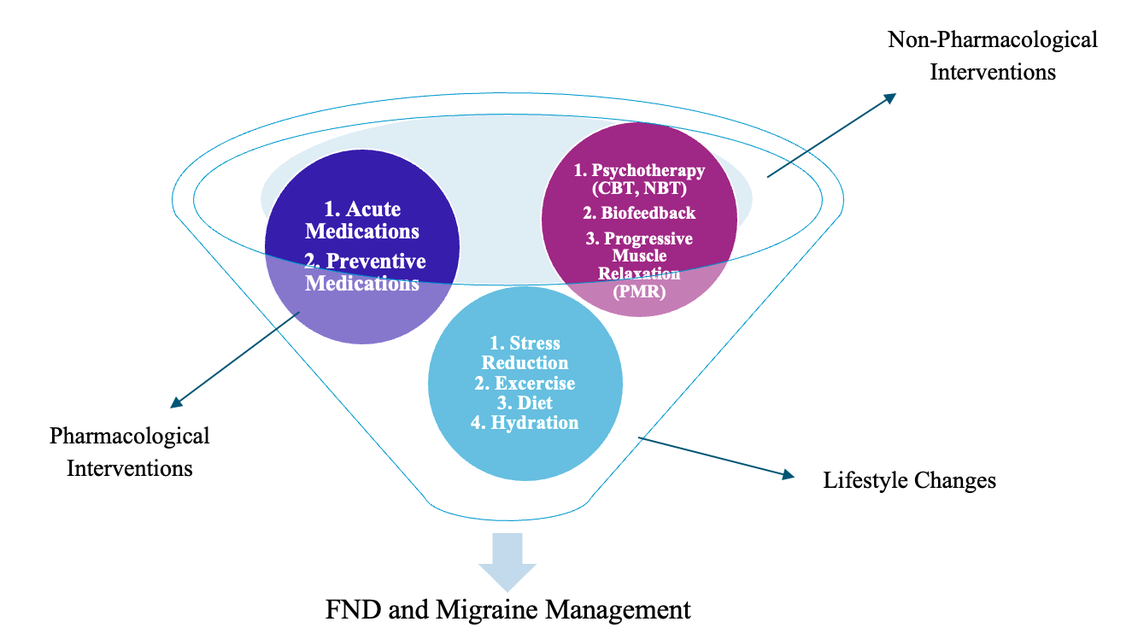
Accurate diagnosis and treatment plans are imperative to avoid unnecessary interventions, ineffective treatments, and delays in managing the functional disorder.42 A comprehensive neuropsychiatric evaluation can be performed to address the neurologic, psychiatric, and developmental history, along with conducting a neurologic, psychiatric, and cognitive examination. FND symptoms triggered by migraine can be managed in multiple ways, as noted previously. The Figure shows examples of possible interventions and how they work together to manage migraine and comorbid FND.

Figure. Management options for co-occurring FND and migraine. A combination of these options is ideal for FND and migraine management.
Abbreviations: CBT, cognitive behavioral therapy; FND, functional neurologic disorder; NBT, neurobehavioral therapy.
Conclusion
FND and migraine frequently overlap, share common triggers, and may exacerbate one another. Migraine can trigger FND symptoms, which contribute to physical and emotional distress and negatively affect quality of life. Understanding this correlation and potential mechanistic similarities between these complex neuropsychiatric conditions, and approaches to accurate diagnosis can have a profound impact on patient care. When possible, multidisciplinary teams may best serve patients by tailoring care based on clinical guidelines. Future research should continue to explore the optimal treatment plan for patients with headache disorders or FND.
Ready to Claim Your Credits?
You have attempts to pass this post-test. Take your time and review carefully before submitting.
Good luck!
Recommended
 Headache & Pain
Cluster Headache Advocacy: The Role and Impact of Patient-Led Organizations
Derek Pyland; Anna WilliamsDerek Pyland; Anna Williams