
Navigating Medicolegal Needs in Headache Medicine: Section 504, FMLA, and SSDI/SSI
Headache specialists play a key role in helping patients secure the accommodations and benefits to which they are entitled; accurate, thorough evaluation and documentation are the foundation of successful claims under applicable legal frameworks.
KEY TAKEAWAYS
- Federal protections increasingly recognize migraine-related disability in educational, workplace, and benefits settings.
- Section 504, FMLA, and SSDI/SSI underscore the importance of clear clinical documentation and functional assessment.
- Neurologists are key advocates in navigating the medicolegal challenges for patients with disabling headache disorders.
Migraine affects ~10% of school-aged children, with prevalence increasing in adolescence.1,2 The burden of migraine in adults is well-documented: ~48 million Americans have migraine headaches, and 20% of those with chronic migraine consider themselves occupationally disabled.3,4
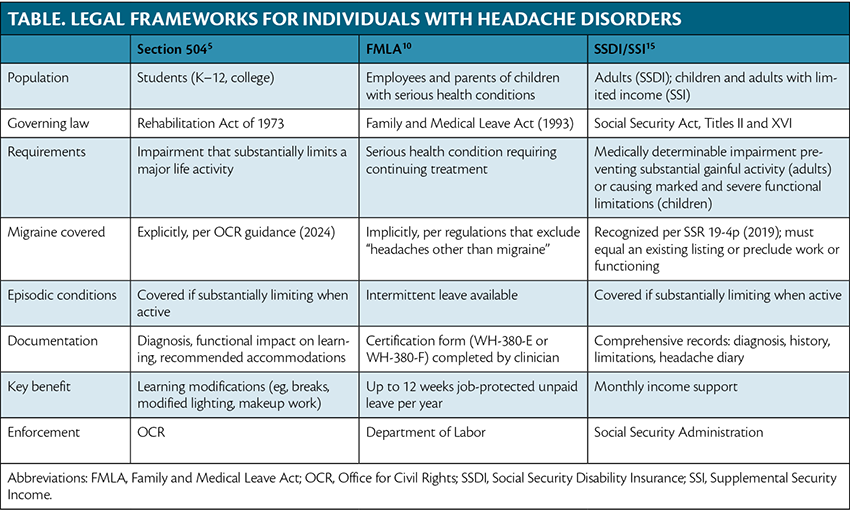
The courts are increasingly recognizing migraine as a legitimate medical condition worthy of legal protection.4 Section 504 of the Rehabilitation Act protects students in federally funded schools; the Family and Medical Leave Act (FMLA) and Social Security Disability Insurance (SSDI)/Supplemental Security Income (SSI) provide additional protections and benefits to address the needs of children and adolescents with headache disorders. The Table summarizes these legal frameworks (Section 504, FMLA, and SSDI/SSD) and their relevance to people with migraine.

For the practicing neurologist, understanding legal aspects of migraine for both adults and children is not purely academic. Clinicians are often asked to complete certification forms, write letters supporting accommodation requests, and provide documentation for disability applications. The quality of that documentation often determines whether individuals receive the protections and benefits they need.
Section 504: Protection for Students With Headache Disorders
Under Section 504 of the Rehabilitation Act of 1973, individuals with disabilities are protected from discrimination in programs or activities receiving federal financial assistance.5 Because virtually all public schools receive federal funding, Section 504 applies broadly to K–12 schools, colleges, and universities. Section 504 was the first federal civil rights law protecting people with disabilities. The Americans with Disabilities Act (ADA) of 1990 built on Section 504 and extended protections to the private sector.6
The standards for determining disability under Section 504 and the ADA are aligned.6,7 In both, a disability is defined as a physical or mental impairment that substantially limits ≥1 major life activities. According to the ADA Amendments Act of 2008, “substantially limits” must be construed broadly; an impairment need not prevent a major life activity to qualify.7,8
A student with a disability is entitled to reasonable accommodations to access educational opportunities. Key for headache disorders, an impairment that is episodic or in remission qualifies as a disability if it would substantially limit a major life activity when active. This provision directly addresses the attack-based nature of migraine.7,8
Office for Civil Rights Guidance
In December 2024, the Office for Civil Rights (OCR) issued a fact sheet specifically addressing migraine under Section 504.8 This federal guidance document, dedicated to headache disorders in the educational context, confirms that migraine can substantially impair function.
The OCR guidance document recognizes that migraine diagnosis is primarily clinical; that is, a clinician’s diagnosis based on history and examination is sufficient to establish disability.8
Modifications Under Section 504
Under Section 504, schools may be required to modify the learning environment, policies, or instructional delivery to accommodate students with disabilities.7 Examples include using nonfluorescent lighting and removing artificial air fresheners; providing alternative material formats, such as audio textbooks; granting periodic distance learning when symptoms intensify; allowing makeup work without penalty for migraine-related absences; providing rest breaks and extended time during examinations; and permitting access to water, snacks, dark or quiet spaces, and medication as needed.8 The guidance also addresses disability-based harassment. Schools must respond to bullying targeted at students because of their medical condition.8
The Clinician’s Role
For students seeking Section 504 modifications, clinicians should provide documentation that establishes migraine diagnosis, describes how migraine affects the student’s functioning in school, and recommends specific modifications. Section 504 modification plans can often be established with proper medical documentation. The December 2024 guidance document explicitly recognizing migraine as a potentially disabling condition should make accommodations recommended by clinicians more accessible to students. (In disability law, “modifications” and “accommodations” have distinct meanings. Modifications alter what is taught or the standards applied; accommodations change how instruction is delivered without changing expectations. Section 504 uses “modifications” to encompass both concepts. In workplace disability contexts, “reasonable accommodations” is the standard term under the ADA.)
Role of Parents
For students who are minors, the modifications to Section 504 covering migraine make it clear that a Section 504 accommodation request is a parent-driven process. Under Section 504, students and their parents have explicit rights, including how long a school has before needing to respond when a formal accommodation request is made. A Section 504 plan does not include federal funding for a case manager, so it is incumbent on parents to ensure the plan is followed. Clinicians should be prepared to work with parents and assist with the development and implementation of the plan.
The American Migraine Foundation has resources available to parents who are shepherding their minor children through the Section 504 accommodation process and individualized education program plans.9
FMLA: Job-Protected Leave
The FMLA provides eligible employees with up to 12 weeks of job-protected, unpaid leave per year for qualifying reasons, including the employee’s own serious health condition or the need to care for a family member with a serious health condition. FMLA applies to employers with ≥50 employees and to employees who have worked at least 1250 hours in the preceding 12 months.10
The Code of Federal Regulations states that “headaches other than migraine” do not meet the definition of serious health condition under FMLA,11 implying that migraine does. Case law supports this interpretation.4,12
Intermittent Leave
For individuals with migraine, intermittent FMLA leave is often more appropriate than continuous leave. The unpredictability of attacks means employees may need to leave work suddenly or miss partial days. FMLA explicitly permits intermittent leave when medically necessary for a chronic serious health condition.
The FMLA certification form (WH-380-E) inquires whether the condition will cause “episodic flare-ups” that would periodically prevent the employee from performing job functions. For migraine, the answer is often yes. Clinicians completing this form should estimate the frequency and duration of episodes and the number of days per month the employee may need leave.13
Caring for a Child With Migraine
FMLA also protects employees who need leave to care for a child with a serious health condition. A parent of a child with disabling migraine may take FMLA leave to attend medical appointments, care for the child during attacks, or manage treatment. The certification form for family member leave (WH-380-F) requires similar information about the child’s condition.14
Social Security Disability: SSDI and SSI
Social Security Disability encompasses 2 programs: SSDI for adults with sufficient work history and SSI for individuals, including children, with limited income and resources.15
For children aged <18 years, SSI eligibility considers medically determinable impairment that results in “marked and severe functional limitations.”16 The Social Security Administration (SSA) evaluates 6 domains of functioning: acquiring and using information, attending and completing tasks, interacting and relating with others, moving about and manipulating objects, caring for oneself, and health and physical well-being. A child qualifies if the impairment causes “marked” limitations in 2 domains or an “extreme” limitation in 1 domain.16
For a child with chronic migraine, this framework requires documenting how attacks affect school attendance, concentration, task completion, and social functioning. Standardized tools and questionnaires, such as the Pediatric Migraine Disability Assessment Test, can help quantify disability in terms adjudicators understand.17
For adults, approval rates for headache-related claims remain low: ~17%, compared with 51% for multiple sclerosis and 78% for Parkinson disease.4,18
The absence of migraine from the SSA’s Listing of Impairments has itself been the subject of litigation. In Shapiro vs SSA,19 a neurologist and headache advocate filed a Freedom of Information Act request seeking documents about why migraine was excluded from the Blue Book. The SSA withheld the documents under deliberative process and privacy exemptions, and the litigation that followed revolved around the fees the SSA charged for processing a request that yielded no documents. The case illustrates the lack of transparency in the SSA’s evaluation criteria for headache disorders that was present in the past and, in our opinion, is improving now with advocacy efforts.
For children, the challenge is compounded by the need to demonstrate functional limitations across multiple domains rather than inability to work.
Documentation for Social Security Disability Claims
For individuals pursuing SSDI/SSI, clinicians should maintain detailed records, including diagnosis and diagnostic criteria met; frequency, duration, and intensity of attacks; associated symptoms, such as photophobia, phonophobia, nausea, and cognitive impairment; medications and treatments tried, including outcomes and side effects; functional limitations, particularly the ability to maintain concentration, persistence, and pace; and results of standardized assessments, such as the Migraine Disability Assessment Test and Headache Impact Test–6.
Documentation and Advocacy: The Clinician’s Role
Effective documentation is a key determining factor across all 3 frameworks and shares common characteristics (Table). Documentation should be specific, describing not just the diagnosis but how the condition manifests in the individual; it must address how the condition affects the individual’s ability to perform relevant activities (learning for students, job duties for employees, daily functioning for disability claimants); it should be current, reflecting recent examinations and the current state of the condition; and it must be consistent with the medical record, as adjudicators will compare the documentation against treatment notes.
Specific Documentation Needs
For Section 504 requests, clinicians should confirm the diagnosis, describe how migraine affects the student’s ability to learn and participate in school, identify known triggers present in educational environments, and recommend specific accommodations tied to the student’s functional limitations.
For FMLA certification, clinicians must complete the appropriate form (WH-380-E for the employee’s own condition, WH-380-F for a family member’s condition), provide estimates of episode frequency and duration, and indicate whether intermittent leave is medically necessary.
For Social Security Disability applications, clinicians should provide comprehensive records documenting the longitudinal course of the condition, response to treatment, and functional limitations. Residual functional capacity assessments addressing the claimant’s ability to perform work-related activities are particularly valuable.
Patient Education
Clinicians should counsel patients on their role in supporting their own claims. Patients should maintain headache diaries documenting attack frequency, duration, symptoms, and functional impact and should keep records of all interactions with schools or employers regarding their condition. Incomplete applications and insufficient documentation are common reasons for denial.
Conclusion
The legal landscape for individuals with headache disorders continues to evolve in a favorable direction.4,17 The December 2024 OCR guidance document on Section 504 represents explicit federal recognition of migraine as a qualifying disability in educational settings. SSR 19-4p, a Social Security ruling that applies to both SSDI and SSI claims, provides a framework for evaluating headache disorders in disability determinations. FMLA protections for intermittent leave address the episodic nature of migraine attacks.
However, barriers remain. Migraine is a genetic neurologic disease characterized by episodic exacerbations. Approval rates for Social Security Disability claims based on headache disorders lag far behind other neurologic conditions.18 Students and employees still commonly encounter skepticism rooted in the invisible nature of pain. Clinicians are uniquely positioned to address these barriers through accurate, thorough documentation and effective advocacy. For individuals with disabling headache disorders, a supportive community is essential, and advocacy should be part of the treatment plan.
Ready to Claim Your Credits?
You have attempts to pass this post-test. Take your time and review carefully before submitting.
Good luck!
Recommended
 Headache & Pain
Breaking the Stigma Around Headache: The Hidden Barrier to Effective Headache Care
Felicitas A. Huber, PhD; Jason Brause, MAFelicitas A. Huber, PhD; Jason Brause, MA