
Cluster Headache Advocacy: The Role and Impact of Patient-Led Organizations
The advocacy efforts of patient-led organizations have improved diagnosis, treatment, and support for people with cluster headache disorders.
KEY TAKEAWAYS
Cluster headache remains underrecognized despite its severity and need for rapid, effective treatment.
Patient advocacy has helped advance research, treatment access, diagnostic tools, and community support.
Cluster headache (CH) is a primary headache disorder characterized by severe attacks of unilateral periorbital pain lasting for 15 to 180 minutes, occurring up to 8 times per day, and accompanied by ipsilateral autonomic dysfunction or a sense of restlessness.1 Around 85% of people with CH experience the episodic form, consisting of periods of attacks lasting for 6 to 12 weeks on average and occurring 1 or 2 times a year, typically around spring or fall.2 CH is not as common as migraine but is not a rare disease; the lifetime prevalence of CH is 1 in 1000, comparable to that of Parkinson disease.3 The pain caused by CH is so severe it may lead to suicidal ideation.4
Despite its severity, CH remains underrecognized in the medical community, leading to underdiagnosis and lack of appropriate treatment. Even among neurologists familiar with the condition, most are unaware of the use of oxygen or transitional therapies to end a cycle early.5 There is a discrepancy between the needs of individuals with CH and current treatment options, research, medical education, public awareness, and community resources. In this environment, advocacy is needed from multiple sources (Table 1). Patient-led organizations—including Clusterbusters (Lombard, IL)—have made vital contributions to these efforts.

Evolution of Cluster Headache Patient Advocacy Organizations
In the early days of the Internet, people with CH who met online through www.clusterheadaches.com developed the first organized nonprofit for the purpose of advocating for and supporting people with CH, called Organization for Understanding Cluster Headaches (OUCH; Jamestown, NC). In 1998, an anonymous poster in the online forum reported that the use of lysergic acid diethylamide (LSD) had prevented CH cycles. Following this report, an online community of people with CH began sharing their own experiences with LSD and other psychedelics.
LSD and most other psychedelics are illegal under US federal law and are classified as Schedule I substances (defined as having a high potential for abuse and no currently accepted medical use in treatment) by the Drug Enforcement Agency. Therefore, these agents were not being studied as medical therapies. As a result, OUCH members began acting as citizen–scientists, using their own data to develop treatment protocols to prevent a CH cycle or end it early, known as “busting.”
In 2002, Bob Wold, who had been living CH for >20 years, created and registered Clusterbusters as a nonprofit advocacy organization with a goal of supporting research into psychedelics for the treatment of CH. In 2006, the first academic reports were published showing the benefit of psilocybin and LSD in participants with CH based on research funded by Clusterbusters.6 Table 2 lists other examples of published research supported by Clusterbusters. A more detailed history is available in the book, Psychedelic Outlaws: The Underground Movement Revolutionizing How We Treat Pain.7

People with CH and CH-focused organizations have aligned with other headache and pain disorder groups to enact greater change. The Coalition for Headache & Migraine Patients (CHAMP; San Rafael, CA) organizes information on education, patient registries, and financial assistance across the spectrum of headache disorders. The Alliance for Headache Disorders Advocacy (AHDA; Voorhees, NJ) is an umbrella organization coordinating federal advocacy efforts. AHDA organizes Headache on the Hill, an event at which people with CH directly address congressional officers to advocate for federal policy change. Current efforts have focused on passing the HEADACHE Act (Headache Education, Access, Diagnosis, and Care Health Equity Act; H.R. 5536), which aims to improve research funding, track disease burden and the impact on society, and increase the number of headache providers.
Treatment Advocacy: Approved and Unconventional
Only 3 drugs (sumatriptan, dihydroergotamine, and Emgality [galcanezumab; Eli Lilly, Indianapolis, IN]) and 1 device (the noninvasive vagus nerve stimulator [gammaCore; electroCore, Basking Ridge, NJ]) have been approved by the Food and Drug Administration for CH treatment. Two of these treatments—galcanezumab and the noninvasive vagus nerve stimulator—were developed for migraine treatment and would not have received indications for CH without patient-led advocacy efforts demanding study in their population.
First-line therapies recommended by medical societies—including high-flow oxygen, prednisone, greater occipital nerve blocks, and verapamil—are used off-label, with variable levels of success. Many headaches are refractory to treatment, and intolerance to current prescription treatment options is common, often leading patients to seek alternative approaches for relief.
When OUCH disbanded in 2012, its data were added to the Clusterbusters website (www.clusterbusters.org), which has emerged as a repository of different treatments attempted by the CH community. Clinicians who manage patients with CH can use this resource to better understand patient-led approaches and their reported outcomes.
As a general rule of patient-focused care, providers should create a nonjudgmental environment where individuals are willing to discuss their efforts at self-treatment. Exploring these options with the patient is a form of advocacy. Practitioners should be aware of the methods their patients are trying because there could be unexpected or unknown complications of unstudied treatments. For example, individuals using the vitamin D3 anti-inflammatory regimen are aiming for a serum 25-hydroxyvitamin D level >80 ng/mL and require monitoring of vitamin D, parathyroid hormone, and calcium levels. Prescribers should be aware that lithium and monoamine oxidase inhibitors may intensify the psychoactive effects of psilocybin or LSD, whereas other agents, such as triptans, dihydroergotamine, steroids, verapamil, selective serotonin reuptake inhibitors, and serotonin and norepinephrine reuptake inhibitors, may block the effects (although not validated in clinical trials or pharmacodynamic studies, these interactions have been extensively documented by patients). Caffeine- and taurine-containing beverages, such as Red Bull (Red Bull, Fuschl am See, Austria) or 5-hour Energy (Living Essentials, Farmington Hills, MI), may be consumed in an attempt to abort an acute attack, and should be asked about as a possible contributor if a patient develops high blood pressure.
Advocacy for Mental Health Needs and Support
CH is widely recognized as one of the most intensely painful human experiences. According to results from the International Cluster Headache Questionnaire, CH pain had a mean score of 9.7; labor pain was ranked at 7.2.12 In the same study, mood disturbance and hopelessness scores were higher in individuals with maximal pain scores. Previous work has found an association between CH and suicidal ideation,4 and between higher attack intensity and suicidal behavior,19 highlighting the need for neurologists to be prepared to talk about suicide and provide referrals to mental health practitioners. The rate of active and passive suicidal ideation (35.8% vs 64.8%) is much higher during an attack than in the interictal phase (3.8% vs 4%).19 Another study found suicidal ideation to be associated with demoralization but not depression.20 There is additional psychological trauma related to the episodic cluster form of CH, as patients are aware that the next cycle will break the respite achieved in remission.
Many people with CH do not know anyone else with their disease. Clusterbusters has created peer support opportunities to help combat isolation. Table 3 includes information that could be shared with patients in their after-visit summary in addition to instructions to call 988 for the Suicide and Crisis Lifeline if needed. In 2012, representatives from Clusterbusters met with the Substance Abuse and Mental Health Services Administration (SAMHSA) to develop training material for hotline operators about CHs.

Advocacy for Improved Diagnosis
The Will Erwin Headache Research Foundation (Houston, TX) was created in 2014 with a stated goal to find a cure for debilitating headaches, including CH. The group’s namesake, who had both migraine and CH, died by suicide at age 24 years. The foundation supports headache research, which has included projects such as creating a biobank and CH registry to connect interested people with clinical trials.
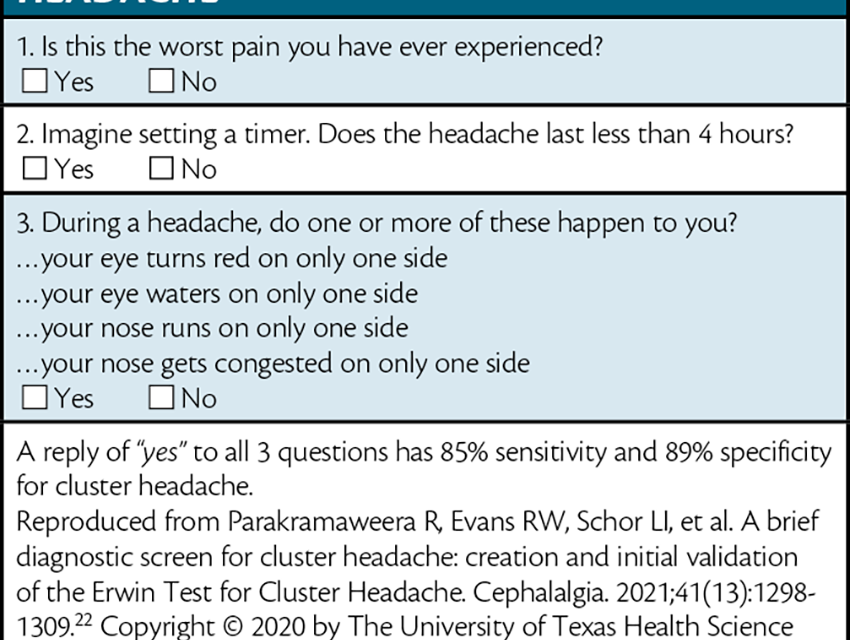
A recent systemic review of data published through December 2024 estimates the diagnostic delay for CH to be 10.43 years, reflecting an urgent need for better diagnostic screening for emergency and primary care providers to more easily recognize CH.21 Support from the Will Erwin Headache Research Foundation led to the development of the 3-item Erwin Test for Cluster Headache (ETCH)22 (Table 4) to enable practitioners to quickly and easily screen for CH.

Home Oxygen Coverage: Advocacy in Action
Oxygen was first shown to have benefit in acute CH attacks in 1981.23 Despite being a simple, safe, and effective treatment, the Centers for Medicare & Medicaid Services (CMS) issued a National Coverage Determination in 2011 blocking payment for home oxygen use. CMS representatives dismissed randomized controlled trial data and recommended that people experiencing CH pain go to the emergency department, fundamentally misunderstanding the short, severe nature of CH attack pain.24
Organizations including Clusterbusters, AHDA, the American Academy of Neurology, and the American Headache Society worked for more than a decade to change this recommendation by issuing position statements, collecting patient stories, publishing additional research, and advocating for policy action. In 2019, a formal appeal was submitted to the CMS. In 2021, the CMS removed the National Coverage Determination, but limited use to “some Medicare beneficiaries,” as determined by regional Medicare Administrative Contractors.25
Many private insurance companies follow the example of CMS, but oxygen therapy is still not universally covered. In addition, some medical supply companies decline to fill oxygen orders, either because they do not consider the high flow requirement legitimate or are uncertain that orders for oxygen equipment for a nonrespiratory indication will be reimbursed. In these cases, a letter or telephone call from a doctor’s office may clear this barrier.
Conclusion
With the expanded understanding of the nature of CH and its treatment options, the outlook for patients is optimistic. Advocacy efforts over the past 3 decades have improved recognition of the disease, diagnostic tools, and treatment options, and created opportunities for individuals to support one another through patient communities. Advocacy organizations are a testament to the change that can occur when people mobilize around a common cause, and that these advances can take place at many levels (eg, federal regulations, regional policies, clinical trials, clinician education). Current advocacy projects focus on improving research funding, increasing access to care, decriminalizing psychedelics, ensuring universal insurance coverage for home oxygen therapy, and advancing clinical trials with LSD and psilocybin that replicate use within the community. Providers treating people with CH are essential not only for providing prescriptions, but for advocacy, facilitating community, and engaging with their patients to explore novel solutions.
Ready to Claim Your Credits?
You have attempts to pass this post-test. Take your time and review carefully before submitting.
Good luck!
Recommended
 Headache & Pain
Navigating Medicolegal Needs in Headache Medicine: Section 504, FMLA, and SSDI/SSI
Nina Riggins, MD, PhD; Lorenzo Paris, JDNina Riggins, MD, PhD; Lorenzo Paris, JD