
Breaking the Stigma Around Headache: The Hidden Barrier to Effective Headache Care
Migraine stigma has emerged as an important social factor that may affect patient and provider behavior and exacerbate migraine burden.
KEY TAKEAWAYS
Migraine-related stigma is common and can affect disability, quality of life, mental health, care seeking, and treatment access.
Stigmatizing beliefs reflect the invisibility of symptoms, misconceptions about migraine, and moral judgments.
Reducing stigma requires carefully designed education, contact-based approaches, and effective clinician messaging.
Migraine is a leading reason for neurology consultation and a major cause of disability.1 People with migraine are frequently misdiagnosed and undertreated.2,3 Headache disorders receive disproportionately low research funding,4,5 and headache medicine is among the least preferred fellowship types among neurology residents.6 In this article, we discuss societal impacts of migraine stigma, potential sources of stigma, and ways to combat stigma.
Migraine Stigma
Migraine stigma is increasingly recognized as an important social factor that may affect patient and provider behavior and exacerbate migraine burden.7 Stigma arises from the interaction between a personal attribute and a societal stereotype about that attribute. For example, if people with brown hair were widely believed to have poor spatial awareness, people with brown hair may believe themselves to have poor spatial awareness (ie, internalized or self-stigma), be teased about having poor map-reading or driving skills (ie, public or social stigma), or experience barriers to obtaining a driver’s license (ie, structural stigma).
Society holds several types of stigmatizing attitudes about migraine. First, migraine is often considered “just a headache,” minimizing its disease burden.8 When this belief manifests as internalized stigma, a person with migraine may believe they should keep working through a migraine attack; as public stigma, friends and family may minimize migraine burden or compare migraine with less severe headaches; as structural stigma, employers may refuse migraine accommodations, or providers may not recognize or treat migraine symptoms.
A second stigmatizing attitude is “secondary gain”: the belief that people with migraine use symptoms to avoid responsibilities.8 When this attitude manifests as internalized stigma, people with migraine may feel excessive guilt when migraine interferes with attending important events; as public stigma, partners of individuals with migraine may resent being unable to attend activities due to migraine attacks; as structural stigma, loss of educational or occupational opportunities and status may occur.
People with migraine report experiencing public stigma in their daily lives. The OVERCOME study (Observational Survey of the Epidemiology, Treatment, and Care of Migraine),9 which included 59,001 participants with migraine in the United States, found that almost one-third reported frequently experiencing migraine-related stigma. A recent cross-national study10 of 3712 people with migraine and 774 partners, friends, or relatives of those with migraine found that 93% of individuals with migraine believed the disease was not well understood by the public and endorsed moderate levels of stigma from different social groups, including medical professionals.
People who experience migraine-related stigma report higher migraine burden across domains (eg, disability, quality of life, mental health, care seeking, treatment access).9,11,12 In OVERCOME, participants who reported exposure to both minimizing and secondary gain stigmatizing attitudes had more than double the risk of severe migraine disability compared with those who experienced no stigma.9 Higher stigma scores were also independently associated with higher interictal burden on the 4-item Migraine Interictal Burden Scale and lower migraine-specific quality of life. Migraine stigma also negatively affects various mental health outcomes.11,13,14
The associations among headache frequency, stigma, quality of life, and disability are complex and likely multidirectional. Studies have demonstrated that participants with chronic migraine (≥15 days/month) reported experiencing more stigma than those with episodic migraine (≤14 days/month) or epilepsy,13 highlighting the important role that the frequency and inescapability of migraine symptoms can play in the experience of migraine stigma. It is possible that having frequent symptoms makes it difficult to “mask” (ie, hide migraine symptoms to avoid stigma), contributing to exponentially increased burden compared with those who can hide their disease from others. Indeed, one study found that stigma mediated the relationship among headache frequency, quality of life, and disability.12 In addition, migraine may be more central to one’s self-concept when experienced more frequently, suggesting that a stronger migraine self-concept could lead to increased perceptions of stigma.12
Migraine stigma is associated with reduced patient care seeking and health care utilization behaviors. In the OVERCOME study, higher levels of migraine stigma were directly associated with hesitancy to seek care for migraine.15 Furthermore, the Migraine Report Card survey found that migraine-related stigma was more common in people with medication overuse headache.14 In addition, social determinants of health (eg, sex, race, socioeconomic factors) likely intersect with stigma, further affecting access to care.16
Where Does Migraine Stigma Come From?
A central driver of stigma is migraine’s invisibility. Migraine lacks sensitive and specific biomarkers and signs, and its symptoms (eg, pain, nausea, cognitive fog, sensory sensitivity, vertigo) are often undetectable.15 A linguistic conflation of migraine with less disabling headache types creates an assumption that those with migraine are exaggerating or coping poorly with “headache.” With lack of objective validation of severe and disabling pain, people with migraine may be alleged to be pain imposters.
Media coverage reinforces public misconceptions about migraine. Nearly one-third of migraine-related US newspaper articles contain stigmatizing language,17 and approximately half of the uses of the word “headache” in media refer to a stigmatizing metaphor rather than a medical condition (eg, the disruption caused a major “headache” for the company).18 In media generally, migraine is among the most likely health conditions to be described with stigmatizing language.19 Visual media depictions of migraine emphasize stereotyped “acute pain behavior” that diverges from typical clinical presentations.20 If people with migraine do not “look like the picture,” their claims may be doubted. Conversely, those who resemble the stereotype risk being perceived as fragile or unreliable. Such framing normalizes skepticism and diminishes public empathy.
Migraine stigma is fueled by moralized judgments about work productivity, invisibility of symptoms, stereotyped imagery, and polarized disability narratives: “just a headache” vs “profound disability.” The heterogeneity of migraine (low frequency with high socioeconomic participation vs chronic migraine with substantial disability) creates fertile ground for intragroup comparison and moral judgments about resilience and concealment behaviors. Effective stigma reduction must validate both the legitimacy of severe migraine-related disability and the reality that many individuals with migraine remain highly functional, without allowing either narrative to invalidate the other and perpetuate trivialization and caricature.
Migraine stigma beliefs have been shown to be held by most individuals without migraine. In a US cohort of nearly 12,000 adults without active migraine, almost 70% endorsed at least one stigmatizing belief about people with migraine, and personal familiarity with people with migraine increased the likelihood of those stigmatizing attitudes.9
Migraine stigma also permeates health care. Nearly half of neurologists surveyed believed stigma toward patients with migraine exists among health care professionals.21
Among individuals without migraine, the most frequently cited reasons for migraine-related stigma were the belief that migraine should be easily treatable, that individuals with migraine tend to conceal their condition, and that migraine results from unhealthy behaviors.22
Counterintuitively, people whose migraine symptoms have remitted expressed higher stigmatizing attitudes than those who had never experienced migraines.9 People with infrequent or remote migraines may judge those with more disabling disease as less resilient or as a threat to the concealment of their own disease. A propensity-matched analysis of US adults including participants with low-frequency episodic migraine (≤4 headache days/month), controls without migraine, and participants with chronic migraine found that severe disability based on the Migraine Disability Assessment score far exceeded formal disability claims, suggesting underrecognition or concealment.9 Moreover, participants in the same study with low-frequency episodic migraine attained higher socioeconomic status (eg, education, employment, wealth) compared with controls without migraine, suggesting that people with infrequent migraine may internalize a “coping” narrative and stigmatize those with more disabling disease, similar to individuals with previous migraine.
Experimental vignette studies using a social distance scale further demonstrate that social distance and distrust toward individuals with migraine varied by characteristics of the stigmatizer (ie, younger age, White race, higher empathic distance, greater “fear of pain”).22a Migraine is 3 times more prevalent in women than men, strongly suggesting that migraine stigma is a gendered phenomenon; however, neither the sex of the person with migraine nor that of the stigmatizer has been shown to correlate with stigmatizing attitudes.9
Reducing Migraine Stigma
Whereas efforts have been made to reduce public migraine-related stigma (eg, videos, pharmaceutical advertisements), no published articles evaluating their effectiveness exist. However, there have been studies on interventions aiming to indirectly address stigma toward migraine by increasing knowledge and awareness through education.23-26 A public campaign by Katsuki et al24 has shown that tools such as leaflets, e-learning modules, articles in local newspapers, and television broadcasts were able to increase knowledge, improve awareness, and correct misinformation. Several workplace interventions, including education, evaluations or consults, and referral options, were shown to increase productivity, knowledge, understanding, attitudes, and support from colleagues.23,25-26 Still, stigma itself was not assessed, necessitating further research with direct outcome measurement.
Lessons from how stigma has been successfully addressed in other disease areas, such as mental health, may be helpful if integrated into headache medicine. Results show that both contact-based (ie, direct interaction with members of the stigmatized group) and education-based approaches have small to moderate effects on reducing stigmatizing attitudes and behavioral intentions.27-30 Some researchers found contact approaches to be superior to education,27 but this has not been consistently demonstrated.30 In addition, the long-term durability of these approaches is unclear, and preliminary results suggest that the impact of these interventions is short-lived.28 The prospects for contact approaches to reduce migraine stigma are particularly in need of firm validation in light of the contrary findings that both familiarity with others with migraine and personal experience with migraine increase an individual’s stigmatizing attitudes toward migraine.
Research on stigma related to HIV infection and AIDS has shown that a variety of contact-based, education-based, and additional approaches (eg, games, role play, volunteer activities) have been successful in improving knowledge and attitudes.31-34 A community-based approach including popular opinion leaders over a longer period (1 year) also reduced public stigma, supporting the use of locally engaged, community-driven approaches.35 There is preliminary evidence that providing digital content without a group or testimonial was not helpful,34,36 suggesting that the inclusion of a personal story is necessary for approaches to reduce public stigma to be most successful.
Research on attitudes toward elevated body weight has shown that written materials and educational videos on the causes of overweight and obesity can reduce perceptions of personal responsibility and controllability.37 In addition, health care students who were provided with a genetic explanation for overweight and obesity had reduced anti-fat attitudes and greater acceptance of people with elevated body weight. Approaches focused on empathy (eg, dramatic reading, discussion) and cognitive dissonance (contrasting values of kindness with anti-fat attitudes), as well as contact-based and education-based approaches, have been effective in reducing weight bias as well.37
Some efforts to reduce stigma in other disease states have also provided information about ineffective approaches. Protest attempts (eg, emphasizing injustice, shaming stigmatizers) have shown paradoxical effects.27 Likewise, campaigns that suggest that migraine cannot be well managed or is untreatable have not been shown to be effective, as they elicit pity rather than empowerment. For example, biological explanations of mental health conditions have been shown to have unintended negative effects, including increased pity toward affected individuals and greater feelings of helplessness regarding the condition.38 In addition, mass media campaigns must be carefully designed to avoid inadvertently reinforcing stereotypes.33 Notably, given the previously discussed complexity surrounding intergroup comparisons in migraine, contact-based approaches must carefully consider migraine heterogeneity in their design.
Ideally, efforts to address public stigma would be effective at reducing stigma such that individual interventions would not be necessary. However, given that individuals with migraine are likely to continue experiencing stigma, efficacious individual approaches are needed. For chronic pain conditions, acceptance-based and commitment-based approaches have not been successful in reducing internalized stigma for chronic pain.39,40 This is surprising given that acceptance and commitment therapy and mindfulness-based approaches (as well as education, self-help, and advice giving) have been helpful in reducing internal stigma for individuals with elevated body weight.37 Similarly, cognitive behavioral therapy for chronic pain had no effect on perceived stigma,41 but including a family member or friend early in initial appointments reduced perceived stigma from physicians. The mechanism is unclear, but this could be due to increased social support or opportunities to discuss potentially stigmatizing encounters with someone else and correct or confirm perceptions.
A study on communication training in sickle cell disease found that participants reported increased stigma after the intervention, suggesting increased awareness of stigma.42 Paradoxically, the control intervention (a structured “life review” exercise) led to reduced stigma. The authors suggest that, due to the brevity of their intervention, participants may not have been able to sufficiently practice and apply communication strategies introduced. Studies in people with HIV infection found that both individual interventions (eg, supportive counseling focused on listening and coping) and group therapy reduced internalized stigma, although preliminary evidence suggests that the key mechanism in group therapy may be perceived social support, regardless of specific content.34
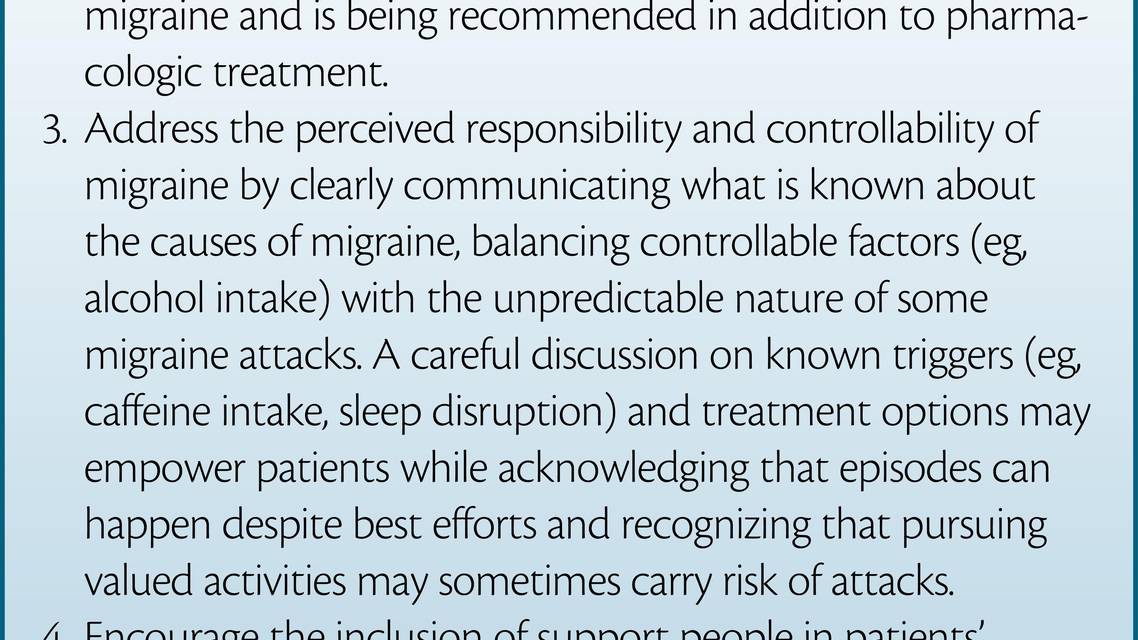
Preliminary work suggests that interdisciplinary pain programs may be helpful in addressing stigma. A qualitative study43 found that these programs boosted empowerment, and participants with chronic pain felt understood, respected, and credible. Unified messaging and consistent reference to the literature across providers, opportunities to clarify misconceptions (eg, that pain is being exaggerated), reduced power differentials, alignment with health care providers, and support for personal learning about pain were identified as helpful. Similarly, a review of psychologic approaches to migraine management44 recommends addressing migraine from a biopsychosocial perspective and emphasizing a multidisciplinary approach. To circumvent the perception of stigma associated with referral to psychology, the authors suggest framing psychologic interventions as a complement to, rather than a replacement for, pharmacologic treatment.
The knowledge base for interventions addressing migraine-related stigma is evolving. We provide recommendations based on the current literature in the Box.

Ready to Claim Your Credits?
You have attempts to pass this post-test. Take your time and review carefully before submitting.
Good luck!
Recommended
 Headache & Pain
Navigating Medicolegal Needs in Headache Medicine: Section 504, FMLA, and SSDI/SSI
Nina Riggins, MD, PhD; Lorenzo Paris, JDNina Riggins, MD, PhD; Lorenzo Paris, JD- Headache & Pain
Effective Communication Strategies for Managing Migraine Care Challenges
Anthony Yan, MD; Kelly Nicol, DOAnthony Yan, MD; Kelly Nicol, DO