
GAD65-Associated Temporal Lobe Epilepsy: Diagnosis and Management
Temporal lobe epilepsy associated with anti-GAD65 autoantibodies is a unique and challenging epilepsy syndrome at the intersection of epilepsy and autoimmunity, characterized by prominent temporal lobe involvement and associated with a range of autoimmune and neurologic conditions.
KEY TAKEAWAYS
- GAD65-associated temporal lobe epilepsy can resemble other forms of focal epilepsy, creating diagnostic challenges when classic features of autoimmune encephalitis are absent.
- The balance between active inflammation and chronic structural epilepsy may change over time, with important implications for the expected benefit of immunotherapy.
- Treatment often requires more than a single strategy, with immunomodulation, antiseizure medications, and selected epilepsy-directed interventions playing different roles across the disease course.
Diagnosis and Management
Temporal lobe epilepsy (TLE) associated with anti–glutamate decarboxylase 65 (GAD65) autoantibodies (GAD-TLE) is a unique and challenging epilepsy syndrome that lies at the intersection of epilepsy and autoimmunity. GAD-TLE is characterized by prominent temporal lobe involvement and is associated with a range of neurologic (eg, stiff person syndrome) and non-neurologic (eg, adult-onset type 1 diabetes mellitus) conditions.
GAD-TLE is a rare cause of epilepsy. Of 582 people with epilepsy of unknown cause without signs of autoimmune encephalitis, 13 (2.2%) were found to have GAD65 autoantibodies.1 However, GAD-TLE is a prominent cause of autoimmune-associated epilepsy, and one in which early intervention may modify the course of the disease.2 A combination of low incidence and possible low-titers of serum GAD65 autoantibodies in individuals with non-neurologic conditions3 highlights the need for clinicians to restrict testing to individuals with clinical features suggestive of the disorder.
The terms “GAD65 autoimmune encephalitis–associated epilepsy” and “GAD-associated epilepsy” have been used in the literature, but we favor the use of GAD-TLE to reflect the latest usage, which emphasizes the frequent temporal lobe involvement of this condition, often as part of a “temporal-plus” pattern. Although most individuals have temporal lobe involvement, a minority will have an extra-temporal presentation.2,4 In this article, “GAD-associated limbic encephalitis (GAD-LE)” is used to designate individuals who present with an acute encephalitic picture and GAD-TLE for individuals with a chronic epilepsy picture, with the latter being the focus of this review.
Pathophysiology
GAD65 is an enzyme that converts glutamate, an excitatory neurotransmitter, into GABA, an inhibitory neurotransmitter (the “65” refers to the molecular weight of the enzyme in kilodaltons).3 Although it may be tempting to conclude from this that autoantibodies ostensibly targeted at GAD65 play a pathophysiologic role in the development of GAD-TLE, this is far from certain. Indeed, like other neuronal autoantibodies targeted at the intracellular neuronal compartment, it remains unclear how, or even whether, those autoantibodies can reach their target.2
In fact, cytotoxic T cells, rather than B cells, appear to play a prominent role in the pathophysiology of GAD-TLE. Brain tissue from individuals with GAD-TLE who underwent epilepsy surgery showed diffuse CD8+ cytotoxic T-lymphocyte proliferation and only scant plasma cell involvement and no signs of autoantibody-mediated tissue damage.4 Interestingly, this immune reaction appeared to be inversely proportional to the time elapsed from epilepsy onset to resection. In other words, the immune response in GAD-TLE appears to abate over time.4
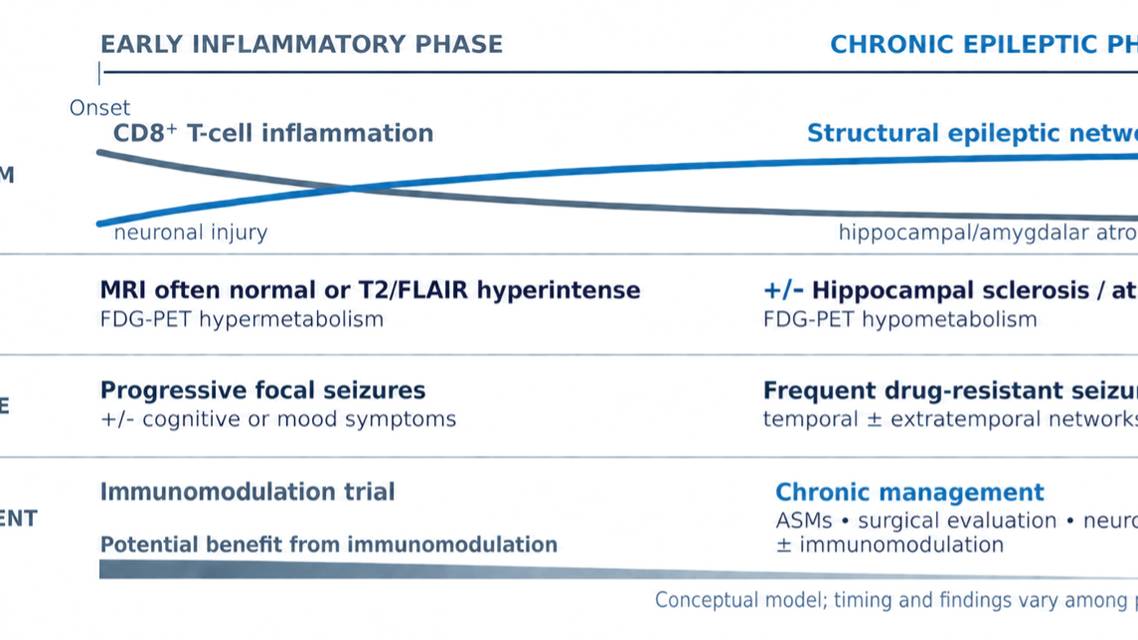
A prevalent, albeit imperfect, heuristic is to conceptualize GAD65 epilepsy as an initial acute inflammatory period followed by a chronic epileptic phase, which itself is sustained by structural damage.2,4 The 2 phases likely exist on a continuum, without a clearly delineated transition point, and considerable variability is expected between individuals. There are limitations with this paradigm. For instance, no correlation was found between the severity of hippocampal sclerosis and disease duration, and the decreases in median concentrations of cytotoxic T cells noted over time mask a degree of heterogeneity.4
In some cases, there seems to be a genetic susceptibility to GAD-TLE, with reported cases of “familial” GAD-TLE in members with shared human leukocyte antigen haplotypes.5 Loci that appear to confer susceptibility to anti-GAD65 neurologic disorders have been identified, with many involved in CD4+ T-cell regulation.6 Interestingly, the GAD65 enzyme is also found in pancreatic islet cells, which may explain the association between GAD-TLE and type 1 diabetes.3 A conceptual disease continuum of GAD-TLE is provided in the Figure.

Figure. A conceptual disease continuum of glutamate decarboxylase 65 antibody-associated temporal lobe epilepsy (GAD-TLE). An early, predominantly inflammatory phase is characterized by CD8+ cytotoxic T-cell activity, which may be accompanied by hypermetabolism on [¹⁸F]fluorodeoxyglucose positron emission tomography (FDG-PET). This then gradually gives way to chronic neuronal injury, hippocampal sclerosis, and a structural epileptic network, thus sustaining chronic drug-resistant epilepsy. The likelihood of a meaningful response to immunomodulation is greatest when therapy is initiated early. Timeline varies between individuals and typically cannot be established with precision. Some patients may present with a subacute encephalitic clinical picture (GAD-associated limbic encephalitis [GAD-LE]) and then develop GAD-TLE in the postacute phase.
Abbreviations: ASM, antiseizure medication; FLAIR, fluid-attenuated inversion recovery.
Clinical Presentation and Seizure Semiology
People with GAD-TLE are more likely to be women in their second to fourth decade of life (Table 1).7-10 A minority of individuals with GAD-TLE present with GAD-LE, but most have a protracted disease course resembling a non-autoimmune focal temporal epilepsy phenotype.7,8 In 20 participants with GAD-TLE who presented with isolated seizures, 90% were found to develop seizures over >3 months (ie, beyond the subacute timeline that defines limbic encephalitis).8 Seizures are frequent, typically occurring at least monthly, and often multiple times per day.2,11 Resistance to antiseizure medication (ASM) is the norm,7 as is involvement of structures beyond the mesial temporal regions.4,9,12
Notwithstanding this propensity for involvement beyond the mesial temporal lobe, the most common seizure semiologies in individuals with GAD-TLE include automatisms, epigastric sensation, déjà-vu/jamais-vu, and impairment in awareness—all typical stigmata of mesial temporal seizures.7,8,11,13
Musicogenic epilepsy—a form of reflex epilepsy in which seizures are triggered by specific melodies—is seen in 18% of individuals with GAD-TLE and appears to be much more prevalent than in non–GAD-related TLE.13 In a study of 16 participants with musicogenic epilepsy tested for autoantibodies, 9 had GAD-TLE. No individual with LGI1-associated epilepsy (another form of autoimmune-associated epilepsy) was reported to have such musicogenic seizures.11 Musicogenic seizures localize to the Heschl gyrus and to the superior temporal gyrus and may have a penchant for the nondominant temporal lobe.7,11,12 The musical genre that induces seizures is usually individual-specific but not disease-specific, with reported genres ranging from pop music to church hymns. The musicogenic predilection of GAD-TLE can emerge years after disease onset.11
Somatosensory and autonomic symptoms are also commonly reported in people with GAD-TLE.12 Somatosensory manifestations can be varied, with individuals reporting paresthesia, sometimes unpleasant, in the arms, face, tongue, and perioral regions, often in a migrating pattern.12 Some clinical features suggestive of insular involvement, such as throat tightness, have also been reported.12

Associated Non-Neurologic Autoimmune and Neuropsychiatric Comorbidities
Approximately 39% to 54% of people with GAD-TLE have associated systemic autoimmune conditions, including adult-onset type 1 diabetes, Hashimoto thyroiditis, pernicious anemia, and vitiligo,7-10 and a quarter have a family history of such autoimmune disorders.8
In terms of comorbid neuropsychiatric symptoms, 32% to 75% of people with GAD-TLE have some degree of memory impairment.8,12,14 Frontal executive dysfunction is the cognitive domain most frequently impaired, followed by anomia and visuospatial impairment.8 Mood disturbances are reported in about half of individuals and typically emerge within months from onset.8
People who present with a GAD-LE picture are more likely to have neuropsychiatric disturbances.8 However, studies have found no significant difference in the incidence of cognitive and psychiatric comorbidities between people with GAD-TLE and those with temporal epilepsy of nonautoimmune etiology.12,13
Overlap With GAD65 Spectrum Neurologic Disorders
Approximately 19% to 45% of people with GAD-TLE will have other GAD65 spectrum neurologic disorders, including cerebellar ataxia (15% to 23%), stiff person syndrome (SPS; 6% to 11%), and a triad of GAD-TLE, SPS, and cerebellar ataxia (3%).7-10 These overlap GAD neurologic conditions may either precede or follow the development of epilepsy.8 People with GAD-TLE tend to have a younger age at disease onset, a shorter disease duration at presentation, and a higher likelihood of cognitive impairment than individuals with SPS or cerebellar ataxia.9 A minority of individuals present with a clinical picture of GAD-LE, with subacute onset (ie, <3 months) of cognitive and psychiatric symptoms, as well as seizures which will, in most cases, evolve to GAD-TLE.7,8,14
Routine Cerebrospinal Fluid Studies
Most individuals with GAD-TLE lack pleocytosis on cerebrospinal fluid (CSF) white blood cell (WBC) counts, with only 6% to 19% having pleocytosis (median CSF WBC count, 1 x 10⁶/L).7-10 This proportion is higher among individuals who present with acute GAD-LE.7 CSF oligoclonal bands (OCBs) appear to be a helpful adjunct in the workup of GAD-TLE, with 38% to 89% of individuals with GAD-TLE having CSF-specific OCBs.7-9,14 Of note, however, individuals can have negative OCBs despite CSF production of GAD65 autoantibodies,14 and 12% of individuals with GAD-TLE have been found to have both normal CSF WBC counts and no OCBs.8 CSF protein concentrations were elevated in 63% of individuals with GAD-TLE.7
Autoantibody Testing
The clinical significance of serum GAD65 autoantibodies depends largely on concentration. A high concentration is strongly associated with neurologic disorders, but low titers of GAD65 autoantibodies have been associated with type 1 diabetes and can be seen in up to 8% of healthy individuals.3 In people with suspected GAD-TLE, CSF testing can provide additional confirmation of the diagnosis.3 In individuals with a GAD-LE presentation, combined serum/CSF autoantibody panel testing is recommended to assess for other autoantibodies, which can present with limbic encephalitis phenotypes that overlap with GAD-LE.12 For more information, please see the article by Dr. Gilani and Dr. Dubey in this issue.
Neuroimaging
Between 40% and 80% of people with GAD-TLE have normal brain MRI results. For those with abnormal MRI results, temporal lobe abnormalities are, by far, the most common finding.9 People with GAD-TLE have been reported to have a higher proportion of normal brain MRI scans than those with non–GAD-related TLE.13 Signal abnormalities in the insula have also been reported.12
The proportion of people with abnormal brain MRI findings increases over time: ~40% of individuals with disease duration of >1 year develop hippocampal sclerosis.12,15 Over time, atrophy predominantly affecting the hippocampus and amygdala is often seen.8,14-16 Hypometabolism in the mesial temporal structures is the most common finding on [¹⁸F]fluorodeoxyglucose PET (FDG-PET), but insular hypometabolism has also been noted in up to 40% of individuals with GAD-TLE.12 In the acute phase, temporal and extratemporal hypermetabolism have been reported, likely reflecting active inflammation.17
Electroencephalography
People with GAD-TLE typically have abnormal EEG findings, with temporal interictal epileptic discharges and seizures being the most common findings.9,11,14 Compared with individuals with mesial temporal sclerosis of nonautoimmune etiology, individuals with GAD-TLE were found to have interictal epileptic discharges in a more widespread distribution, including in the frontopolar, frontocentral, occipital, and parietal regions.12
Cancer Screening
Cancer is rare in GAD-TLE. Among 4 cohorts totaling 185 participants, 7 participants (4%) were diagnosed with cancer within 5 years from disease onset, including thymoma, teratoma, breast cancer, and gastric neuroendocrine tumor.7-10 As such, after an initial cancer screening, the benefits of repeated screening beyond age-appropriate recommendations are unclear.
Management
Immunomodulation
Seizure freedom can sometimes be achieved with immunomodulation, especially if it is initiated within 12 months of seizure onset20–22; however, most of the benefits of immunomodulation take the form of seizure reduction rather than complete elimination and must be weighed against potential side effects (Table 2).18,19,21
In a cohort of 20 individuals with GAD-TLE, a “complete response” was noted in 1 (5%), while 10 (50%) showed some degree of response at a median of 4 years after onset based on retrospective review of clinical documentation.7 Available studies have not demonstrated significant group-level improvements in memory or depressive symptoms following immunomodulation.16 However, 1 of 7 patients with available neuropsychological assessments demonstrated improvement in figural memory following corticosteroid treatment.23 Therefore, a trial of first-line immunomodulation is recommended, particularly for those early in the disease process and when there is evidence of ongoing inflammation. Individuals who achieve a prespecified seizure reduction goal (eg, >50% seizure reduction)2 may then transition to maintenance immunomodulation.
Clinicians should have a candid discussion with patients, establishing clear a priori treatment goals and acknowledging that the transition from an inflammatory active phase to a chronic structural phase exists on a continuum. While hypermetabolism on brain FDG-PET or edema on brain MRI is associated with an ongoing inflammatory phase, there is a paucity of reliable biomarkers of active inflammation in GAD-TLE, and an absence of these findings should not necessarily be interpreted as an absence of ongoing inflammation.10,12,15
Options for first-line immunomodulation include glucocorticoids, intravenous immunoglobulin (IVIg), and plasmapheresis (PLEX).7–10,16 Second-line immunomodulation options include rituximab, cyclophosphamide, and tocilizumab.8,10,22 For patients who transition to maintenance immunomodulation, treatment with steroid-sparing agents, such as mycophenolate mofetil, has been studied.7–9,14,16 Maintenance IVIg can also be considered based on data from the SPS population.19 Side effects were common in patients exposed to glucocorticoids and included Cushing syndrome, hyperglycemia, and neuropsychiatric symptoms.21 No side effects were reported with either IVIg or PLEX.21

Antiseizure Medications
ASMs continue to play a key role in the management of GAD-TLE, and even individuals who achieve seizure freedom typically require ongoing ASM maintenance.7,20,23 In a cohort of 7 participants with GAD-TLE treated with ASMs alone, 1 (13%) achieved seizure freedom; the specific ASM regimen was not specified.23
In a group of 8 participants with GAD-TLE with a median epilepsy duration of 16 years, introduction of cenobamate (Xcopri; SK Life Science, Paramus, NJ), an agent with dual mechanisms of action on both the GABA receptors and sodium channels, was associated with a median seizure reduction of 92%.24 Participants who received concurrent therapy with cenobamate and clobazam achieved even greater seizure reduction.24 The median seizure reduction observed in the group of participants with GAD-TLE was significantly higher than in a control group of 20 participants with drug-resistant epilepsy from nonautoimmune etiology who also received cenobamate and clobazam, suggesting that the effect of this ASM combination may be specific to GAD-TLE, possibly through rebalancing of GABAergic inhibition.24 Those results should be interpreted with caution given the relatively small sample size.
Epilepsy Surgery and Neuromodulation
Among 58 participants with GAD-TLE who underwent epilepsy surgery across 9 different studies, 6 (10%) achieved seizure freedom,4,7,11,21,23,25-29 and 9 of 36 participants (25%) achieved >50% seizure reduction.4,23,25,27-29 There is a paucity of data on postoperative cognitive function in GAD-TLE. Among 5 participants with GAD-TLE who underwent selective amygdalohippocampectomy, 2 had no cognitive changes after surgery, and 3 had worsened cognition.26 People with evidence of inflammation on histopathology and those with unilateral findings may be more likely to achieve good seizure outcomes after epilepsy surgery.2,26
Data from 18 participants with GAD-TLE who underwent neuromodulation were identified across 5 studies.11,28-31 No participant achieved seizure freedom without undergoing subsequent epilepsy surgery, but one-third of participants treated with vagal nerve stimulation11,28 and two-thirds of those treated with responsive neurostimulation achieved >50% seizure reduction.11,29,30
Outcomes and Prognosis
GAD-TLE remains a challenging condition to manage, and more efficacious treatment options are needed. Although earlier treatment is associated with better outcomes, almost all individuals who present with GAD-LE and acute symptomatic seizures go on to develop GAD-TLE.14
Despite this, clinicians can positively influence the disease course through a combination of interventions that can incrementally lead to seizure reduction, improved quality of life, and, in some cases, seizure freedom. At a median follow-up of 34 months, through a combination of first- and second-line immunomodulation therapies, epilepsy surgery, and ongoing ASM maintenance, 10 of 11 participants (91%) with GAD-TLE had achieved >50% seizure reduction compared with baseline at visit 1 (median 18 months from symptom onset).23 In a cohort of 91 participants with GAD-TLE, 22 (24%) achieved seizure freedom.10 In a case series of 20 participants with GAD-TLE, 8 (40%) reported “no impact on daily life activities” from their disease at last follow-up (median 88 months).8
In addition to addressing systemic, neurologic, cognitive, and psychiatric comorbidities through multidisciplinary care, clinicians can help their patients better understand GAD-TLE through education and research.
Ready to Claim Your Credits?
You have attempts to pass this post-test. Take your time and review carefully before submitting.
Good luck!
Recommended
 Epilepsy & Seizures
Neural Antibodies in Seizures With a Suspected Autoimmune Etiology: Testing, Interpretation, and Clinical Significance
Kia Gilani, MD; Divyanshu Dubey, MDKia Gilani, MD; Divyanshu Dubey, MD