
Treatment of Autoimmune-Associated Seizure Disorders
This article discusses the treatment of seizures associated with autoimmune encephalitis, including immunotherapies, antiseizure medications, and epilepsy surgery.
KEY TAKEAWAYS
- Antibody type and underlying disease mechanism can influence whether seizures resolve with treatment of inflammation or evolve into chronic autoimmune-associated epilepsy.
- Early immunotherapy and antiseizure treatment remain central to acute management, but the need for long-term therapy varies considerably across autoimmune seizure disorders.
- For persistent drug-resistant seizures after the inflammatory phase, epilepsy surgery and neuromodulation may offer additional options in carefully selected patients.
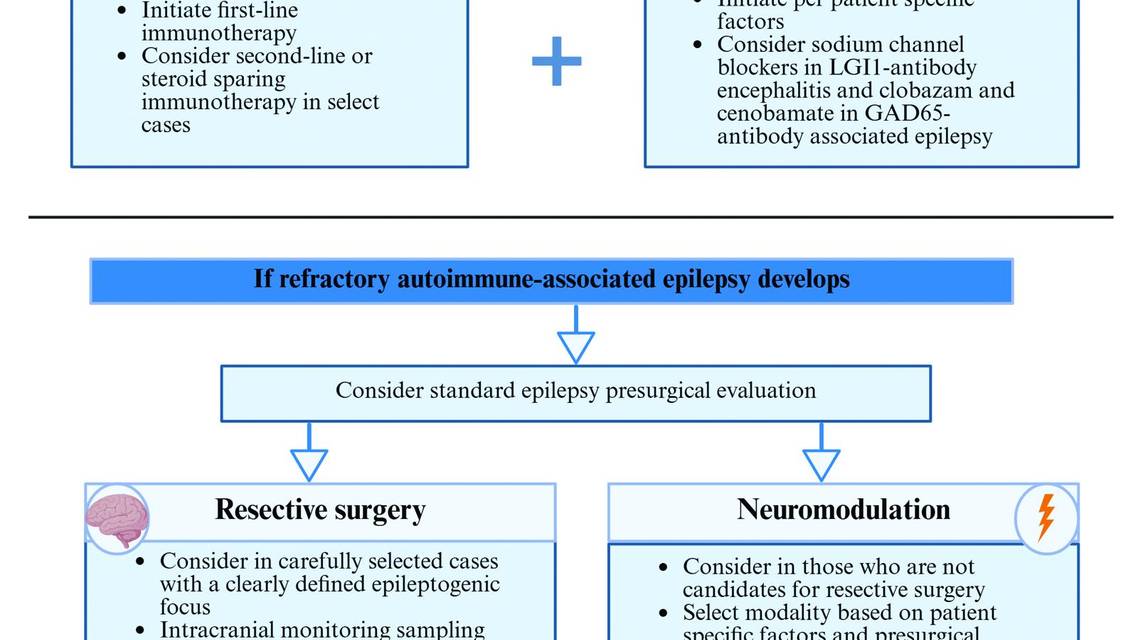
Treatment of autoimmune-associated seizure disorders requires a multifaceted approach (Figure) that aims to control active inflammation to limit cerebral damage and to reduce neuronal hyperexcitability through the use of immunotherapy and antiseizure medications (ASMs). Treatment response depends on multiple factors, including whether antibodies to cell-surface antigens or to intracellular antigens are present.
In disorders associated with antibodies to cell-surface antigens, such as leucine-rich glioma-inactivated 1 (LGI1) encephalitis and NMDA receptor (NMDAR) encephalitis, outcomes of immunotherapy are generally favorable, often resulting in resolution of seizures.1 In these scenarios, the seizures at inception of the illness should be considered acute symptomatic seizures, and long-term immunotherapy or ASMs may not be required.2
However, in conditions associated with antibodies to intracellular antigens, such as high-risk paraneoplastic antibodies and glutamic acid decarboxylase 65 (GAD65) antibodies, and in some cases involving antibodies to cell-surface antigens, seizures respond less favorably to immunotherapy, and autoimmune-associated epilepsy may develop. In cases that are refractory to immunotherapy and ASMs, an epilepsy surgery evaluation may be warranted.
Immunotherapy
Once an autoimmune diagnosis is reasonably confirmed, immunotherapy is typically indicated (Table 1), especially in scenarios that are particularly responsive to immunotherapy, such as autoimmune encephalitis associated with antibodies to cell-surface antigens. When an antibody associated with an increased risk of malignancy is identified, individuals should undergo appropriate malignancy screening. If a tumor is present, treatment should also address the underlying malignancy. Table 2 summarizes antibodies associated with seizures and their risk of association with malignancy.
Early immunotherapy should be initiated with minimal delay, as early therapy has been associated with better outcomes.3 Given the rarity of these disorders and potential consequences of treatment delays, placebo-controlled clinical trials are challenging to conduct.4 Thus, most available data and treatment recommendations are based on retrospective studies and expert opinion.
First-Line Immunotherapy
First-line immunotherapy consists of corticosteroids or intravenous immunoglobulin (IVIg). Corticosteroids are typically given as high-dose IV methylprednisolone (1 g/d at our institution) for 5 days, followed either by infusions at gradually increasing intervals or by a high-dose oral prednisone taper over several weeks to months. IVIg is typically given as 0.4 g/kg ideal body weight daily for 5 days or 1 g/kg ideal body weight daily for 2 days.5 Plasma exchange may be considered but is typically reserved for severe cases. Response to immunotherapy varies based on the underlying disorder and whether antibodies to cell-surface or intracellular antigens are present.
Seizures are typically acute symptomatic seizures associated with autoimmune encephalitis that resolve with immunotherapy when antibodies to cell-surface antigens, such as LGI1 and NMDAR antibodies, are present.1 Long-term immunotherapy or ASMs are usually not required in these cases.2

Second-Line Immunotherapy
Depending on the clinical course after initial treatments, second-line immunotherapies may be indicated, such as cyclophosphamide or rituximab. Initiation of rituximab after first-line therapies has become commonplace in clinical practice to facilitate tapering of first-line therapy and to prevent relapse.
In NMDAR and LGI1 encephalitis, early rituximab treatment has been found to be associated with reduced risk of relapses.6,7 Cyclophosphamide is typically considered in severe and refractory conditions, especially those associated with antibodies to intracellular antigens, which are driven by T-cell–mediated inflammation.5
Maintenance Immunotherapy
Duration of immunotherapy depends on many underlying clinical and individual factors. When long-term steroid-sparing immunotherapy is indicated, maintenance IVIg, rituximab, mycophenolate mofetil, or azathioprine are typical options used. In certain clinical scenarios, such as chronic epilepsy with high-titer GAD65 antibodies, complete responses to immunotherapy are uncommon, as active inflammation may not be present in the chronic phase.8 It is reasonable to attempt immunotherapy in such cases, but the limited response rates necessitate appropriate counseling and expectation setting before initiation.

Special Considerations
In scenarios where a malignancy is present, pharmacokinetic interactions between chemotherapy and immunotherapy must be considered.
Other immunotherapies are sometimes trialed in autoimmune-associated seizure disorders, although evidence is limited, with case reports suggesting a potential role of anakinra (Kineret; Swedish Orphan Biovitrum AB, Waltham, MA) or bortezomib, among others.9
Interleukin-6 receptor blockade with tocilizumab can be trialed in refractory cases of autoimmune encephalitis.10
Safety and Monitoring
Before initiating specific immunotherapy treatments, appropriate screening may include hepatitis B infection, immunoglobulin levels, vaccination status, and infection risk; concomitant immunosuppression should also be reviewed.
Immunotherapy is associated with many possible adverse effects, and appropriate monitoring is crucial to reduce the risk of complications. The need for ongoing treatment should also be regularly reassessed.
Clinical Trials
Clinical trials exploring immunotherapies with diverse mechanisms of action to treat these disorders are underway.11,12 The Encephalitis Treatment With Inebilizumab for NMDAR and Guidance on Serum + Cerebrospinal Fluid (CSF) Biomarkers to Predict Health Outcomes trial (ExTINGUISH; NCT04372615)is one such trial, evaluating inebilizumab (Uplizna; Amgen, Thousand Oaks, CA), a monoclonal antibody targeting CD19 on B cells, including plasmablasts and plasmocytes, for the treatment of NMDAR encephalitis.11 Another clinical trial, A Study to Evaluate the Efficacy, Safety, Pharmacokinetics (PK), and Pharmacodynamics (PD) of Satralizumab in Participants With NMDAR or LGI1 Encephalitis (CIELO; NCT05503264), is currently investigating satralizumab (Enspryng; Genentech, South San Francisco, CA) for the treatment of NMDAR and LGI1 encephalitis.12 Satralizumab is a monoclonal antibody targeting the interleukin-6 receptor that is approved for neuromyelitis optica spectrum disorder.12

LGI1 Encephalitis: An Immunotherapy-Responsive Autoimmune Seizure Disorder
LGI1 encephalitis is a useful paradigm for autoimmune-associated seizures because faciobrachial dystonic seizures, focal seizures, cognitive impairment, psychiatric symptoms, hyponatremia, and medial temporal MRI abnormalities often improve substantially when immunotherapy is instituted early.13 In clinical practice, treatment should be initiated promptly once the clinical syndrome and antibody result support the diagnosis or, in cases awaiting antibody results that are highly suggestive of LGI1 encephalitis once infectious causes have been reasonably excluded, to lessen the risk of seizure pharmacoresistance, irreversible hippocampal injury, and worse cognitive outcomes.14
High-dose IV methylprednisolone is typically used first (1 g/d for 5 days, followed by 1 g/wk for 6 weeks, or, after the daily IV steroid course, oral prednisone 60 mg/d with taper over weeks to months). Early antibody- and cytokine-depleting therapy may be undertaken with plasma exchange in individuals with severe encephalopathy, frequent seizures, faciobrachial dystonic seizures, or inadequate early response to corticosteroids.15 Plasma exchange is generally administered as 5 to 7 exchanges over ~10 to 14 days. IVIg may also be considered as a first-line treatment option, particularly when corticosteroids are poorly tolerated or plasma exchange is contraindicated or unavailable.4,16
Rituximab is increasingly initiated early to facilitate steroid tapering.7 A commonly used regimen is rituximab 1000 mg followed by a second 1000 mg dose 2 weeks later, with repeat dosing every 6 months; in individuals who tolerate therapy and have relapsing or severe disease, maintenance for ~2 to 3 years is often considered. The goal is not indefinite immunosuppression for all individuals but rather early disease control, prevention of relapse, and avoidance of chronic medial temporal injury and drug-resistant epilepsy.14
Seizure management should proceed in parallel with immunotherapy. Sodium channel–blocking ASMs, including carbamazepine, oxcarbazepine, lacosamide, or lamotrigine, may be helpful for focal seizures and faciobrachial dystonic seizures, but responder rates are low (15%) and immunotherapy is more effective than ASMs at controlling seizures.3
Cutaneous reactions may occur with carbamazepine,17 and with both carbamazepine and oxcarbazepine, hyponatremia risk is substantial.1,18 ASMs can usually be tapered cautiously once seizure freedom is achieved after successful immunotherapy treatment, the timing of which depends on degree and duration of clinical response.
Individuals whose condition continues to decline despite corticosteroids, plasma exchange, and rituximab require reassessment to ensure accuracy of diagnosis and to consider evaluation for persistent inflammation versus fixed injury. Persistent symptoms accompanied by ongoing seizures, new MRI or [¹⁸F]fluorodeoxyglucose PET abnormalities, or inflammatory cerebrospinal fluid findings indicate a relapse, in which case additional immunotherapy is warranted, whereas prominent hippocampal atrophy and a static amnestic syndrome may reflect residual injury that is unlikely to improve with further treatment.
In refractory active disease, options such as cyclophosphamide 800 to 1000 mg/m2 monthly for 6 months, with dose adjustments as needed based on blood cell counts and liver and kidney function, or interleukin-6 pathway blockade (tocilizumab or satralizumab) may be considered.7

Antiseizure Medications
Although seizure freedom is rarely obtained with ASMs alone in autoimmune-associated seizure disorders, ASMs are indicated as an adjunct to immunotherapy. No prospective clinical trials have evaluated specific ASM regimens, and the available data are retrospective, often comprise heterogeneous antibody-mediated disorders, and are subject to confounding by other factors.
Carbamazepine and other sodium channel–blocking medications may be helpful for seizures, especially for non-faciobrachial dystonic seizures associated with LGI1 encephalitis, although rash and hyponatremia occur at a relatively high prevalence and require counseling and monitoring.1,18 Data suggest that levetiracetam may not be as effective and may have an elevated risk of behavioral side effects in this patient population.1 In GAD65 antibody–associated epilepsy, a small study has suggested that the combination of cenobamate (Xcopri; SK Life Science, Paramus, NJ) and clobazam may be efficacious.19 Acetazolamide has been reported to reduce pilomotor seizures.20
The duration of ASM therapy depends on the underlying antibody and clinical course. In scenarios where seizures are acute symptomatic seizures related to autoimmune encephalitis, ongoing ASM treatment after resolution of the acute inflammatory process is most often unnecessary.2 However, the duration of the acute inflammatory phase is poorly defined and likely varies among individuals.
Surgical and Neuromodulatory Treatment Strategies
Many individuals with autoimmune-associated seizure disorders present with acute symptomatic seizures that respond favorably to early immunotherapy, but some, most commonly those with antibodies to intracellular antigens, may develop chronic epilepsy.
In some disorders, such as GAD65 antibody–associated epilepsy, chronic drug-resistant epilepsy is common. The term autoimmune-associated epilepsy has been proposed to describe this scenario and reflects contributions from both persistent immune-mediated mechanisms and secondary structural epileptogenic changes.2
This section focuses on surgical and neuromodulation treatment strategies for autoimmune-associated epilepsy (Table 3). Other immune-mediated epilepsy disorders, such as Rasmussen syndrome, are not addressed here.
An epilepsy presurgical evaluation can be considered in individuals with disabling seizures despite adequate immunotherapy and optimized ASM treatment. Even when seizure freedom is unlikely, meaningful seizure reduction and improved quality of life may be achieved. Early referral to a comprehensive epilepsy center is appropriate in individuals with disabling seizures.
Presurgical evaluation generally follows standard protocols for focal drug-resistant epilepsy. However, intracranial EEG with stereoelectroencephalography or intracranial electrocorticography is usually required to fully define the epileptogenic network and guide treatment planning.2
Evidence evaluating epilepsy surgery outcomes in autoimmune-associated epilepsy remains limited. No randomized trials have compared surgical and nonsurgical management, and available studies have limitations due to their retrospective nature.
Most published experience comes from GAD65 antibody–associated epilepsy, and data associated with other antibody-mediated conditions are sparse.21-23 In GAD65 antibody–associated epilepsy, temporal lobectomy has yielded less favorable seizure-freedom rates than in other forms of temporal lobe epilepsy, with Engel class I and II outcomes reported in 25% to 38% of cases.8,21,24 The reasons for this are not always clear in the series covering surgical outcomes but may include persistent inflammation or presence of bilateral temporal involvement and epileptogenic networks extending beyond the mesial temporal regions to neighboring structures due to the diffuse nature of the underlying inflammatory pathogenic etiology.8,21,24
Less invasive surgical approaches to treat drug-resistant focal epilepsy, such as laser interstitial thermal therapy and stereoelectroencephalography-guided radiofrequency thermocoagulation (SgRFTC), are increasing in popularity. However, their role in autoimmune-associated epilepsy has not been systematically evaluated. A recent case report described >95% seizure reduction in an individual with insular epilepsy after seronegative autoimmune encephalitis treated with SgRFTC.25 By enabling precise targeting of deep or distributed epileptogenic networks, SgRFTC expands treatment options for individuals who may not be candidates for conventional resection.
Treatment recommendations regarding epilepsy surgery in autoimmune-associated epilepsy must be individualized, taking into account the underlying antibody, clinical course, imaging, electrophysiologic data, and individual preferences. Further studies with larger populations are needed to define the role and determine the ideal modality and timing of epilepsy surgery in autoimmune-associated epilepsy.
Neuromodulatory Approaches
Neuromodulation has become an important treatment strategy for autoimmune-associated epilepsy, particularly when resection or ablation is not feasible because of multifocal epileptogenic networks, bilateral seizure onset, or uncertain localization.26 Available modalities include vagus nerve stimulation (VNS), responsive neurostimulation (RNS), and deep brain stimulation (DBS). Although immunotherapy raises theoretical concerns regarding device-related infections, current studies have not demonstrated increased infection rates among individuals with implanted devices receiving immunosuppressive treatment.27
Vagus Nerve Stimulation
VNS has the benefit of being less invasive than the other neuromodulation devices and can be used in cases of multifocal epilepsy, where a single epileptogenic focus is not well defined. However, evidence supporting VNS in autoimmune-associated epilepsy remains limited. Studies of postencephalitic epilepsy have reported seizure reductions of ~50% to 70% after VNS implantation.28 However, a Mayo Clinic cohort demonstrated a much more limited benefit in GAD65 antibody–associated epilepsy.24 VNS has also been used in new-onset refractory status epilepticus, including isolated reports of seizure freedom.29
Responsive Neurostimulation
Among neuromodulatory therapies, RNS offers unique therapeutic and diagnostic advantages.27,30,31 In addition to delivering responsive stimulation, RNS provides long-term ambulatory electrocorticography recordings that substantially exceed the diagnostic yield of short-term epilepsy monitoring unit evaluations.26 These data can help identify dominant seizure generators, guide immunotherapy and ASM adjustments, and inform surgical decision-making.
Data for the use of RNS in autoimmune-associated epilepsy are largely limited to small series and case reports. Across published autoimmune-associated epilepsy cohorts, ~60% to 70% of participants experience reductions in seizure frequency and severity, with low infection rates even among individuals receiving immunosuppressive therapy.27 In a case series of 4 participants with GAD65 antibody–associated epilepsy, RNS produced >50% seizure reduction and helped identify a candidate for temporal lobectomy who became free of clinical seizures after surgery.30
Deep Brain Stimulation
Evidence supporting DBS in autoimmune-associated epilepsy is also limited, with case reports describing favorable outcomes in GAD65 antibody–associated epilepsy and cryptogenic new-onset refractory status epilepticus treated with thalamic DBS.32,33 Additional studies are needed to determine the optimal neuromodulatory approach in autoimmune-associated epilepsy, including stimulation parameters and identification of optimal thalamic targets. Long-term outcome data are also essential so that proper counseling can be provided.
Conclusion
Initial treatment of autoimmune-associated seizure disorders comprises treatment with immunotherapy and ASMs. Earlier immunotherapy may be associated with improved outcomes. Treatment recommendations are primarily based on expert opinion and retrospective data.
In individuals with acute symptomatic seizures secondary to autoimmune encephalitis, long-term immunotherapy and ASMs may not be indicated, as seizures typically resolve once the acute inflammation is treated. However, some individuals develop autoimmune-associated epilepsy, which likely represents the evolution of acute inflammatory encephalitis into a chronic structural or network-based drug-resistant epilepsy.
In carefully selected individuals, epilepsy surgery or neuromodulatory therapies may provide meaningful clinical benefit to those with autoimmune-associated epilepsy, even when complete seizure freedom is not achievable. Future multicenter studies are needed to define ideal treatment algorithms in autoimmune-associated seizure disorders.
Ready to Claim Your Credits?
You have attempts to pass this post-test. Take your time and review carefully before submitting.
Good luck!
Recommended
 NOV 2026 ISSUE
Electrodiagnostic Testing for Cervical and Lumbosacral Radiculopathy
Peyman Roomizadeh; Samane MasoudiPeyman Roomizadeh; Samane Masoudi- Epilepsy & Seizures
Neural Antibodies in Seizures With a Suspected Autoimmune Etiology: Testing, Interpretation, and Clinical Significance
Kia Gilani, MD; Divyanshu Dubey, MDKia Gilani, MD; Divyanshu Dubey, MD