
Clinical Approach to Neurocognitive Symptoms: A Practical Framework for Primary Care, General Neurology, and Psychiatry
With disease-modifying therapies now available for early Alzheimer disease, a structured approach for evaluating cognitive complaints can help clinicians identify appropriate candidates for biomarker testing, specialist referral, and treatment.
KEY TAKEAWAYS
- Earlier recognition of cognitive change now has greater implications for biomarker testing and treatment eligibility.
- Collateral history and functional assessment help distinguish normal aging, mild cognitive impairment, and dementia.
- MoCA, MMSE, SLUMS, imaging, and biomarkers should be interpreted within the clinical context.
Cognitive complaints comprise an increasing share of outpatient visits in primary care, general neurology, and psychiatry clinics. More than 7 million Americans have Alzheimer disease (AD), and that figure is projected to nearly double by 2060 due to aging of the population.1
The availability of the US Food and Drug Administration–approved amyloid-targeting disease-modifying therapies (DMTs) for early AD has raised the clinical stakes of front-line evaluation. Early recognition of AD, workup, and referral are associated with the greatest potential benefit, whereas delayed identification may place patients outside the therapeutic window.2 Despite this, delayed referrals are common, owing to the lack of recognition of cognitive changes, difficulties with diagnosing AD in its earliest stages, and delays in engaging treating subspecialists.3
This article offers a framework for evaluating patients with cognitive concerns, including recommendations for obtaining a structured history; selecting appropriate laboratory and imaging studies (including blood-based biomarkers and amyloid positron emission tomography [PET]); recognizing features suggestive of less common forms of cognitive impairment; and interpreting cognitive testing in linguistically and culturally diverse populations.
Clinical History
Obtaining a targeted, comprehensive patient history is the foundation of initial cognitive screening and assessment. Many patients with cognitive issues have difficulty providing a detailed history due to lack of recognition of impairment (ie, anosognosia), executive dysfunction, language impairment, or difficulty attending to questions. A collateral source/informant who knows the patient well and is familiar with their baseline functioning can provide essential insight into the clinical picture and potential diagnoses.
Presenting Symptoms
Patients and informants most frequently report memory loss as a cognitive concern. This term includes a wide range of phenomena: word-finding difficulty in language disorders, slips of routine action in attentional disorders, and forgetting recent events in amnestic syndromes. Specific examples should be elicited from the informant. A patient who insists that nothing is wrong when a family member describes significant decline or uncharacteristic changes in behavior warrants greater concern than a worried patient with intact daily function. Informant-reported memory loss predicts current and future dementia far more reliably than self-report.4
Tempo of Illness
Onset and pace of decline shape the differential diagnosis (Table 1). Insidious progression over months to years suggests a neurodegenerative process. Stepwise decline temporally linked to vascular events suggests vascular cognitive impairment. Subacute progression over weeks to a few months raises concern for autoimmune encephalitis, paraneoplastic syndromes, prion disease, or central nervous system malignancy, all of which warrant evaluation at a tertiary center.

Functional Capacity
The line between mild cognitive impairment (MCI) and dementia is functional. MCI involves objective cognitive deficits with preserved daily function; a diagnosis of dementia (“major neurocognitive disorder” in Diagnostic and Statistical Manual of Mental Disorders, 5th edition) requires functional decline that interferes with independence.5,6 Both instrumental activities of daily living (eg, managing finances, managing medications, driving, shopping, and preparing meals) and basic activities of daily living (eg, bathing, dressing, and toileting) should be assessed specifically through questioning. Financial competence is particularly sensitive to early decline.
Demographic Modifiers
Roughly 5% of adults >65 years and 35% to 50% of those >85 years meet criteria for dementia.1 The likelihood of neurodegenerative disease rises substantially in older adults with corroborated progressive cognitive decline. Education and sex influence presentation. Highly educated patients may score in the normal range on brief screens despite clear functional decline. Women with AD often retain verbal fluency longer than men with equivalent pathology, producing falsely reassuring screening scores.7
Examination
Mental Status Examination
Several brief instruments can be helpful for outpatient use (Table 2). The Mini-Mental State Examination (MMSE) is quick and familiar but less sensitive to MCI, with ceiling effects in educated patients; in a pooled meta-analysis, its sensitivity and specificity for dementia were ~0.81 and ~0.89, respectively, with substantially lower performance for MCI.8 The Montreal Cognitive Assessment covers executive and visuospatial domains more thoroughly. The original validation reported sensitivity of ~80% to ~90% for MCI compared with 18% to 45% for the MMSE,9 and a cutoff of 24 rather than 26 reduces false-positives, particularly in patients with lower educational attainment.10 The St. Louis University Mental Status Examination performs similarly to the Montreal Cognitive Assessment, is freely available, and is well-suited to primary care. The Mini-Cog combines 3-word recall with clock drawing in ~3 minutes but is also less sensitive for detecting MCI. The Clinical Dementia Rating scale is typically too long for bedside screening but is a reliable longitudinal measure used to gauge progression and response to treatment, predominantly in clinical trials.11
When the screening result is incongruent with the clinical picture, a more detailed assessment of attention, language, memory, visuospatial function, and executive function is warranted, such as neuropsychological testing. Neuropsychological testing can be ordered for specific clinical questions, including discordance between clinical impression and screening results, better characterization of the cognitive profile, and the establishment of a baseline.12 Neuropsychological testing functions as a diagnostic evaluation rather than a screening tool, and referral of patients with very low screening scores may not be warranted, as meaningful data may be difficult to obtain in later stages of dementia.

General Neurologic Examination
The general neurologic examination provides localizing and etiologic information that complements the cognitive profile. Specific findings, including parkinsonism, supranuclear gaze palsy, focal motor or sensory deficits, ataxia, and abnormalities of gait, shift the differential diagnosis toward specific syndromes (see section on Recognizing Non-AD Syndromes).
Investigations
Laboratory Studies
Recommended routine studies include a complete blood count, comprehensive metabolic panel, thyroid-stimulating hormone, and vitamin B12.13 Human immunodeficiency virus and syphilis serologies are guided by risk factors. Population-based series suggest that truly reversible metabolic dementia is uncommon (<1%), but these laboratory studies are recommended to identify contributing conditions and to set a clinical baseline.14
Common Mimics and Contributors
Several conditions can mimic or worsen cognition and should be considered in the evaluation. Acute fluctuations in attention or arousal suggest delirium or toxic-metabolic encephalopathy rather than dementia. Centrally acting medications, particularly anticholinergics, benzodiazepines, sedative-hypnotics, opioids, bladder antimuscarinics, and first-generation antihistamines, often contribute to cognitive symptoms; the 2023 American Geriatrics Society Beers Criteria are a useful reference for medication review. Obstructive sleep apnea is independently associated with cognitive decline and is treatable. Hearing and vision loss can amplify cognitive deficits and are key modifiable risk factors identified by the 2024 Lancet Commission. Heavy alcohol use, prescription misuse, and other substance use should be elicited; chronic alcohol use is an established cause of cognitive impairment that may partially reverse with abstinence. Functional cognitive disorder, with internally inconsistent symptoms and preserved performance on objective testing, can coexist with or be misdiagnosed as a neurodegenerative process.
Structural Neuroimaging
Noncontrast brain MRI, preferably with coronal slices oriented perpendicular to the hippocampus, is recommended in patients with suspected cognitive impairment.13 MRI testing also rules out strokes, tumors, subdural collections, and normal pressure hydrocephalus (NPH). The atrophy pattern visualized itself is informative: hippocampal and temporoparietal atrophy supports AD; frontal or anterior temporal atrophy supports frontotemporal dementia; bilateral superior parieto-occipital atrophy suggests posterior cortical atrophy; anterior inferior temporal atrophy suggests semantic variant primary progressive aphasia.13 Microhemorrhage distribution carries both diagnostic and therapeutic weight: cortical microbleeds suggest cerebral amyloid angiopathy; basal ganglia, thalamic, or pontine microbleeds suggest hypertensive microangiopathy. The burden and distribution of microbleeds, along with the presence of cortical superficial siderosis, factor directly into amyloid-targeted therapy eligibility under the Leqembi (lecanemab; Eisai, Nutley, NJ) and Kisunla (donanemab; Eli Lilly, Indianapolis, IN) Appropriate Use Recommendations.15
Amyloid Biomarkers
Amyloid biomarkers establish or exclude AD pathology and are the gateway to DMT eligibility. The 2024 revised Alzheimer’s Association diagnostic criteria define AD biologically, with Core 1 biomarkers including amyloid PET, cerebrospinal fluid (CSF) Aβ42/40 and p-tau ratios, and accurate plasma assays.16 In May 2025, the Food and Drug Administration cleared the first blood-based test for AD (the Lumipulse [Fujirebio, Malvern, PA] G pTau217/β-amyloid 1-42 plasma ratio) for adults >55 years with cognitive symptoms. The 2025 Alzheimer’s Association Clinical Practice Guideline on blood-based biomarkers recommends plasma assays with sensitivity and specificity both ≥90% for the diagnostic workup of objective cognitive impairment in specialized care, where they may serve for triaging and, in some cases, as confirmatory substitutes for amyloid PET or CSF.17 In a recent multicenter study, a plasma p-tau217–based algorithm showed ~90% diagnostic accuracy in both primary and secondary care.18 Amyloid PET and CSF remain the gold standards when plasma results are equivocal or the picture is atypical and are typically obtained by the dementia specialist.
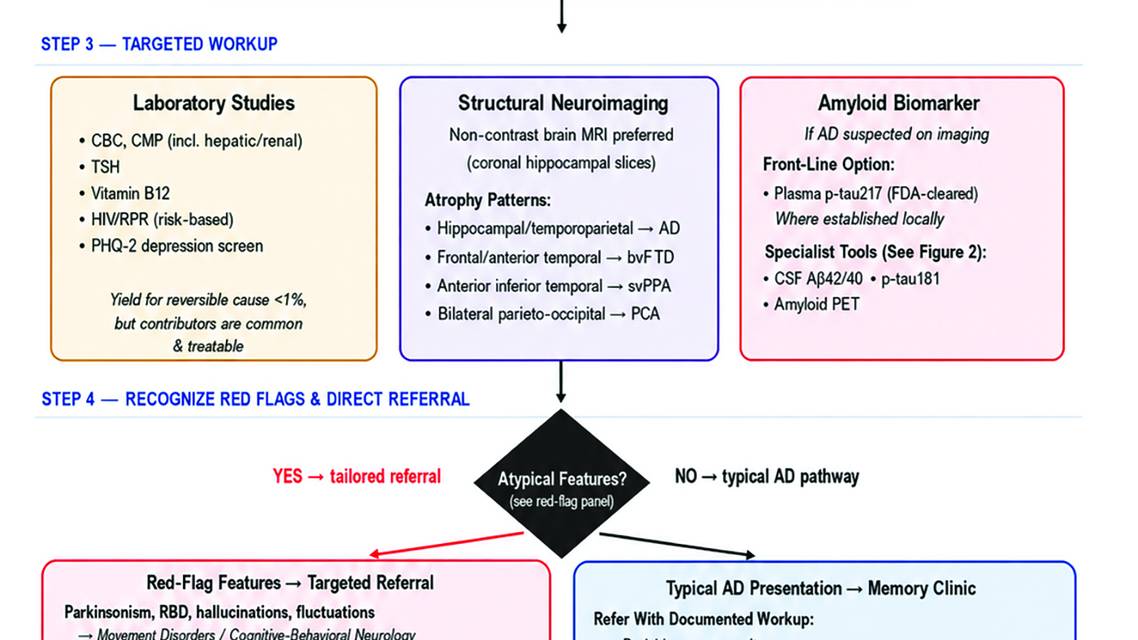
A practical, front-line pathway can be summarized as follows: cognitive concern, history with informant, objective bedside screen, laboratory panel, brain MRI, plasma p-tau217 (where available, appropriate, and interpretable in context) if AD is suspected and imaging is consistent, and referral to a dementia subspecialist for DMT evaluation. Figure 1 outlines this algorithm graphically. Figure 2 illustrates the typical course from symptom onset through specialist care.

Figure 1. Frontline clinical decision pathway.
Stepwise approach for the health care provider without specialized dementia expertise, from the initial cognitive concern through specialist referral. The algorithm progresses from informant-corroborated history through objective bedside screening, laboratory workup, structural neuroimaging, and plasma p-tau217, where available. In Step 4, patients with red-flag features are referred to the appropriate subspecialist, and patients with typical AD presentations are referred to memory disorders specialists or cognitive neurologists with the initial workup completed. Amyloid PET and CSF testing are often deferred to the dementia specialist (see Figure 2).
Abbreviations: AD; Alzheimer disease; AD8, Ascertain Dementia 8/Eight-item Interview to Differentiate Aging and Dementia; ARIA, amyloid-related imaging abnormalities; bvFTD, behavioral variant frontotemporal dementia; CBC, complete blood count; CDR, Clinical Dementia Rating; CMP, comprehensive metabolic panel; DMT, disease-modifying therapy; FDA, US Food and Drug Administration; MCI, mild cognitive impairment; MMSE, Mini-Mental State Examination; MoCA, Montreal Cognitive Assessment; NPH, normal-pressure hydrocephalus; PCA, posterior cortical atrophy; PHQ-2, 2-item Patient Health Questionnaire; PPA, primary progressive aphasia; RBD, rapid eye movement sleep behavior disorder; RUDAS, Rowland Universal Dementia Assessment Scale; SLUMS, St. Louis University Mental Status Examination; svPPA, semantic variant primary progressive aphasia; TSH, thyroid-stimulating hormone.

Figure 2. Patient pathway through specialist care.
Generalized workflow after referral to a subspecialist for confirmation of amyloid pathology, DMT eligibility determination, and longitudinal management. A branch at the eligibility check directs patients into either an antiamyloid DMT pathway with structured ARIA surveillance or a symptomatic and supportive care pathway. A shared longitudinal management band includes follow-up cadence, rehabilitation, psychosocial support, and advance planning. The figure separates the front-line referral handoff (left) from the typical specialist domain (center and right). Institutional partners and infusion sites have been generalized.
Abbreviations: AA, Alzheimer’s Association; AD, Alzheimer disease; ARIA, amyloid-related imaging abnormalities; AUR, Appropriate Use Recommendations; BBM, blood-based biomarker; CDR, Clinical Dementia Rating; CPG, clinical practice guideline; DMT, disease-modifying therapy; FDA, US Food and Drug Administration; FDG-PET, [¹⁸F]fluorodeoxyglucose positron emission tomography; LP, lumbar puncture; MCI, mild cognitive impairment; MMSE, Mini-Mental State Examination; MoCA, Montreal Cognitive Assessment; PCP, primary care provider; PET, positron emission tomography; PPA, primary progressive aphasia; SSRI, selective serotonin reuptake inhibitor; subQ; subcutaneous; svPPA, semantic variant primary progressive aphasia.
Recognizing Non-AD Syndromes
A common challenge in dementia evaluations is detecting red flags that suggest a non-AD diagnosis. Up to one-third of patients with behavioral variant frontotemporal dementia (bvFTD) may have their symptoms ascribed to a psychiatric diagnosis.19 Dementia with Lewy bodies (DLB) can also present a diagnostic challenge. Cognitive fluctuations, hallucinations, and rapid eye movement sleep behavior disorder can be helpful for distinguishing DLB from AD—a diagnosis often given to patients with DLB.20 Brief targeted questioning about a small number of features can be helpful for distinguishing these syndromes from typical AD and accelerates appropriate referral (Table 3).

Movement, Sleep, and Hallucinations
Inquiring about tremor, stiffness, slowness of movement, or changes in gait can lead to consideration of DLB, Parkinson disease dementia, progressive supranuclear palsy, or corticobasal degeneration and favor referral to a movement disorders neurologist.20 Asking the patient and bed partner about acting out dreams, kicking, punching, or yelling in sleep is often a high-yield question for suggesting an underlying synucleinopathy. Rapid eye movement sleep behavior disorder was upgraded to a core diagnostic feature of DLB in the 2017 DLB Consortium consensus criteria.20 Visual hallucinations of people or animals and noticeable cognitive fluctuations between good and bad days are core DLB features that can be helpful for making this diagnosis.
Personality and Behavior
Early changes in personality, including impulsivity, loss of empathy, apathy, or unusual behaviors, with relatively preserved memory, suggest bvFTD. Patients presenting with these personality changes are frequently misdiagnosed with depression, bipolar disorder, or late-life personality change.19 Subspecialty clinics can be helpful for using other methods to distinguish bvFTD from other disorders.
Language as the First Symptom
A language-predominant presentation may suggest primary progressive aphasia. Three variants are recognized (nonfluent/agrammatic, semantic, and logopenic),21 each of which carries distinct localization, diagnosis, and management implications. Neuropsychologic testing; other techniques, such as [¹⁸F]fluorodeoxyglucose PET scans; and speech-language pathology evaluation may be helpful in diagnosis.
Gait, Urinary, and Cognitive Triad
The combination of a magnetic or shuffling gait, urinary urgency or incontinence, and cognitive slowing raises concern for NPH. Gait is typically the first and most shunt-responsive feature, and neurosurgical evaluation can be considered when imaging is suggestive of NPH.
Stepwise Decline and Rapid Progression
Stepwise decline with focal findings favors vascular cognitive impairment; the recently published VasCog-2-WSO criteria provide updated operational guidance.22 Progression over weeks to a few months warrants an urgent workup for autoimmune encephalitis, paraneoplastic syndromes, prion disease, or central nervous system malignancy.
Considerations in Linguistically and Culturally Diverse Populations
Cognitive screening instruments were largely developed and normalized on native English-speaking populations, and translating these screening tools does not necessarily make them culturally equivalent. Bilingual Spanish–English speakers, for example, score lower on English-language semantic fluency tasks than monolingual English speakers despite normal cognition, owing to cross-language interference. Baseline differences within native-language assessment also matter. In South Texas, for example, Spanish-speaking adults >60 years with a <4th-grade education have an average baseline MMSE of 22 when cognitively healthy—well below conventional cutoffs for impairment.23 Interpreter-mediated testing introduces additional error when interpreters simplify instructions, provide nonverbal cues, or alter standardized administration.
Practical strategies include documenting the patient’s primary language and the language of testing; using validated native-language versions of screening tools when available; using language-reduced instruments, such as the Rowland Universal Dementia Assessment Scale, which performs comparably to the MMSE across diverse populations24; and interpreting low scores cautiously, recognizing that linguistic and cultural factors may drive the result. Referral to a bilingual neuropsychologist, or to one using culturally appropriate norms, is reasonable when uncertainty persists.
A particularly difficult challenge arises when the patient’s language domain itself is compromised, as in primary progressive aphasia. A patient with significant nonfluent aphasia may score in the severely impaired range on any verbally administered screen, not because cognition is globally impaired but because the instrument is not designed for this population. Staging in such cases may rely on caregiver-rated functional measures, behavioral observation, and, where possible, nonverbal cognitive tasks.
Safety, Capacity, and Postdiagnostic Planning
Practical safety and capacity issues should be addressed early, ahead of diagnostic confirmation. Driving, financial management, medication adherence, firearm access, and wandering risk should be raised with the patient and informant and revisited as the illness evolves. Caregiver burden is common and benefits from early acknowledgment and connection to community resources. Postdiagnostic planning, including advance directives, durable power of attorney, and referral to disease-specific support organizations, such as the Alzheimer’s Association and the Association for Frontotemporal Degeneration, need not await specialist confirmation. The 2018 NICE guideline on dementia (NG97) provides a useful framework for postdiagnostic care.
Conclusions
The primary care practitioner, general neurologist, and psychiatrist are in a prime position for initiating the workup of cognitive-related symptoms. A structured, front-line approach comprising a targeted history with a collateral informant, demonstration of objective impairment with bedside testing, targeted laboratory and imaging studies, and recognition of red flag features suggesting non-AD syndromes allows referral to the appropriate specialist with important components of the necessary workup completed. With amyloid-targeting DMTs now available for early AD, improved efficiency in screening may translate into faster access to treatment. The companion articles in this issue extend this foundation, covering biomarker-guided diagnosis, amyloid-targeting therapeutics, and the communication and ethical dimensions of delivering a diagnosis of a neurodegenerative disease.
Ready to Claim Your Credits?
You have attempts to pass this post-test. Take your time and review carefully before submitting.
Good luck!
Recommended
 Alzheimer Disease & Dementias
Next-Generation CNS Drug Delivery: Brainshuttle Technology and Clinical Implications in Alzheimer Disease
Luka Kulic, MDLuka Kulic, MD- Alzheimer Disease & Dementias
Clinical Biomarker Testing for Alzheimer Disease Pathology in the Context of Amyloid-Targeting Treatments
Anna Hofmann, MD; Suzanne E. Schindler, MD, PhDAnna Hofmann, MD; Suzanne E. Schindler, MD, PhD - Alzheimer Disease & Dementias
Building Confidence in Alzheimer Disease Care: Real-World Communication Strategies
Jeongyeon Hwang, MD; Samuel Gandy, MDJeongyeon Hwang, MD; Samuel Gandy, MD