
Janus Kinase Inhibitors: Emerging Therapeutic Options for Giant Cell Arteritis
This article provides a bench-to-bedside review of current and emerging treatments for giant cell arteritis.
KEY TAKEAWAYS
- JAK inhibitors target multiple inflammatory pathways implicated in giant cell arteritis (GCA), offering a potential new approach beyond current therapies.
- Emerging data suggest JAK inhibition may help control disease activity and reduce steroid exposure, although important questions about safety and patient selection remain.
- Understanding where JAK inhibitors fit into treatment algorithms for GCA is increasingly relevant.
Giant cell arteritis (GCA), often referred to as temporal arteritis, is a granulomatous vasculitis affecting large and medium-sized arteries, with a predilection for the cranial branches of the aorta. GCA almost exclusively affects individuals aged >50 years, with a mean age of 70 years, and women are more commonly affected than men.1,2 GCA, the most common primary vasculitis among adults in North America and Europe,1,2 is treated as a medical emergency at presentation or when suspected due to the risk of irreversible life- and vision-threatening ischemic complications. Long-term glucocorticoids are a mainstay of treatment, but often contribute to morbidity through adverse events.1,3
Recent advances in understanding the molecular pathways involved in GCA have identified numerous new treatment targets. The major inflammatory pathways in GCA involve T helper 1 (Th1) and T helper 17 (Th17) cells. Th1 cells produce interferon-γ, which stimulates vascular smooth muscle cells and endothelial cells to secrete chemokines, thereby recruiting inflammatory cells into vessel walls and activating macrophages and promoting granuloma formation along with interleukin-12 (IL-12). Th17 cells produce interleukin-17 (IL-17), which promotes vascular remodeling, activates vascular stromal cells, upregulates interleukin-6 (IL-6), and results in inflammation and neoangiogenesis.4 Th1 cells, Th17 cells, and macrophages have been identified in arterial inflammatory lesions in animal models of GCA.5,6
Established Therapies
Glucocorticoids
Glucocorticoids are the mainstay of GCA treatment, quickly inducing remission and reducing risk of vision loss. However, glucocorticoid monotherapy is associated with high relapse rates and substantial toxicity.1 Prednisone 1 mg/kg/d (up to 60 to 80 mg daily) is the standard initial therapy, started immediately when GCA is suspected to prevent irreversible ischemic complications. For individuals with new or threatened vision loss, the American College of Rheumatology recommends intravenous methylprednisolone (.25 to 1.0 g/d for 3 days) instead of oral glucocorticoids.2
The duration of glucocorticoid treatment varies substantially depending on clinical disease activity, relapse history, and comorbidities. Typical treatment regimens aim to reduce the dose to 15 to 20 mg/d within 3 months of treatment initiation and to 0 to 5 mg/d by 12 months. In practice, many individuals require ≥18 months of glucocorticoid therapy.
Although glucocorticoids act through multiple molecular pathways, in GCA, they appear to selectively suppress Th17 cells while sparing Th1 cells.7 This Th1 resistance may contribute to high relapse rates and treatment failure even at high doses. A meta-analysis reported a glucocorticoid monotherapy relapse rate of 47.2% (95% CI, 40% to 54.3%), primarily occurring in the first 2 years of treatment.8 This risk of relapse is greater in individuals with severe ischemic complications or large-vessel involvement at diagnosis.8
Glucocorticoid-related morbidity occurs in the majority of people with GCA, with up to 99% of individuals on glucocorticoid treatment reporting at least 1 adverse event.9 Short-term adverse effects include insomnia (72%) and other cognitive and psychological symptoms. Long-term adverse effects include diabetes (9% to 21%), osteoporosis or fractures (38% to 42%), and cardiovascular complications, such as hypertension (30%).1,6 Even at daily doses as low as 9 mg, the risk of these complications increases significantly.1,9 Efforts to reduce glucocorticoid-related morbidity hinge on finding alternative safe and effective steroid-sparing therapies.
Methotrexate
Methotrexate is one of the oldest and most frequently used glucocorticoid-sparing therapies for GCA. Methotrexate modulates proinflammatory cytokine signaling, including pathways involving Janus kinase 1 (JAK1) and Janus kinase 2 (JAK2), with effects on both Th1 and Th17 pathways, making it theoretically beneficial in GCA.10 Clinical trials assessing adjunct methotrexate in GCA have had mixed results; however, a meta-analysis of pooled participant data demonstrated a modest but statistically significant decrease in relapse risk and cumulative glucocorticoid exposure.6 The complexity of methotrexate dosing in combination with glucocorticoids may have contributed to the development of alternative therapies.
Tocilizumab
Tocilizumab, a monoclonal antibody targeting the IL-6 receptor, was first approved for rheumatoid arthritis (RA) by the Food and Drug Administration (FDA) in 2010 and subsequently approved for GCA in 2017. In clinical trials, tocilizumab demonstrated higher rates of sustained remission compared with glucocorticoid therapy alone.3
The randomized, double-blind, placebo-controlled Efficacy and Safety Study of Tocilizumab (RoActemra/Actemra) in Participants With Giant Cell Arteritis (NCT01791153) demonstrated efficacy of subcutaneous tocilizumab in achieving sustained remission, defined as absence of signs or symptoms of GCA from week 12 through week 52.3 Participants were randomized to placebo with glucocorticoid or tocilizumab with glucocorticoid. Tocilizumab was given either weekly or every 2 weeks at 162 mg, and glucocorticoids were tapered over 26 or 52 weeks. Sustained remission was achieved in 56% of participants on weekly tocilizumab with a 26-week glucocorticoid taper, compared with 18% of participants receiving placebo with a 52-week taper (P<.001). Weekly tocilizumab dosing was superior to every-2-week dosing in preventing relapse. Glucocorticoid-sparing effects were also evident in the tocilizumab group, with a median cumulative prednisone dose of 1862 mg in the weekly tocilizumab group vs 3818 mg in the placebo group with a 52-week taper (P<.001).3
In the Giant Cell Arteritis Actemra trial (GiACTA), tocilizumab plus a prednisone taper reduced relapse compared with prednisone taper alone, but it also made laboratory confirmation of relapse more difficult.6 Because c-reactive protein (CRP) is synthesized by hepatocytes largely downstream of IL-6–mediated JAK/STAT signaling, IL-6 receptor blockade with tocilizumab can suppress CRP even during clinically active disease. This was reflected in GiACTA, in which CRP elevation accompanied only a minority of relapses among patients receiving tocilizumab, compared with most relapses in the prednisone-only/placebo arms. Therefore, clinicians should rely primarily on clinical assessment—and, when appropriate, vascular imaging—rather than CRP alone when evaluating suspected relapse in patients receiving tocilizumab. In addition, despite the efficacy of IL-6 blockade, approximately 30% to 40% of patients relapse after discontinuation of tocilizumab, suggesting that pathogenic pathways outside the IL-6/Th17 axis—particularly Th1-mediated inflammation—may remain active.11 IL-6, which is targeted by tocilizumab, acts within the Th17 pathway, which is glucocorticoid-sensitive. Treatment failure or disease relapse with tocilizumab may be due to ineffective suppression of Th1 pathways.
Janus Kinase Inhibitors
JAK inhibitors, such as Rinvoq (upadacitinib; AbbVie, North Chicago, IL), Olumiant (baricitinib; Eli Lilly, Indianapolis, IN), and tofacitinib, are small molecules that prevent activation of signal transducer and activator of transcription (STAT) proteins. This prevents downstream inflammation cascades, blocking the actions of IL-6 in the Th17 pathway and interferon-γ in the Th1 pathway, making JAK inhibitors theoretically well-suited for use in GCA, particularly as adjuncts to glucocorticoids or in individuals who fail glucocorticoid or tocilizumab therapy. Upadacitinib was first FDA-approved for RA in 2019 and became the second FDA-approved therapy for GCA in April 2025, following tocilizumab.11
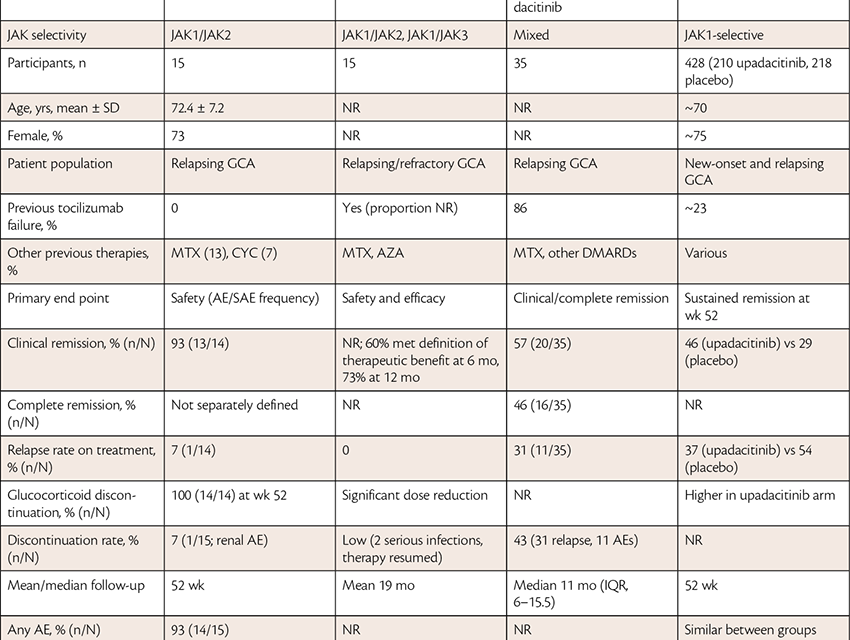
Several JAK inhibitors have been studied in GCA, with the largest trial to date being A Study to Evaluate the Safety and Efficacy of Upadacitinib in Participants With Giant Cell Arteritis (SELECT-GCA; NCT03725202) (Table 1).11 This phase 3 trial randomized 428 individuals with new-onset or relapsing GCA in a 2:1:1 ratio to receive upadacitinib 15 mg/d, upadacitinib 7.5 mg/d, or placebo. Glucocorticoids were tapered over 26 weeks in both upadacitinib groups and over 52 weeks in the placebo group. Upadacitinib 15 mg with a 26-week taper was found to be superior to placebo with a 52-week taper; 46.4% of participants achieved sustained remission at week 52 compared with 29.0% of participants in the placebo group (P=.002). Higher-dose upadacitinib was also associated with lower cumulative glucocorticoid exposure. The 7.5-mg dose did not achieve significant superiority compared with placebo.

An open-label pilot study conducted by Koster and Warrington12 examined 15 tocilizumab-naive participants receiving baricitinib 4 mg daily plus glucocorticoid taper over 52 weeks. Fourteen participants completed the study, with 93% achieving glucocorticoid discontinuation and persistent remission at 52 weeks. One participant discontinued baricitinib due to renal impairment. However, 29% of participants developed a GCA flare within 12 weeks after discontinuation and restarted baricitinib.
Two additional observational studies demonstrated similar or slightly better rates of clinical remission in treated individuals, albeit with shorter follow-up periods. Loricera and colleagues13 retrospectively analyzed the use of baricitinib, tofacitinib, and upadacitinib in 35 participants with relapsed GCA, 86% of whom had previously failed tocilizumab.13 They found that 57% of participants achieved clinical remission and 46% achieved complete remission over 6 to 15 months of follow-up. Eriksson and colleagues14 examined baricitinib and tofacitinib in participants with relapsed or refractory GCA and found no apparent relapses at 6 or 12 months.
JAK inhibitors generally have a tolerable safety profile, but concerns include herpes zoster reactivation, creatine kinase elevation, and the potential for tuberculosis reactivation. Adverse events have been primarily studied in RA and younger populations. Herpes zoster has been observed more frequently with upadacitinib compared with placebo, with an increased risk confirmed in an analysis of 3834 individuals.13 Before starting JAK inhibitor therapy, the recombinant zoster vaccine should be administered, and individuals should be screened for latent tuberculosis (and treated, if indicated).
SELECT-GCA did not demonstrate a higher rate of major adverse cardiovascular events (MACEs) compared with placebo, with no MACE occurring in either group treated with upadacitinib (vs 2 in the placebo group); however, a higher risk of MACEs has been found in individuals receiving JAK inhibitors who have RA, age >65 years, or cardiovascular risk factors.15 Creatine kinase elevations were notably higher in the upadacitinib 15 mg group compared with the upadacitinib 7.5 mg and placebo groups.11 JAK inhibitors have also been associated with an increased risk of thromboembolic events, including deep vein thrombosis and pulmonary embolism, particularly in patients with predisposing risk factors.
Conclusion
GCA treatment traditionally has required immediate high-dose glucocorticoids to prevent permanent vision loss. Glucocorticoid-sparing therapy is an emerging option to reduce the burden of glucocorticoid treatment as well as the risk of relapse. Upadacitinib is now FDA-approved for the treatment of GCA following the SELECT-GCA trial, becoming the second approved agent alongside tocilizumab. Upadacitinib targets multiple inflammatory pathways and has demonstrated efficacy in achieving sustained remission, particularly in refractory or relapsed GCA, with the added benefit of being an oral medication. Safety concerns with JAK inhibitors include an increased risk of herpes zoster reactivation, tuberculosis reactivation, thrombosis, and possible cardiovascular events, especially in older individuals. Overall, emerging evidence supports expanding treatment options for people with GCA, but longer-term safety data and comparative data will be important for navigating the therapeutic landscape of GCA.
Ready to Claim Your Credits?
You have attempts to pass this post-test. Take your time and review carefully before submitting.
Good luck!
Recommended
 MS & Immune Disorders
Radiologic Differential Diagnosis of Multiple Sclerosis
Jared V. Goodman, MD, PhD; Apisit Kaewsanit, MDJared V. Goodman, MD, PhD; Apisit Kaewsanit, MD