
MS Minute: Chimeric Antigen Receptor T-Cell Therapy for Progressive Multiple Sclerosis: Rationale, Evidence, and Therapeutic Potential
CAR T-cell therapy represents a new strategy for treating progressive multiple sclerosis by targeting pathogenic B cells involved in compartmentalized neuroinflammation.
Multiple sclerosis (MS), an inflammatory demyelinating disease of the central nervous system (CNS), often begins with a relapsing-remitting course, which in some individuals transitions to a secondary progressive course. A small proportion of individuals have progressive disease from onset and are classified as having primary progressive MS. Progressive MS is characterized by insidious disability accrual independent of relapses. Whereas relapsing-remitting MS (RRMS) and progressive MS were historically viewed as distinct diseases, current research supports the concept that MS exists on a spectrum within a single disease process.1
In relapsing MS, inflammation is mediated by peripheral immune activation, characterized by trafficking of autoreactive T- and B-lymphocytes across a disrupted blood–brain barrier, leading to clinical relapses and associated lesion formation. In contrast, in progressive MS, there is a shift toward compartmentalized, smoldering neuroinflammation. This includes the expansion and proliferation of CNS-resident immune cells, such as microglia, macrophages, and B-cells, leading to the formation of meningeal B-cell follicles that secrete cytokines and antibodies. Whereas peripheral immune responses drive RRMS, immune responses confined to the CNS dominate progressive MS.1 Although many disease-modifying therapies (DMTs) effectively reduce relapses and MRI activity in RRMS by targeting peripheral inflammation, their ability to target plasma cells and penetrate the CNS is limited. As a result, current treatments have only modest effects on disability progression.
Chimeric Antigen Receptor T-Cell Therapy: Rationale, Mechanism, and Principles
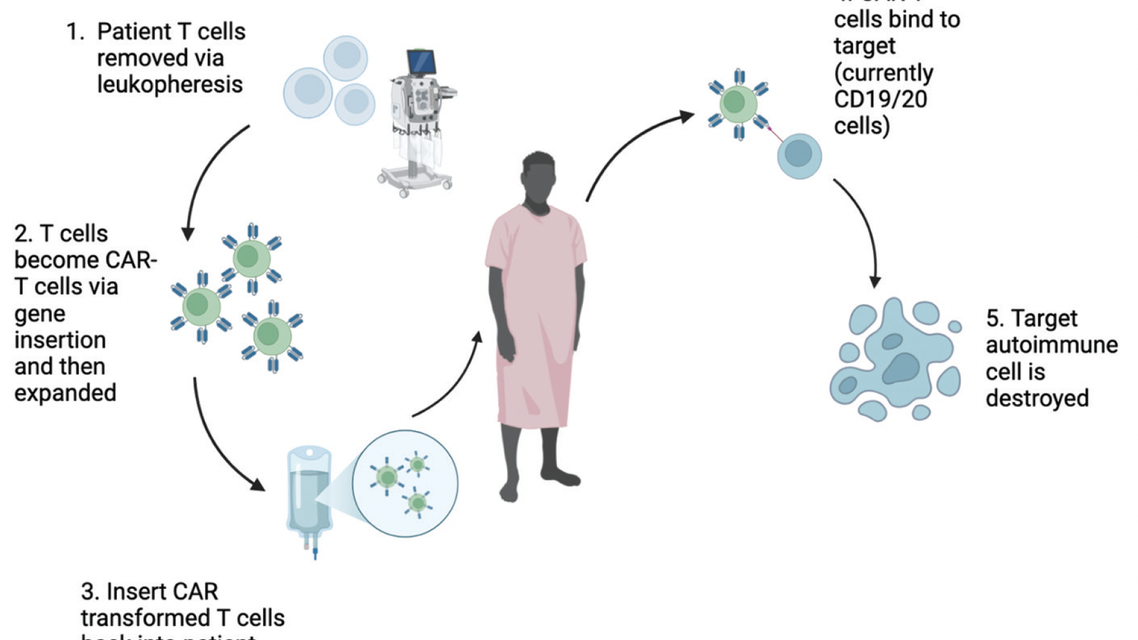
A promising approach to addressing progressive MS and CNS compartmentalized inflammation involves chimeric antigen receptors (CARs). CARs are synthetic receptors inserted into immune cells, typically using viral vectors, to activate specific immune responses. Once the CAR T-cell binds to the target cell, intracellular signaling triggers T-cell proliferation and cytokine release to attack the target cell (Figure). CAR T-cells are administered as a single infusion following lymphodepleting conditioning regimens, typically using fludarabine and cyclophosphamide, which are used to facilitate CAR T-cell expansion.

Figure. A schematic showing how chimeric antigen receptor (CAR)-T cells are engineered and administered. From Conway SE, Galetta K. Therapeutic advances in multiple sclerosis: novel therapies (immune checkpoint inhibitors, CAR-T, Anti-CD40L). Neurotherapeutics. 2025 22:e00558. doi: 10.1016/j.neurot.2025.e00558. Epub 2025 Feb 27. PMID: 40021418; PMCID: PMC12418423. https://creativecommons.org/licenses/by-nc-nd/4.0/
CAR T-cells have been used successfully to treat hematologic malignancies and have been applied to other B-cell–mediated autoimmune diseases, such as systemic lupus erythematosus.2,3 In MS, CAR T-cells may offer the advantage of crossing the blood–brain barrier to target B cells and plasma cells driving compartmentalized CNS inflammation. This could lead to more effective elimination of autoreactive B-cells implicated in disease progression. Two primary approaches are being investigated: CD19-targeted CAR T-cells, which target cells of B-cell lineage; and B cell maturation antigen (BCMA)–targeted CAR T-cells, which target plasma cells.4
Preclinical Studies
For >2 decades, investigators have explored whether infusions of regulatory T-cells could prevent or reverse experimental autoimmune encephalomyelitis (EAE), a widely used mouse model of MS.5 Early approaches using antigen-specific strategies, such as CD25-targeted regulatory T-cells, successfully suppressed disease in myelin basic protein–induced EAE but failed to improve outcomes in other models, including myelin oligodendrocyte glycoprotein–induced EAE.6 Subsequent studies generated CAR-based products with diverse antigen targets and binding specificities, yielding mixed results.7,8
In parallel, the past decade has seen increasing clinical success using B-cell directed therapies in MS, motivating preclinical efforts to test anti-CD19 and anti-CD20 CAR T-cell strategies in EAE models. These results have likewise been variable: some studies reported disease exacerbation with CD19 CAR T-cell treatment,9 whereas others demonstrated disease amelioration.10,11 Gupta et al11 showed that CD19-targeted CAR T-cell therapy achieved durable B-cell depletion in both the CNS and periphery with greater persistence than monoclonal antibody–based approaches. Other work has expanded beyond B-cell depletion to target autoreactive T-cells12 and to eliminate dendritic cell populations that drive pathogenic Th1 responses.13 Collectively, these preclinical studies highlight the wide spectrum of potential CAR T-cell targets in MS and underscore the continued evolution of antigen-specific cell therapy strategies in neuroimmunology.
Clinical Studies and Safety
Early clinical development of CAR T-cell therapy for MS is expanding rapidly with at least 13 phase 1 or 2 trials registered across the United States, Europe, and China (Table). Most studies target the B-cell and plasma cell axis, predominantly CD19; however, dual and multiantigen approaches, such as CD19/CD20, CD19/BCMA, and CD19/CD20/CD22, are also under investigation, reflecting an emerging consensus that B-lineage cells contribute centrally to MS pathobiology. Although controlled efficacy data are not yet available, early reports from progressive MS cohorts are notable. Data from a study sponsored by Kyverna (Emeryville, CA) on 6 individuals from 2 sites treated with CD19-directed KYV-101 (Emeryville, CA) have been reported: robust T-cell expansion was observed in serum, with evidence of CNS penetration based on CAR–fluorescence activated cell sorting analysis in all 6 individuals. Peripheral B-cell counts declined to 0 in the 4 individuals with available data. There was variable reduction in oligoclonal bands and cerebrospinal fluid (CSF) kappa free light chains in early follow-up CSF analysis. In addition, stability or improvement was noted in Expanded Disability Status Scale and functional measures, such as independent activities of daily living and fatigue scales.14,15

BCMA-targeted CT103A (IASO Biotechnology; Pleasanton, CA) was evaluated in 5 individuals with progressive MS. All individuals demonstrated improvement in Expanded Disability Status Scale, 9-hole peg test, and timed 25-foot walk scores. No individual had a new lesion on follow-up MRI, and 2 individuals experienced a decrease in lesion volume.4 According to CSF analysis, there was a reduction of oligoclonal bands, and CAR T-cell expansion was detected. In addition, preliminary data suggest that BCMA-directed CAR T-cells attenuate microglial activation on translocator protein–positron emission tomography imaging.4 These findings highlight some of the ways in which CAR T-cells may target the underlying pathophysiology of progressive MS.
To date, safety findings of CAR T-cells in individuals with MS appear favorable relative to the use of CAR T-cell therapy for oncology indications, with mostly grade 1 or 2 cytokine release syndrome, rare immune effector cell–associated neurotoxicity syndrome, and no reports of severe neurotoxicity.4,15 In 1 study, retention of immunoglobulin G protection to pneumococcus, tetanus, diphtheria, and Epstein-Barr virus was observed at 6 months after treatment.15 Collectively, these early signals suggest that CAR T-cell therapies are feasible in MS, may offer clinical benefit even in progressive disease, and are driving renewed interest in precision depletion of B-lineage and antibody-producing cells.
Key caveats remain regarding the use of CAR T-cells in individuals with MS, who may represent a more vulnerable neurologic substrate and may be more susceptible to medication side effects and neurotoxicity. In addition, the potential impact of CAR T-cell conditioning regimens on fertility remains an important consideration.
Larger controlled studies are needed to confirm these preliminary results and determine durability, long-term safety, and comparative efficacy. In addition, the optimal antigenic target for CAR T-cells in MS is unknown. Because progressive MS pathology reflects a complex interplay among CD19+ B-cells, autoreactive T-cells, microglia, and tertiary lymphoid structures, multitarget CARs may be necessary.
Conclusions
Much progress has been made in the treatment of RRMS; however, an unmet need remains for therapies targeting progressive MS. Current DMTs have had limited effect on progressive MS, likely because of their inability to cross the blood–brain barrier and target the compartmentalized neuroinflammation seen in progressive MS. CAR T-cells have shown promise in penetrating the CNS, thereby targeting the B and T cells driving compartmentalized inflammation. CAR T-cell therapy for MS has been evaluated in a small number of individuals, with preliminary successful results and overall reassuring safety data. Despite promising early results, additional data are needed on optimal patient selection, timing of treatment, durability of response, and optimal antigen target, as well as comparative trials with existing DMTs. Manufacturing costs and practical issues, such as cell manufacturing and the need for specialized centers to manage toxicities, are potential barriers to more widespread implementation.
Ready to Claim Your Credits?
You have attempts to pass this post-test. Take your time and review carefully before submitting.
Good luck!
Recommended
 MS & Immune Disorders
Autologous Stem Cell Transplantation Inducing Durable Remission in Relapsing Tumefactive Multiple Sclerosis
Andrea Waser, BBiomedSc, MBBS; Mike Boggild, MD, FRACPAndrea Waser, BBiomedSc, MBBS; Mike Boggild, MD, FRACP- MS & Immune Disorders
MS Minute: Emerging Myelin Repair Therapies in Multiple Sclerosis
Mahtab Moniri, MPhil; Meher Sabharwal, BA (Hons)Mahtab Moniri, MPhil; Meher Sabharwal, BA (Hons) - Imaging & Testing
Practical MRI in Neurology: Use Cases, Technologies, and Opportunities for Outpatient Clinics
Joseph Fritz, PhD; Edmond A. Knopp, MD, DABR, FASFNRJoseph Fritz, PhD; Edmond A. Knopp, MD, DABR, FASFNR