
Building Confidence in Alzheimer Disease Care: Real-World Communication Strategies
This overview provides communication tips and tactics for clinicians caring for people with Alzheimer disease in clinical practice.
KEY TAKEAWAYS
- Alzheimer disease care depends on clear communication across diagnosis, treatment, and longitudinal planning.
- SPIKES and CLEAR can support difficult conversations about prognosis and disease-modifying therapy.
- Ongoing engagement with care partners strengthens shared decision-making and person-centered dementia care.
The question “Do I have Alzheimer disease?” is frequently heard in the clinic, prompting a pause. Delivering a diagnosis of Alzheimer disease (AD) is neither discrete nor momentary. Diagnosis is a longitudinal process, shaped by evolving understanding, emotional nuance, functional decline, and caregiver involvement, which begins before the words are spoken and extends across many visits.
For clinicians, the challenge lies not in diagnostic accuracy alone but in calibrating clarity without confusion, confidence without determinism, and empathy without detachment.1 As biomarkers and disease-modifying therapies (DMTs) continue to reshape the landscape of AD care,2 diagnostic, prognostic, and therapeutic uncertainty has become a persistent feature of clinical practice. Practical communication strategies, therefore, are no longer adjunct skills but central to the care of people with AD.3
Conveying the Diagnosis as a Process, Not a Pronouncement
Some individuals describe receiving a diagnosis of AD as a death sentence. Patients and families have varying interpretations of symptoms, levels of insight, and emotional expectations.4 Considering the emotional weight of diagnostic disclosure for both patients and clinicians, delivering such a diagnosis requires a structured approach that recognizes the conversation as a process rather than a single event.
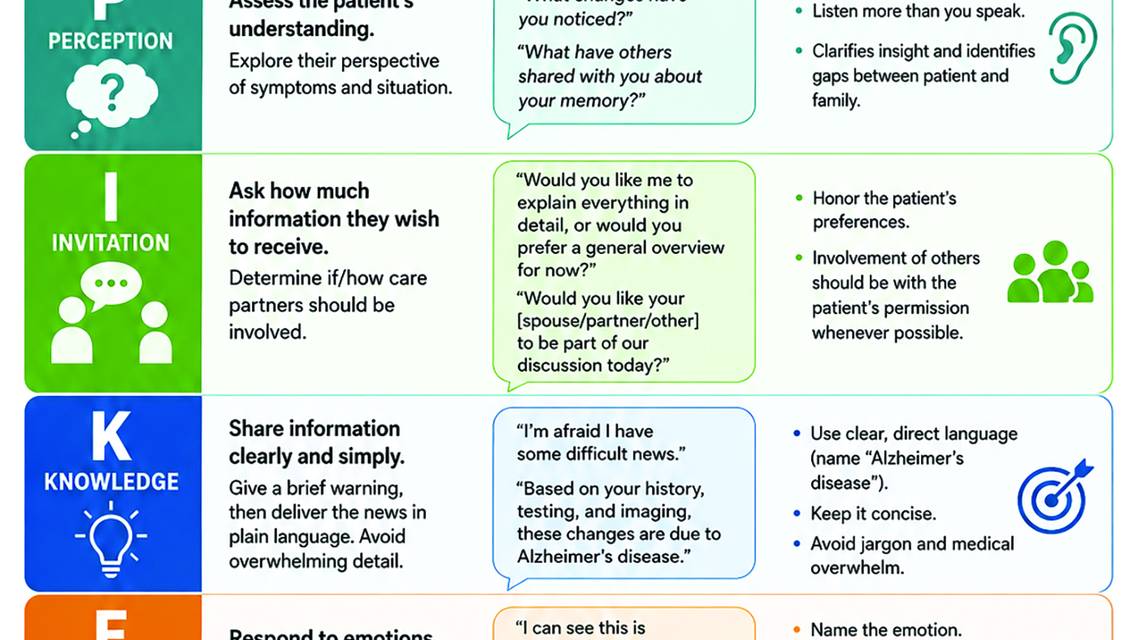
The SPIKES protocol (setting, perception, invitation, knowledge, emotions, strategy/summary) offers a practical framework to guide this process and ensure that key elements are addressed systematically (Figure 1).5,6
- Setting: an environment with privacy, minimal interruptions, and appropriate seating that supports focus and respect.
- Perception: an assessment of the patient’s current understanding. A question such as “What changes have you noticed?” can clarify both the patient’s insight and discrepancies with family observations.
- Invitation: clarification of how much information the patient wishes to receive and whether care partners should be included, allowing the discussion to align with preferences.
- Knowledge: a brief warning statement, such as “I’m afraid I have some difficult news,” to prepare the patient, followed by a clear and concise explanation. The clinician should avoid overloading the patient with excessive detail at this stage.
- Emotions: space for the patient’s response rather than immediately moving forward.
- Strategy/Summary: conclusion of the conversation with clear next steps, reinforcing continuity and reducing uncertainty.
Equally important is understanding what matters most to the patient, such as independence, minimizing burden on family, not being stressed about cognitive symptoms, or maintaining daily routines. The goals of care should be individualized on the basis of the patient’s desires, which should be explored early, as they shape subsequent decision-making.7 Framing diagnosis as a staged and ongoing process, rather than a single disclosure event, reduces distress, improves understanding, and builds the foundation for enduring trust in this life-changing process.8

Figure 1. The SPIKES protocol for delivering difficult news in those living with Alzheimer disease. Image generated using ChatGPT 5.5 (OpenAI, San Francisco, CA) based on editor-developed prompts. The authors reviewed and edited the final figure.
Clarity and Empathy Are Not in Tension
If SPIKES provides the structure for delivering a diagnosis, the CLEAR framework (compassionate language and empathetic approaches for respectful dementia disclosure) guides how the diagnosis should be communicated (Figure 2).9 The CLEAR framework emphasizes person-centered engagement, emotional attunement, cultural sensitivity, appropriate involvement of care partners, and the cultivation of realistic hope.
When diagnostic criteria are met, explicit terminology matters. Phrases such as “memory problems” or “cognitive changes” may feel gentler but often create confusion. Clearly naming “Alzheimer disease” provides a framework from which patients and families can begin to understand the condition and plan next steps. A direct statement such as “Based on your history, testing, and imaging, these changes are due to Alzheimer disease” is more helpful than vague euphemisms.10 Clarity and empathy are not opposing goals, but they are mutually reinforcing. Patients and families benefit most when honesty and kindness are integrated.
Emotional responses vary widely and may include shock, denial, sadness, anger, and relief.11 Recognizing and addressing these reactions in real time is essential. Structured empathy—naming the emotion (“I can see this is overwhelming”), validating it (“That reaction is very understandable”), and allowing silence—helps individuals feel acknowledged.12
Silence itself is a crucial tool. The impulse to fill silence is strong, especially under time pressure. Yet individuals frequently retain little complex information immediately after receiving distressing news. What they remember is whether the clinician acknowledged their reaction and made room for it.
A common pitfall is premature reassurance. Statements intended to comfort, such as “It’s early, so don’t worry,” may inadvertently minimize the patient’s experience.13 More effective communication is acknowledging the difficulty while maintaining direction: “This is a lot to take in, and we will work through it together, step by step.” Ultimately, although patients may not recall every detail of the explanation, they will remember whether the interaction felt clear, respectful, and humane. That perception forms the foundation for trust and ongoing engagement in care.

Figure 2. The CLEAR framework. Image generated using ChatGPT 5.5 (OpenAI, San Francisco, CA) based on editor-developed prompts. The authors reviewed and edited the final figure.
Communicating Uncertainty: From Diagnosis to Treatment
Modern AD care encompasses a spectrum of stages and categories (eg, subjective decline, mild cognitive impairment, biomarker-positive states, early AD, and dementia syndromes) that are not intuitive to patients. Effective communication requires replacing false precision with structured transparency, without overwhelming patients.Whenever possible, discussions regarding goals of care, future planning, and treatment preferences should occur early, while decision-making capacity remains largely intact.
Uncertainty should be acknowledged openly. Statements such as “Here is what we know now” and “Here is what we will continue to monitor” are preferable to either overconfidence or vagueness. Prognosis is best framed functionally rather than by rigid timelines. When patients ask “How long do I have?,” no schedule can be promised, but clinicians can discuss the domains likely to change over time, such as medication management, finances, driving, household tasks, community engagement, and personal care.14
Treatment discussions benefit from categorical structure, separating options into pharmacologic approaches, nonpharmacologic approaches, and DMTs, to help patients process information more effectively. When discussing amyloid-targeting DMTs, clinicians should also review eligibility requirements, as well as confirm amyloid pathology, MRI monitoring protocols, and treatment-associated risks, such as amyloid-related imaging abnormalities (ARIA). Especially for DMTs, expectation-setting is essential not only for decision-making but also for maintaining confidence in the medical system. When patients understand the realistic goal as preserving function longer rather than restoring the previous baseline, they are better positioned for informed, shared decision-making.15 Discussing logistical demands and potential risks early prevents later misalignment.
There remains substantial practical uncertainty surrounding newer drugs, and what has and has not been studied should be stated plainly. Whereas the benefits of amyloid-targeting therapies are commonly reported as changes in the slope of cognitive decline, patients and families may find the same data more meaningful when reframed as the probability of avoiding further decline. In the phase 3 Clarity AD trial (NCT03887455), treatment with Leqembi (lecanemab; Eisai, Nutley, NJ) in individuals diagnosed with early AD was associated with a statistically significant slowing of cognitive and functional decline over 18 months compared with placebo.16 However, available trial data do not establish that most treated patients remain clinically stable or avoid further decline altogether. Further studies monitoring cognition longitudinally remain essential to characterize each individual’s trajectory and assess long-term response.
Beyond the trial data, a growing set of real-world questions has yet to be answered. Who fails to respond, and why? Who responds more rapidly than expected? Who carries a disproportionate risk of adverse effects? The pivotal trials predominantly enrolled participants with typical amnestic AD. How these therapies perform in atypical AD presentations, across a broader age range, or in the presence of copathologies remains largely unknown. These are not peripheral concerns; they bear directly on individualized treatment decisions in everyday clinical practice.
Overconfidence in prognosis or treatment effect erodes trust when reality diverges. Excessive vagueness, conversely, breeds anxiety. The goal is calibrated transparency: a clear and honest delineation of what is established, what remains uncertain, and what can realistically be offered.
Triadic Communication: The Patient, the Clinician, and the Care Partner
AD communication rarely involves the patient alone. Most visits include spouses, adult children, or other caregivers, whose perspectives may differ sharply from the patient’s own. The clinician’s role is not simply to gather information but to actively align these perspectives into a shared understanding.
The patient should remain the primary interlocutor whenever possible, particularly early in the disease.17 Addressing the patient directly preserves autonomy and dignity, even when insight is limited. Discrepancies between patients and their caregivers are common: patients frequently minimize symptoms while caregivers emphasize functional concerns. Rather than adjudicating who is “correct,” acknowledging all of their concerns reduces defensiveness and builds collaboration: “I’m hearing that this feels manageable to you and more concerning to your husband. Let’s work through both.”18
Certain domains require early, proactive attention regardless of alignment, such as driving safety, medication management, and financial decision-making.14 These are far better addressed proactively before an adverse event occurs than reactively afterward. Caregiver burden should also be recognized early. Clinicians should periodically assess caregiver strain and connect families with appropriate support resources, as caregiver well-being directly influences long-term care outcomes. Even in the earliest stages, family members begin to anticipate increasing responsibility and may already be experiencing grief, exhaustion, and role transition.19 Phrases such as “This can be a lot to carry over time” validate their experience and open the door to support. Structured communication training programs for caregivers, including instruction in simplified language, de-escalation techniques, and reframing behaviors as expressions of unmet needs rather than defiance, consistently improve caregiver competence and may reduce neuropsychiatric symptoms in patients.20
Effective triadic communication is less about balancing competing voices and more about synchronizing them into a shared framework of understanding and planning.
Day-to-Day Communication: Practical Adjustments With High Impact
The goal of everyday communication in AD care is not to preserve normal conversation but to enable successful interaction.
Verbal communication should be simplified.3 Short sentences, one idea at a time, and allowance for adequate response time are essential. Rushing increases confusion and frustration. Open-ended questions (“What do you want to do today?”) place disproportionate cognitive demand on the patient; structured choices (“Would you like tea or coffee?”) reduce that burden.20 Tone is as important as content. Slower speech, warmth, clear emphasis, and a calm affect support comprehension. Correcting errors or testing recall often does more harm than good. If a patient cannot recall a detail, moving forward gently is often better than insisting on correctness.
As patients’ language declines, nonverbal communication becomes increasingly important.21 Eye contact, facial expression, gestures, gentle touch when appropriate, close but respectful proximity, and facing the patient directly can convey comprehension and reassurance more reliably than words. Patients are highly sensitive to emotional tone: a hurried posture or tense expression may escalate distress even when spoken language is neutral.
The physical environment also shapes communication. Reducing background noise, improving lighting, and limiting multiple simultaneous conversations can markedly improve interaction. Visual support with written reminders, labeled drawers, calendars, and picture boards may help patients express needs and navigate routines.
Behavioral symptoms, such as agitation, resistance, or repetitive questioning, often reflect unmet needs, discomfort, fear, overstimulation, or inability to express distress.22 The DICE framework (describe, investigate, create, and evaluate) offers a structured method for assessing triggers and developing individualized, communication-based responses before defaulting to medication.23
From Disclosure to Longitudinal Care
A diagnosis of AD initiates an ongoing process of communication that evolves over time. The primary task encompasses what to say as well as how to thoughtfully sequence information across visits.
The initial visit should conclude with a clear summary and explicit next steps.1 Written after-visit materials help compensate for the limited retention that follows receipt of emotionally distressing news. Defining a follow-up appointment communicates continuity and reduces uncertainty. In subsequent visits, information should be staged: addressing prognosis, treatment, safety, and long-term planning in a single session can be overwhelming. Immediate concerns take priority; other topics are revisited as understanding develops. Future planning, including advance directives, financial supervision, and residential considerations, should be prepared proactively but introduced gradually.24 Framing discussions as part of maintaining patient control, rather than anticipating decline, improves receptivity.
As the disease progresses, communication strategies must adapt. Patient insight may decline, caregiver involvement may increase, and priorities may shift toward safety and quality of life. Revisiting and recalibrating previous discussions is a continuous process. Confidence in care is built not through a single well-executed conversation but through consistent, structured, and responsive communication across the disease trajectory.
Conclusion
AD has entered an era defined by biomarkers and emerging DMTs. With this progress comes a greater demand for effective communication. Individuals and families are now asked to understand, decide, and anticipate more than at any previous point in the history of AD.
In this context, communication is not just ancillary to clinical expertise but a core competency. It shapes how a diagnosis is understood, how treatments are chosen, and whether trust is sustained. Building confidence in AD care depends not only on what we know but on how clearly, consistently, and humanely we communicate that knowledge.
Ready to Claim Your Credits?
You have attempts to pass this post-test. Take your time and review carefully before submitting.
Good luck!
Recommended
 Alzheimer Disease & Dementias
Subcutaneous Lecanemab for Early Alzheimer Disease: Evidence, Safety, and Patient Selection
Michael Irizarry, MD, MPHMichael Irizarry, MD, MPH- Alzheimer Disease & Dementias
Next-Generation CNS Drug Delivery: Brainshuttle Technology and Clinical Implications in Alzheimer Disease
Luka Kulic, MDLuka Kulic, MD - Alzheimer Disease & Dementias
Establishing a Sustainable Amyloid-Targeting Treatment Program: Lessons from One Institution
Rachel Hart, DORachel Hart, DO